

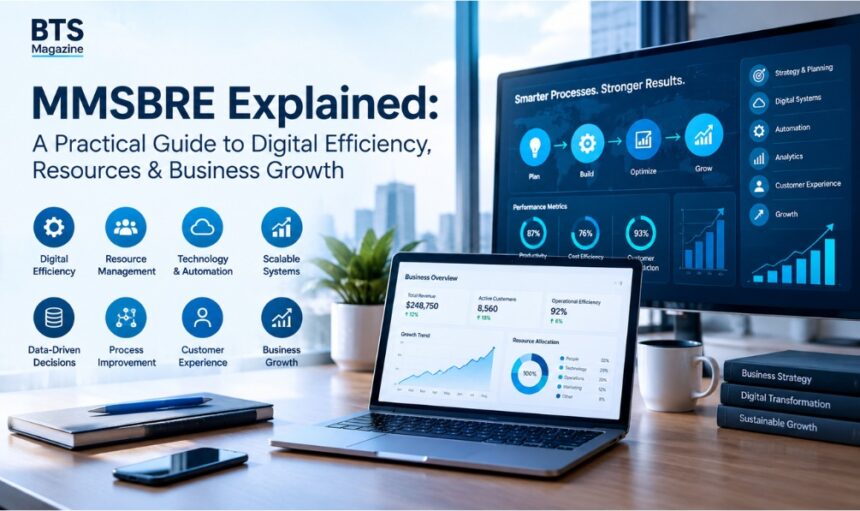
MMSBRE is an emerging term associated with digital business efficiency, smarter resource management, technology, and sustainable growth. It does not currently have one universally accepted definition, so its meaning may differ depending on where and how the term is used.
- What Does MMSBRE Mean?
- Why Is MMSBRE Becoming Relevant?
- The Core Principle: Improve Efficiency Without Losing Quality
- MMSBRE and Business Strategy
- Improving Workflows and Processes
- Smarter Resource Management
- Building Scalable Digital Infrastructure
- Customer Experience Should Remain Central
- Using Data to Make Better Business Decisions
- Potential Benefits of an MMSBRE Approach
- Greater Operational Clarity
- Better Use of Time
- More Controlled Spending
- Easier Business Growth
- Improved Customer Service
- Challenges and Limitations of MMSBRE
- How Businesses Can Apply the Main Ideas
- What Is the Future of MMSBRE?
- Final Thoughts
At its core, MMSBRE can be understood as a broad approach to improving how a business operates. It brings together areas such as strategy, people, technology, data, resources, workflows, branding, and customer experience.
The basic principle is straightforward: businesses should make better use of what they already have while building systems that can support future growth. This means reducing unnecessary work, improving processes, using data carefully, and creating better experiences for customers.
What Does MMSBRE Mean?
MMSBRE is best described as an emerging digital and business concept rather than an established international standard or formal methodology.
Different online explanations may associate the term with areas such as:
- Business strategy
- Resource management
- Digital infrastructure
- Process improvement
- Customer experience
- Data-driven decision-making
- Marketing and branding
- Business efficiency
Because there is no single standardized definition, readers should focus on the principles connected with the term rather than assuming that MMSBRE represents one fixed system.
The central idea is to organize business resources more intelligently. This can involve improving internal workflows, selecting suitable technology, reducing unnecessary expenses, and making sure business decisions support measurable goals.
Why Is MMSBRE Becoming Relevant?
Businesses today often operate across multiple digital platforms. They may use separate systems for communication, accounting, customer management, marketing, project management, payments, and analytics.
While technology can make work easier, too many disconnected systems can create new problems. Employees may enter the same information more than once, teams may struggle to access important data, and managers may spend too much time dealing with inefficient processes.
This is where the ideas associated with MMSBRE become useful.
A company can examine how work is performed from beginning to end and identify unnecessary steps, delays, duplicated tasks, and inefficient use of resources. It can then redesign those processes around clearer goals.
The Core Principle: Improve Efficiency Without Losing Quality
Efficiency does not simply mean doing everything as cheaply or quickly as possible. A business can reduce costs and still create a poor customer experience or lower the quality of its work.
A better approach is to achieve useful results while minimizing unnecessary time, effort, money, and complexity.
For example, a company might discover that a simple customer request passes through four employees before being completed. Reviewing that workflow could reveal that two approval stages are unnecessary.
Removing those steps may shorten response times without reducing service quality.
This type of process analysis is closely related to business process management, a discipline focused on understanding, improving, measuring, and optimizing business activities. You can learn more about the broader concept through Wikipedia’s Business Process Management overview.
MMSBRE and Business Strategy
Business improvements work better when they are connected to a clear strategy.
A company should understand what it is trying to achieve before changing its tools or workflows. Its priorities might include increasing sales, improving customer service, reducing operating costs, improving product quality, or preparing for expansion.
Once those objectives are clear, individual processes can be reviewed against them.
For instance, if customer support is a major priority, the company may need to focus on response times, support tools, employee training, and customer feedback. If reducing operating costs is the priority, management may instead examine software subscriptions, repetitive manual tasks, and resource allocation.
This creates a direct connection between strategy and daily operations.
Improving Workflows and Processes
A workflow describes how a task moves from one stage to another. Poorly designed workflows can create bottlenecks, repeated work, unnecessary approvals, and communication problems.
An MMSBRE-oriented approach can begin with mapping the existing process.
Businesses can ask:
- Where does the process begin?
- Who is responsible for each stage?
- Which steps create real value?
- Where do delays occur?
- Which tasks are repeated?
- Can technology safely simplify any part of the process?
- How should success be measured?
Once these questions are answered, the organization can redesign the workflow.
Automation may help with repetitive activities, but automation should not be added simply because a task can be automated. The technology should solve a genuine business problem.
Smarter Resource Management
Resources are limited in every organization. They include employee time, budgets, equipment, software, information, office space, and other business assets.
Effective resource management means directing those resources toward activities that produce meaningful results.
For example, a company may discover that employees spend several hours every week manually preparing reports. If the reporting process can be simplified or partially automated, that time could potentially be redirected toward customer service, sales, product development, or other important work.
The same principle applies to financial resources. A low-cost software solution is not always the most economical option if it creates extra manual work or requires several additional tools.
The real question is not simply, “What costs less?” It is “What provides useful value for the resources invested?”
Building Scalable Digital Infrastructure
Digital infrastructure is another important part of the concept.
Modern organizations depend on technology for communication, data storage, customer records, payments, analytics, project management, and many other activities.
A system that works well for a small company may become difficult to manage when the business grows. More employees, customers, transactions, and data can place additional demands on digital systems.
Scalable infrastructure should therefore be considered when selecting technology.
Depending on business requirements, this may involve:
- Cloud-based applications
- Centralized data systems
- Secure user access
- Integrated software
- Automated workflows
- Reliable backup systems
- Analytics platforms
- Customer management tools
There is no universal technology stack for every business. The right setup depends on the organization’s size, industry, budget, security requirements, and future plans.
Customer Experience Should Remain Central
Internal efficiency is only valuable when it contributes to better business outcomes. One important outcome is customer satisfaction.
Customers generally expect businesses to provide clear information, convenient processes, responsive support, and reliable service.
A company may improve its internal workflow but accidentally make the customer journey more complicated. That would not necessarily represent meaningful improvement.
For this reason, customer needs should be considered when changing business processes.
Customer feedback, support requests, website behavior, surveys, and other forms of user information can help identify areas that need attention.
The goal is to make processes easier for both employees and customers whenever possible.
Using Data to Make Better Business Decisions
Data can help organizations understand what is actually happening.
Useful business data may include:
- Sales performance
- Customer behavior
- Operating costs
- Employee workload
- Support response times
- Website activity
- Product performance
- Process delays
However, collecting large amounts of information does not automatically produce better decisions.
Businesses need meaningful metrics connected to specific objectives. A simple report showing a few important indicators can sometimes be more useful than a complicated dashboard containing hundreds of numbers.
An effective data-driven approach should lead to action. If a report reveals that customers are abandoning a particular step in a process, the business should investigate the reason and test possible improvements.
Potential Benefits of an MMSBRE Approach
Although MMSBRE does not represent one universally defined methodology, the ideas associated with it can support several practical business objectives.
Greater Operational Clarity
Clearly defined responsibilities, processes, and goals can make it easier for teams to understand what needs to happen and who owns each task.
Better Use of Time
Removing unnecessary steps and repetitive work can help employees spend more time on activities that require human judgment or create greater value.
More Controlled Spending
Reviewing software, staffing, processes, and resource usage can help businesses identify areas where money may be used inefficiently.
Easier Business Growth
Scalable systems and organized processes can make it easier to handle additional customers, employees, transactions, and data as the organization expands.
Improved Customer Service
When internal processes are designed around customer needs, businesses may be able to provide faster and more consistent service.
Challenges and Limitations of MMSBRE
The biggest challenge is the lack of a single established definition.
Because MMSBRE is an emerging term, different websites or organizations may use it differently. Businesses should therefore avoid treating it as a formal standard with universally accepted rules.
Another concern is unnecessary complexity.
Adding more software, dashboards, automation, or processes does not automatically make a business more efficient. In some situations, excessive technology can make operations harder to understand.
There is also a risk of focusing too heavily on efficiency while overlooking people and customers. A process may be fast but still produce poor results if employees lack the necessary support or customers find the experience frustrating.
The best approach is to start with a clearly identified problem and then select an appropriate solution.
How Businesses Can Apply the Main Ideas
A company does not need to adopt MMSBRE as a complete system to use its underlying principles.
A practical starting point could look like this:
Step 1: Define the goal
Identify the business outcome that needs improvement.
Step 2: Review the existing process
Map how work currently moves through the organization.
Step 3: Identify waste
Look for repeated tasks, delays, unnecessary approvals, and unused resources.
Step 4: Review technology
Determine whether existing tools are helping or creating additional complexity.
Step 5: Measure performance
Choose a few meaningful metrics that show whether the changes are working.
Step 6: Consider the customer
Check whether the proposed improvement makes the user experience clearer or more convenient.
Step 7: Improve gradually
Test changes before introducing them across the entire organization.
This practical approach can help businesses improve operations without making unnecessary changes.
What Is the Future of MMSBRE?
The future meaning of MMSBRE is difficult to define because the term itself is still developing.
However, many of the ideas associated with it are already important in modern business. Automation, cloud computing, analytics, digital workflows, customer research, and integrated systems continue to influence how organizations operate.
As these technologies develop, MMSBRE could eventually become a more clearly defined business term. Alternatively, it may remain a flexible label used to describe several connected approaches to digital efficiency and growth.
Regardless of what happens to the name, the underlying principles remain practical: simplify work, use resources carefully, understand customers, measure meaningful results, and build systems that can adapt as the organization grows.
Final Thoughts
MMSBRE can be viewed as a broad emerging concept focused on improving business efficiency through better strategy, resource management, digital systems, data, workflows, and customer-focused thinking.
Its lack of a universal definition means it should not be treated as an official business standard. Instead, organizations can examine the individual principles associated with the term and apply the ones that solve real problems.
The most useful lesson is simple: improve the process before adding unnecessary complexity. Use technology when it creates genuine value, connect data to practical decisions, and make sure operational improvements also support customers.
For a growing business, these principles can provide a useful foundation for building clearer processes, smarter systems, and more sustainable digital operations.
Read also: Stripe Sessions 2026: Everything You Need to Know About the Biggest Payments Event of the Year