

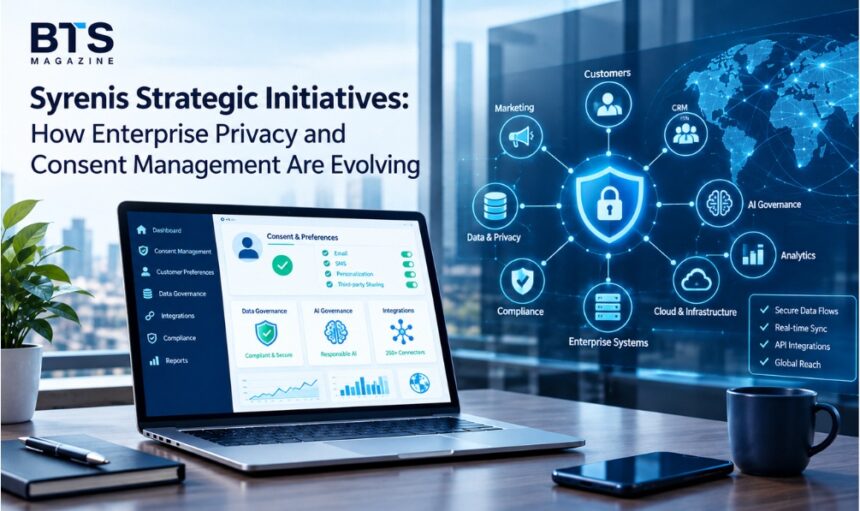
Enterprise privacy has become closely connected to marketing, customer experience, artificial intelligence, data governance, and long-term business trust. For large organizations, collecting consent is only one part of the challenge. They also need to know what customers agreed to, where that information is stored, and whether every connected system respects those choices.
- What Are Syrenis Strategic Initiatives?
- Why Enterprise Privacy Requires Connected Systems
- International Expansion Is a Major Part of the Strategy
- Building an Enterprise-Focused Commercial Operation
- Partnerships Extend the Reach of the Platform
- AI Governance Creates an Expanding Privacy Requirement
- 350+ Integrations Connect Privacy Data With Business Tools
- Preference Management Improves the Customer Experience
- A Central Consent Record Can Strengthen Accountability
- Where the Strategy Can Create Business Value
- Better Data Consistency
- Stronger Customer Control
- More Efficient Integration
- Improved Auditability
- Support for Responsible Data Use
- Challenges Syrenis Still Needs to Address
- The Future Direction of Syrenis Strategic Initiatives
- Conclusion
This is where Syrenis strategic initiatives come into focus. Syrenis is positioning its enterprise privacy platform around consent management, preference management, integrations, risk management, and connected data operations. Its current strategy also emphasizes international expansion, enterprise customers, technology partnerships, and the growing privacy requirements created by AI.
Rather than treating privacy as a standalone compliance activity, the company is building a model in which consent and preference information can become part of everyday business operations.
What Are Syrenis Strategic Initiatives?
Syrenis strategic initiatives refer to the company’s broader approach to expanding its enterprise privacy technology, strengthening its international presence, developing partnerships, and connecting privacy information with business systems.
At the platform level, Syrenis focuses on consent and preference management for complex organizations. Its technology is designed to connect privacy information across websites, applications, CRM platforms, marketing systems, analytics environments, and other enterprise tools.
The company describes this approach as creating a more consistent foundation for privacy data. Its platform currently promotes 350+ integrations, along with APIs, configurable connectors, data exports, and system mapping capabilities.
The underlying idea is straightforward: a customer’s privacy decision should not remain isolated inside one database. The same information should be available to the systems that need to act on it.
Why Enterprise Privacy Requires Connected Systems
Modern organizations can interact with customers through many different channels. A single person may use a company’s website, mobile application, customer service center, physical store, email service, and other digital products.
Every interaction can create or update information about that customer.
The problem appears when these systems do not share the same privacy information. One platform might contain an opt-in while another still holds an older preference. This type of fragmentation can create operational problems and make privacy management harder to audit.
Information privacy covers issues surrounding how personal data is collected, stored, used, and shared. Organizations therefore need both appropriate processes and technical controls to manage those activities.
Syrenis addresses this challenge by connecting consent and preference information with the wider enterprise technology environment. Its platform supports synchronization and real-time updates so that connected systems can work from more current information.
International Expansion Is a Major Part of the Strategy
Syrenis has been expanding its presence beyond its UK base. The company’s current public information lists operations in the United States, including offices in Austin and Atlanta, alongside its European location at Sci-Tech Daresbury in the UK.
The company says it launched its US operations to support enterprise customers across North America. Its 2026 brand relaunch also positioned the unified Syrenis brand around international growth in the US, UK, and Europe.
This expansion is important because enterprise privacy requirements vary between jurisdictions. Organizations operating internationally may need to manage different regulatory environments while maintaining consistent internal processes.
A stronger local presence can therefore help a privacy technology provider work more closely with enterprise customers and understand their operational requirements.
Building an Enterprise-Focused Commercial Operation
Another part of Syrenis’s strategy is strengthening its enterprise sales organization.
Large privacy technology purchases often involve multiple departments. Legal and privacy teams may examine regulatory requirements, IT teams may review integrations, data teams may consider governance, while marketing and customer experience teams may focus on usability and customer engagement.
Syrenis has expanded its leadership team as it develops its enterprise and international operations. Its company information describes a commercial organization focused on enterprise growth, including expansion in the United States.
For an enterprise platform, this commercial approach matters because successful adoption involves more than simply installing software. The technology must fit an organization’s existing architecture and business processes.
Partnerships Extend the Reach of the Platform
Technology alone does not address every privacy challenge. Enterprises may also need consulting, policy development, implementation support, data mapping, and organizational change.
For this reason, partnerships form another important part of Syrenis strategic initiatives.
Syrenis and KPMG
Syrenis has created a dedicated resource hub for KPMG following a workshop and product demonstration. The material highlights enterprise consent and preference management and discusses how implementation partners can add value around privacy technology.
The partnership model also highlights the business side of consent management. Syrenis’s resources discuss areas such as improving opt-in rates, increasing first-party data quality, reducing unsubscribes, and measuring the return generated by privacy programs.
This suggests that consent is increasingly being treated as part of customer data strategy rather than simply as a regulatory checkbox.
Broader Privacy Ecosystem Partnerships
Syrenis also continues to build its position within the wider privacy technology ecosystem. Partnerships can combine software capabilities with consulting and implementation expertise, allowing organizations to address both the technical and organizational sides of privacy management.
For large companies, this combination can be useful because privacy programs often require coordination between technology teams, legal departments, marketing groups, and external specialists.
AI Governance Creates an Expanding Privacy Requirement
Artificial intelligence has introduced another major consideration for enterprise privacy teams.
AI systems may rely on large datasets, which means organizations need to understand the origin, permissions, purpose, and handling of information used by those systems.
Syrenis has published guidance specifically addressing privacy priorities for organizations adopting AI. Its recommendations include treating privacy as a core AI principle, examining data flows, training employees, using privacy-preserving techniques, and allocating resources to AI privacy.
Consent management can contribute to this environment by providing records that show how data-use preferences were captured and updated.
However, consent should not be viewed as the complete solution for AI governance. Organizations still need broader controls covering security, access, data quality, model governance, risk management, and human oversight.
The value of a centralized consent record is that it can provide one important layer of evidence when organizations need to understand whether particular data-use activities align with recorded permissions.
350+ Integrations Connect Privacy Data With Business Tools
One of the clearest technology priorities in Syrenis’s current platform is integration.
The company promotes more than 350 integrations that can connect privacy information with CRM, marketing, analytics, and other enterprise systems.
This matters because consent data has limited practical value when it remains trapped inside a single platform.
Syrenis supports several methods of connecting systems, including:
- Pre-built integrations
- Configurable data mapping
- APIs
- Connector services
- Data exports
- Real-time synchronization
Its API offering is designed to capture, update, and apply privacy information across digital products, internal systems, and connected workflows.
This approach can also reduce the pressure to replace an organization’s entire technology stack. Instead, privacy capabilities can be connected to systems that the company already uses.
Preference Management Improves the Customer Experience
Privacy management is not only a technical issue. The way customers interact with consent and preference controls also matters.
A complicated privacy interface can make it difficult for people to understand what they are accepting or rejecting. A clearer experience can make choices easier to manage.
Syrenis provides preference management capabilities, including preference centers and progressive profiling. Progressive profiling allows organizations to collect additional information gradually rather than requesting every detail at the beginning of a relationship.
This can support a more useful customer profile over time while reducing unnecessary friction.
The company also promotes real-time synchronization so that updated customer choices can be reflected across connected systems.
For businesses, better preference management can potentially improve data quality and help reduce communications that do not match customer expectations.
A Central Consent Record Can Strengthen Accountability
One of the central ideas behind Syrenis’s platform is maintaining a consistent view of consent and preferences.
Instead of allowing different departments to maintain separate versions of customer choices, a connected privacy environment can give teams access to a more consistent record.
Such a record can contain information about what was selected, when a choice was made, and how that preference should be applied.
This can be particularly useful during internal reviews or regulatory inquiries because organizations need to demonstrate how privacy decisions are managed.
Syrenis describes its platform as providing centralized and auditable consent management across systems, jurisdictions, and customer touchpoints.
The benefit can extend across departments. Legal teams can gain better visibility, marketing teams can work with current preferences, IT teams can manage integrations, and data teams can use clearer privacy signals.
Where the Strategy Can Create Business Value
The broader Syrenis approach connects privacy with several areas of enterprise performance.
Potential areas of value include:
Better Data Consistency
When connected systems receive updated privacy information, organizations can reduce conflicts between different databases and applications.
Stronger Customer Control
Preference centers and clearer privacy experiences can make it easier for customers to manage their choices.
More Efficient Integration
Pre-built connectors, APIs, and configurable mapping can help organizations connect privacy data with existing technology environments.
Improved Auditability
Centralized records can make it easier to review how consent and preferences were captured and applied.
Support for Responsible Data Use
Organizations can use privacy information as one part of a wider governance framework for marketing, analytics, customer experience, and AI-related activities.
Challenges Syrenis Still Needs to Address
Enterprise privacy technology operates in a complicated environment, so there are practical challenges alongside the potential benefits.
Large companies often have legacy systems, custom applications, multiple cloud services, and different data models. Connecting these environments can require significant planning.
Privacy requirements can also vary between jurisdictions. A global company may need different policies and processes while still maintaining a unified operating model.
Partnerships introduce another consideration. Software providers and consulting organizations need clearly defined responsibilities to prevent implementation delays or gaps.
AI creates additional complexity. Consent information can help establish whether certain data-use activities are permitted, but it does not replace a complete AI governance program.
These factors mean that successful privacy transformation depends not only on technology but also on implementation, governance, organizational processes, and ongoing monitoring.
The Future Direction of Syrenis Strategic Initiatives
Syrenis’s recent developments show a broader movement from traditional consent management toward connected enterprise privacy infrastructure.
Its current platform combines consent management, preference management, risk and policy capabilities, and data integrations. The company is also emphasizing APIs, real-time synchronization, international expansion, and enterprise-scale architecture.
The 2026 brand relaunch further reflects this positioning. Syrenis says it has moved toward a unified enterprise platform designed for organizations dealing with complex jurisdictions, multiple brands, and large-scale data governance requirements.
The next stage will depend on how effectively these capabilities work together in real enterprise environments.
For large organizations, the broader concept is important: privacy does not have to remain a disconnected legal process. When consent and preference information can move reliably across business systems, privacy decisions can become part of everyday data operations.
Conclusion
Syrenis strategic initiatives reflect the changing role of enterprise privacy technology. The focus is no longer limited to cookie banners or basic consent collection. Instead, the company is developing a connected approach that brings consent, preferences, integrations, customer experience, risk management, and data governance together.
Its expansion in North America, enterprise-focused commercial strategy, partner ecosystem, AI privacy focus, and 350+ integrations all support this broader direction.
For enterprises, the key idea is consistency. Customer choices need to remain accurate as information moves between websites, applications, CRM platforms, marketing systems, analytics tools, and other business environments.
A centralized and connected privacy framework can help organizations improve visibility, strengthen accountability, and use customer data with greater control. That makes enterprise consent and preference management an increasingly important part of modern data strategy.
Read also: iFixit Tri-Point Y1 Screwdriver: Uses, Features & Tips