

Ever looked at a company’s financial report and felt completely lost? You’re not alone. A balance sheet can seem like a wall of confusing numbers. But once you know the basics, it becomes one of the most useful tools you own.
- What Is a Balance Sheet and How Do You Read It?
- Why Is Reading a Balance Sheet Important?
- Key Features and Benefits of Understanding a Balance Sheet
- Step-by-Step Guide: How to Read a Balance Sheet
- Step 1: Find the Date
- Step 2: Review the Assets
- Step 3: Review the Liabilities
- Step 4: Check the Equity
- Step 5: Confirm It Balances
- Step 6: Calculate Two Simple Ratios
- Common Mistakes to Avoid
- Expert Tips / Pro Tips
- FAQs
- What are the three main parts of a balance sheet?
- What is the accounting equation?
- How is a balance sheet different from an income statement?
- What is a good current ratio?
- Can beginners learn to read a balance sheet?
- How often should I review my balance sheet?
- Conclusion
This guide breaks down how to read a balance sheet in plain English. Here’s what you’ll learn:
- What a balance sheet actually shows
- The three core parts: assets, liabilities, and equity
- A simple bakery example you can follow
- Beginner mistakes and expert tips
Let’s make sense of those numbers together.
What Is a Balance Sheet and How Do You Read It?
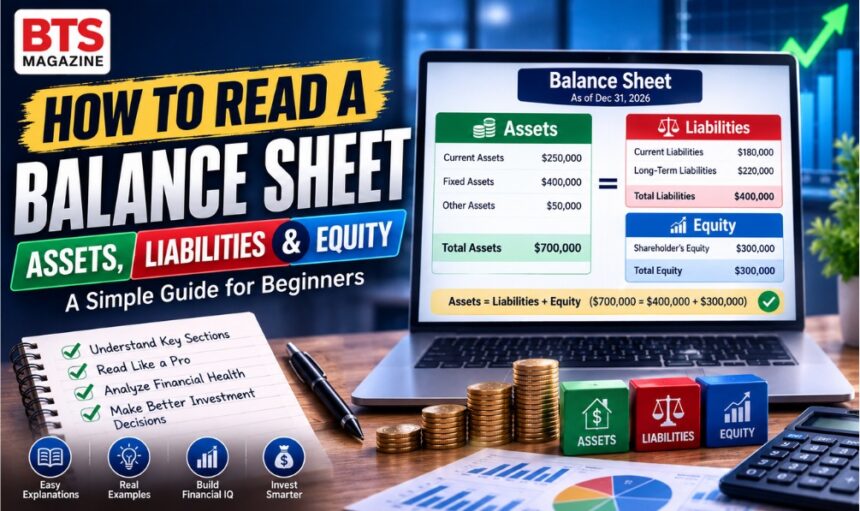
A balance sheet is a financial statement that shows what a company owns, what it owes, and what’s left over for the owners at a specific moment in time. You read it by comparing assets against liabilities and equity, which always balance out to equal totals.
Think of it as a financial snapshot. It captures one exact day, not a full year. This makes it different from an income statement, which tracks money over time.
The whole thing rests on one simple formula, called the basic accounting equation:
Assets = Liabilities + Equity
You can learn more about its history and structure on this Wikipedia page about the balance sheet.
The Three Core Parts
- Assets: Everything the business owns that has value (cash, equipment, inventory).
- Liabilities: Everything the business owes to others (loans, unpaid bills).
- Equity: What’s left for the owners after debts are paid.
Why Is Reading a Balance Sheet Important?
Reading a balance sheet matters because it reveals the true financial health of a business. It tells you if a company can pay its bills, how much debt it carries, and whether it’s growing stronger or weaker over time.
For small business owners, this is huge. Understanding financial statements helps you make smart choices before you borrow, hire, or expand.
Here’s why it pays off:
- Investors use it to decide if a company is worth buying.
- Lenders check it before approving loans.
- Owners use it to spot problems early.
That means you don’t guess about small business financial health. You know it.
Key Features and Benefits of Understanding a Balance Sheet
Learning balance sheet basics gives you real advantages. You stop relying on gut feelings and start using facts.
Key benefits include:
- Clear picture of net worth: See exactly what your business is worth today.
- Better decisions: Know when you can afford to grow.
- Stronger loan applications: Show lenders you understand your numbers.
- Early warning signs: Catch too much debt before it hurts you.
The best part? These skills work for reading a company balance sheet of any size, from a corner shop to a giant corporation.
Step-by-Step Guide: How to Read a Balance Sheet
Ready to try it yourself? Follow these steps. We’ll use a small bakery called Sweet Crumbs as our example.
Step 1: Find the Date
Look at the top of the sheet. It shows a single date, like “As of December 31.” Everything reflects that one day.
Step 2: Review the Assets
Assets are usually split into two groups:
- Current assets: Cash and things you’ll use within a year (like flour and sugar).
- Non-current assets: Long-term items (like ovens and the building).
For Sweet Crumbs:
- Cash: $10,000
- Inventory: $5,000
- Baking equipment: $15,000
- Total assets: $30,000
Step 3: Review the Liabilities
Now check what the bakery owes:
- Current liabilities: Bills due soon (like a $3,000 supplier bill).
- Long-term liabilities: Debts due later (like a $7,000 equipment loan).
- Total liabilities: $10,000
Step 4: Check the Equity
Equity is what’s left for the owner. Use the equation:
Assets ($30,000) − Liabilities ($10,000) = Equity ($20,000)
So Sweet Crumbs is worth $20,000 to its owner. Not bad for a bakery!
Step 5: Confirm It Balances
The two sides must match:
- Assets: $30,000
- Liabilities + Equity: $10,000 + $20,000 = $30,000 ✓
If they don’t match, something’s wrong with the math.
Step 6: Calculate Two Simple Ratios
Ratios turn raw numbers into insights.
- Current ratio = Current assets ÷ Current liabilities. It shows if you can pay short-term bills. A ratio above 1 is healthy. Sweet Crumbs: $15,000 ÷ $3,000 = 5.0 (very strong).
- Debt-to-equity ratio = Total liabilities ÷ Total equity. It shows how much you rely on debt. Lower is safer. Sweet Crumbs: $10,000 ÷ $20,000 = 0.5 (low debt).
Common Mistakes to Avoid
Beginners often trip over the same issues. Watch out for these:
- Confusing profit with cash: A balance sheet shows what you own, not how much you earned.
- Ignoring the date: Numbers change daily. Always note the snapshot day.
- Forgetting to balance: If both sides don’t match, recheck your figures.
- Overlooking liabilities: Small unpaid bills add up fast.
- Skipping ratios: Raw numbers mean little without context.
Avoiding these keeps your reading accurate and useful.
Expert Tips / Pro Tips
Want to read like a pro? Try these practical habits:
- Compare over time. Look at two or three years side by side to spot trends.
- Watch your current ratio. Aim to keep it above 1 so you can cover short-term debts.
- Keep debt-to-equity low. Less debt means less risk if sales slow down.
- Link statements together. Read the balance sheet alongside the income statement for a fuller view.
- Update regularly. For small businesses, review it monthly, not just once a year.
Pro tip: Trends matter more than single numbers. One good day means little. Steady growth means a lot.
FAQs
What are the three main parts of a balance sheet?
The three parts are assets (what you own), liabilities (what you owe), and equity (what’s left for owners). Together they form the accounting equation: Assets = Liabilities + Equity. This balance is the heart of every balance sheet.
What is the accounting equation?
The accounting equation is Assets = Liabilities + Equity. It shows that everything a company owns is funded either by debt or by the owners’ investment. Both sides must always equal each other, which is why it’s called a “balance” sheet.
How is a balance sheet different from an income statement?
A balance sheet shows a snapshot of one specific day. An income statement tracks money earned and spent over a period, like a month or year. Together, they give a complete view of a company’s finances.
What is a good current ratio?
A current ratio above 1.0 is generally healthy. It means a business has enough short-term assets to cover its short-term debts. Many experts prefer a ratio between 1.5 and 3 for extra safety.
Can beginners learn to read a balance sheet?
Yes, absolutely. You only need to understand three parts and one simple equation. Start with a small example, practice the steps, and the numbers quickly start making sense.
How often should I review my balance sheet?
Small business owners should review it monthly. Regular checks help you catch cash-flow issues, track debt, and spot growth early instead of waiting for year-end surprises.
Conclusion
Reading a balance sheet isn’t as scary as it looks. Once you know the three parts and the simple equation, the numbers start telling a clear story about any business.
Remember the key idea: Assets = Liabilities + Equity. Add a quick current ratio and debt-to-equity check, and you’ll understand a company’s financial health in minutes.
Ready to try? Grab a real balance sheet, or use the Sweet Crumbs example above, and walk through the six steps today. The more you practice, the easier it gets.
Read also: Any Time Interrogation Explained: Rules, Rights & Risks