

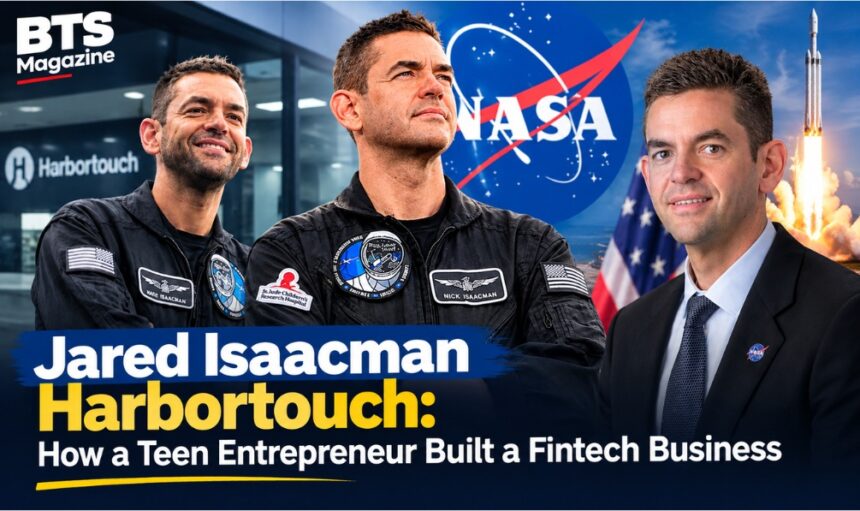
The Jared Isaacman Harbortouch story is closely connected to the development of one of the better-known companies in the payment technology industry. Long before Shift4 Payments became a publicly traded fintech company, Jared Isaacman started a merchant-services business in 1999 at the age of 16. Company filings identify him as the founder of the business that developed into Shift4, while historical accounts connect its earlier United Bank Card identity with the later Harbortouch and Shift4 brands.
- Who Is Jared Isaacman?
- How Jared Isaacman Started His Business
- Where Harbortouch Fits Into the Story
- Why POS Technology Mattered
- From Merchant Services to a Broader Technology Platform
- How Acquisitions Helped Expand the Business
- Harbortouch and Shift4 Payments: What Is the Connection?
- How the Business Expanded After the Shift4 Brand
- The Business Model Behind Shift4
- Technology Was Central to Isaacman’s Business Strategy
- Industries Connected to Shift4
- Challenges of Building a Payments Company
- What the Jared Isaacman Harbortouch Story Shows About Entrepreneurship
- What Happened to Jared Isaacman and Shift4 in 2026?
- Jared Isaacman Harbortouch: The Bigger Picture
- Final Thoughts
- FAQs About Jared Isaacman Harbortouch
Over time, the business expanded beyond payment processing. It moved into point-of-sale technology, brought together additional payment capabilities and used acquisitions to broaden its services. Harbortouch became an important part of that development, but it is more accurate to describe the history as a series of corporate and technology transitions rather than a simple name change.
For anyone researching Jared Isaacman Harbortouch, understanding that timeline is essential. The modern Shift4 business grew from several stages of development, including the earlier merchant-services operation, Harbortouch’s POS activities, Lighthouse Network and the acquisition of Shift4 Corporation.
Who Is Jared Isaacman?
Jared Isaacman is an entrepreneur, pilot and commercial astronaut best known in the business world as the founder of Shift4 Payments. Shift4’s filings state that Isaacman founded Shift4 Payments, LLC in 1999 and remained closely involved with the company for decades. He also founded Draken International and earned a bachelor’s degree from Embry-Riddle Aeronautical University.
His entrepreneurial career began unusually early. At only 16, Isaacman entered the merchant-services industry and began building a company around payment processing and related services.
For additional background, readers can also consult the Jared Isaacman Wikipedia page.
Jared Isaacman Harbortouch Quick Facts
| Detail | Information |
|---|---|
| Full Name | Jared Isaacman |
| Business Career Began | 1999 |
| Age When Business Started | 16 |
| Early Business | United Bank Card |
| Later Brand | Harbortouch |
| Current Company | Shift4 Payments |
| Industry | Payments, software and commerce technology |
| Other Company Founded | Draken International |
| Education | Embry-Riddle Aeronautical University |
| Shift4 IPO | 2020 |
| Current Shift4 CEO | Taylor Lauber |
| Isaacman’s Current Shift4 Role | Founder and former CEO/Executive Chairman |
| 2026 Corporate Development | Shift4 moved to a single Class A share structure |
How Jared Isaacman Started His Business
Starting a company at 16 would be unusual in any industry, but Isaacman’s entry into payments was especially notable because merchant services were already an established business.
The original company, United Bank Card, focused on merchant payment services. Rather than attempting to invent an entirely new payment method, Isaacman concentrated on improving how businesses obtained and used payment services.
Historical accounts describe the company as having very modest beginnings. Isaacman has discussed starting the operation while he was still young, with the business eventually developing into a much larger payment and commerce technology organization.
The company’s early direction was built around practical business problems. Merchant onboarding, payment infrastructure and distribution were areas where improvements could create value for businesses.
That basic approach remained important as the company expanded.
Where Harbortouch Fits Into the Story
Harbortouch represents an important stage in the development of the business because it expanded the company’s activities into point-of-sale technology.
A payment processor primarily handles the transaction side of a purchase. A POS system can play a much broader role. It may help a restaurant take orders, allow a retailer to record sales, connect payments and provide information that supports everyday business operations.
This gave the company a closer relationship with merchants.
Instead of being involved only when a customer paid, its technology could become part of the merchant’s regular workflow. For restaurants and retailers, that can mean using one connected system for several activities rather than relying on separate technologies.
That expansion helped establish the foundation for a broader commerce-technology strategy.
Why POS Technology Mattered
Point-of-sale technology became particularly useful for small and medium-sized businesses.
A large enterprise may have the resources to purchase separate systems for payments, inventory, ordering and business management. A smaller restaurant or retail operation may prefer technology that combines several functions into one platform.
Harbortouch’s POS focus addressed that type of need.
For a restaurant, for example, a POS platform can connect ordering, sales records and payment processing. For a retailer, it can help organize checkout and transaction information.
The importance of this model is that technology becomes part of the merchant’s daily operation rather than remaining a service used only during payment.
From Merchant Services to a Broader Technology Platform
The evolution from payment processing toward POS technology changed the company’s potential role in the merchant ecosystem.
Payment processing remains an important part of commerce, but businesses often need more than a mechanism for accepting cards. They may also need software, hardware, reporting tools, ordering systems and other services.
An integrated technology strategy can bring those functions closer together.
This became increasingly relevant to the business associated with Isaacman. Instead of remaining limited to its original merchant-services activities, the company could expand into connected areas where its existing customers already had technology needs.
The broader strategy eventually became a central part of Shift4’s business model.
How Acquisitions Helped Expand the Business
Organic growth was only one part of the company’s development. Acquisitions also played a significant role.
Buying established businesses can provide access to technology, customers, distribution networks and industry expertise. For a payment and software company, those assets can accelerate expansion into new segments.
The corporate history surrounding Lighthouse Network and Shift4 illustrates this approach. Corporate documents from the period identify Shift4 Corporation as a subsidiary of Lighthouse Network and also list Harbortouch-related entities within the structure.
In 2017, Lighthouse Network acquired Shift4 Corporation, bringing the established Shift4 payment-gateway business into the broader organization. Corporate documents subsequently show Shift4 Payments, LLC as the former Lighthouse Network entity.
This is why the Jared Isaacman Harbortouch connection is better understood as a corporate evolution rather than a simple rebranding exercise.
Harbortouch and Shift4 Payments: What Is the Connection?
One of the easiest mistakes when researching this history is to assume that Harbortouch simply changed its name to Shift4 Payments.
The actual development was more complicated.
The business went through different corporate stages, including Lighthouse Network and the acquisition of Shift4 Corporation. Harbortouch was associated with the POS and merchant-technology side of the organization, while Shift4 Corporation brought payment-gateway capabilities.
The combination created a broader technology platform.
In other words, Harbortouch and Shift4 were connected through the larger corporate structure, but they were not simply two names for the exact same business at the same moment.
This distinction helps explain why searches for Jared Isaacman Harbortouch can produce different company names and historical references.
How the Business Expanded After the Shift4 Brand
After the Shift4 identity became established, the company continued expanding its payment and software capabilities.
Its strategy increasingly focused on combining payments with technology used by merchants and larger commercial organizations. Restaurants and hospitality businesses became important markets, while the company also expanded into areas such as sports, entertainment, theme parks and other commerce environments.
The result was a company that could participate in several stages of the customer transaction rather than focusing only on card processing.
That approach also created opportunities to cross-sell technology and services to existing customers.
The Business Model Behind Shift4
The basic business model can be understood through the relationship between merchants, transactions and software.
When customers make purchases, payment technology helps authorize and process those transactions. A company can generate revenue from payment-related services while also offering software and technology that support merchant operations.
POS systems add another layer.
A merchant may use software to manage orders, track sales and operate its checkout process while using connected payment services to complete transactions. When these functions are integrated, the technology provider can become more deeply embedded in the merchant’s business.
This helps explain why the company moved beyond its original payment-processing focus.
Technology Was Central to Isaacman’s Business Strategy
Technology remained an important part of Isaacman’s approach throughout the company’s development.
The underlying idea was to identify inefficient processes and use technology to make them easier for merchants and business partners.
That philosophy became more visible as the company moved into integrated payments and commerce technology.
Rather than offering a single service, the organization could combine payment processing with software and other merchant tools. This created a platform capable of serving different types of businesses with different operational requirements.
The transformation from a small merchant-services company into a broader technology provider therefore involved more than simply increasing transaction volume. It required the development and integration of multiple technologies.
Industries Connected to Shift4
The company’s customer base has expanded considerably from the smaller-merchant focus associated with its earlier years.
Restaurants remain an important category because they frequently need connected ordering, POS and payment systems.
Hotels can have even more complicated requirements. Payment technology may need to support rooms, restaurants, reservations and other guest services.
Large venues such as stadiums and theme parks can also require payment infrastructure capable of supporting high transaction volumes across multiple locations.
Retail and e-commerce businesses have their own requirements, particularly when they want payment systems to integrate with broader commerce software.
This expansion demonstrates how the original merchant-services concept evolved into a much wider technology business.
Challenges of Building a Payments Company
The payments industry comes with several operational challenges.
Security is critical because payment systems process sensitive financial information. Reliability is equally important because a system failure can immediately interfere with a merchant’s ability to accept transactions.
Compliance is another major consideration. Payment companies operate within a highly regulated environment and must maintain systems and processes designed to meet applicable requirements.
Competition also creates pressure. Payment providers compete through technology, pricing, distribution, customer relationships and additional software services.
Acquisitions can add another layer of complexity because integrating companies requires different technology platforms, teams and business processes to work together.
The evolution associated with Harbortouch and Shift4 therefore involved much more than growing sales. It required the company to develop increasingly sophisticated infrastructure.
What the Jared Isaacman Harbortouch Story Shows About Entrepreneurship
The most interesting part of this story is not simply that Isaacman entered business at 16.
A broader lesson comes from how the company changed over time.
The business started with merchant services. It later moved into POS technology, incorporated additional payment capabilities and expanded through acquisitions.
That pattern shows how a company can grow by solving adjacent customer problems.
A business does not necessarily have to remain tied to its original product. As customer needs develop, a company can use its existing technology and relationships to enter related markets.
The Harbortouch chapter is a good example of that broader evolution.
What Happened to Jared Isaacman and Shift4 in 2026?
Isaacman’s role at Shift4 has changed significantly.
After being confirmed as NASA Administrator in December 2025, he resigned as Executive Chairman of Shift4. The company’s filing states that Taylor Lauber became Chairman following Isaacman’s departure from the board.
Shift4 had already announced that Isaacman intended to move away from his leadership role while retaining a substantial ownership interest.
In February 2026, Shift4 completed a corporate simplification transaction that converted its previous multi-class structure into a single Class A share structure. The transaction also involved Isaacman exchanging certain interests and giving up rights under the company’s tax receivable agreement.
SEC ownership records from 2026 continue to identify Isaacman as a significant Shift4 shareholder.
Therefore, older pages describing Isaacman as Shift4’s current CEO or Executive Chairman should be read in their historical context.
Jared Isaacman Harbortouch: The Bigger Picture
The Jared Isaacman Harbortouch story is ultimately about the gradual transformation of a payment-processing business into a broader commerce-technology company.
Isaacman started the original business in 1999 when he was only 16. The company later became associated with Harbortouch and POS technology before the wider organization developed through additional corporate transactions and the integration of Shift4’s payment capabilities.
The important point is that there was no single moment when Harbortouch simply became Shift4 Payments.
Instead, the modern company emerged through multiple stages involving payment processing, POS technology, acquisitions, software and corporate restructuring.
That history explains why Harbortouch remains relevant when researching Isaacman’s business career.
Final Thoughts
The story behind Jared Isaacman Harbortouch provides a useful look at how a technology business can evolve over several decades.
What began as a merchant-services operation developed into a company with POS capabilities, payment infrastructure and a much broader commerce-technology strategy.
Isaacman’s role has also changed. He is no longer running Shift4 as its CEO or serving as its Executive Chairman. Taylor Lauber now leads the company as CEO and Chairman, while Isaacman remains connected to Shift4 through his founder status and ownership interest.
The company’s history is therefore best understood as a sequence of business expansions, acquisitions and technology developments rather than a straightforward brand change.
For anyone researching Jared Isaacman Harbortouch, that distinction provides the clearest way to understand how a company started by a teenager eventually developed into a major payment and commerce technology business.
FAQs About Jared Isaacman Harbortouch
Who Is Jared Isaacman?
Jared Isaacman is an entrepreneur who founded the business that developed into Shift4 Payments. He started the company in 1999 at age 16 and later expanded into payment, POS and commerce technology.
What Was Harbortouch?
Harbortouch was associated with POS and merchant technology and became part of the broader corporate development that eventually produced the modern Shift4 organization.
Did Harbortouch Simply Become Shift4 Payments?
No. The history involved multiple corporate stages, including Lighthouse Network and the acquisition of Shift4 Corporation. Harbortouch was part of the broader business evolution rather than simply being renamed Shift4 Payments.
When Did Jared Isaacman Start His Company?
Isaacman founded the business that developed into Shift4 in 1999, when he was 16 years old. Shift4’s SEC filings confirm the 1999 founding date.
What Does Shift4 Do?
Shift4 operates in payment processing, software and commerce technology. Its business has expanded beyond traditional payment processing into technology designed for restaurants, hospitality, entertainment, retail and other commercial sectors.
Is Jared Isaacman Still the CEO of Shift4?
No. As of 2026, Isaacman is the founder and former CEO and Executive Chairman. Taylor Lauber serves as CEO and Chairman following Isaacman’s departure from the company’s leadership.
Does Jared Isaacman Still Own Shift4 Shares?
Yes. SEC filings from 2026 continue to show Isaacman as a significant shareholder of Shift4.
What Is the Main Point of the Harbortouch Story?
The key point is that the business evolved gradually. It moved from merchant payment services into POS technology and then toward a broader payment and commerce platform through technology development, acquisitions and corporate restructuring.
Read also: Atadevolper Official Website Homepage Explained: Services, Features, Benefits & Key Facts