

For decades, zoos, aquariums, wildlife parks, and safari attractions have given people opportunities to see animals and learn about species they may never encounter in the wild. These places continue to play an important role in wildlife education, research, and conservation awareness.
- Quick Facts About Artificial Zoos
- What Is an Artificial Zoo?
- How Does an Artificial Zoo Work?
- Technology Behind an Artificial Zoo
- What Could Visitors See Inside an Artificial Zoo?
- Artificial Zoo vs. Traditional Zoo
- Why Are People Interested in Artificial Zoo Experiences?
- Are Artificial Zoos More Ethical?
- Can Artificial Zoos Support Wildlife Conservation?
- Education or Entertainment?
- Are Artificial Zoos Good for Children?
- Planning a Visit to an Artificial Zoo
- Accessibility and Artificial Wildlife Experiences
- Limitations and Challenges of Artificial Zoos
- Could Artificial Zoos Replace Traditional Zoos?
- The Future of Wildlife Tourism
- Final Thoughts
- FAQs About Artificial Zoo
- What Is an Artificial Zoo?
- How Does an Artificial Zoo Work?
- Can an Artificial Zoo Show Extinct Animals?
- Are Artificial Zoos More Ethical Than Traditional Zoos?
- Can Artificial Zoos Help Conservation?
- Are Artificial Zoos Suitable for Children?
- Can Artificial Zoos Replace Traditional Zoos?
- What Technologies Are Used in an Artificial Zoo?
- What Is the Future of Artificial Zoos?
However, technology is changing the way people interact with the natural world.
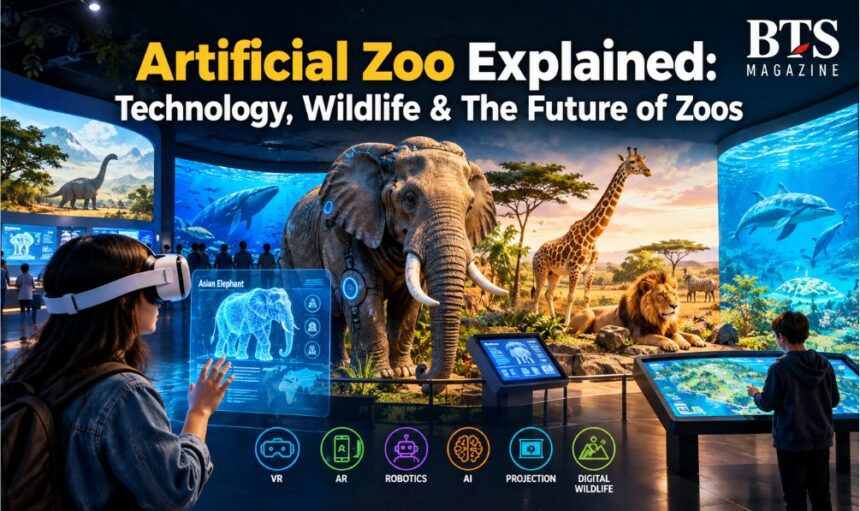
Virtual Reality (VR), Augmented Reality (AR), robotics, Artificial Intelligence (AI), digital simulations, projection mapping, and interactive displays can now create wildlife experiences without depending entirely on live animals. One concept emerging from this technological shift is the Artificial Zoo.
An Artificial Zoo is not necessarily a single type of attraction or a standardized facility. Instead, the term can describe an immersive wildlife environment where digital, robotic, simulated, or interactive technology is used to represent animals and natural habitats.
A visitor might walk through a projected rainforest, explore a virtual ocean, encounter a life-sized robotic elephant, or use augmented reality to view digital wildlife within a physical environment.
The concept does not necessarily mean that traditional zoos will disappear. In many cases, technology could become another tool for wildlife education, conservation communication, accessibility, and entertainment.
Quick Facts About Artificial Zoos
| Feature | Information |
|---|---|
| Concept | Technology-based wildlife experience |
| Main Purpose | Education, entertainment, exploration, and conservation awareness |
| Key Technologies | VR, AR, AI, robotics, projection, sensors, and digital simulation |
| Live Animals Required | No for a fully artificial experience |
| Possible Experiences | Virtual safaris, digital habitats, robotic animals, and immersive ecosystems |
| Extinct Species | Can be represented digitally or mechanically |
| Educational Value | Depends on scientific accuracy and quality of content |
| Conservation Role | Mainly education, awareness, and engagement |
| Accessibility | Indoor digital experiences may provide additional options for some visitors |
| Main Ethical Issue | Transparency about what is real and what is simulated |
| Major Limitation | Technology cannot completely reproduce living wildlife |
| Future Potential | More interactive, personalized, accessible, and immersive experiences |
What Is an Artificial Zoo?
An Artificial Zoo is a technology-driven wildlife attraction that recreates animals, habitats, or natural environments without relying entirely on living animals.
The experience may include robotic animals, animatronics, virtual reality, augmented reality, digital wildlife, interactive screens, projection mapping, immersive sound, or computer-generated environments.
There is no universal design that every Artificial Zoo must follow. One attraction could concentrate on realistic robotic animals, while another might create complete virtual ecosystems using large displays and VR headsets.
The concept can also exist alongside a traditional zoo. A conventional zoo, for example, could use digital technology to explain an animal that isn’t part of its collection, while an Artificial Zoo could focus entirely on simulated environments.
This flexibility is one of the main attractions of the idea.
A traditional wildlife facility must consider physical space, animal habitats, veterinary care, food, climate requirements, safety, and daily animal welfare. A digital environment operates under a very different set of limitations.
Inside one technology-based attraction, visitors could potentially move from an African savanna to an Arctic landscape and then explore a coral reef without traveling between continents.
Artificial experiences can also introduce visitors to extinct animals that cannot be observed alive.
For background on how modern zoological institutions relate to wildlife education and conservation, readers can also explore the broader subject of zoos on Wikipedia.
Most importantly, an Artificial Zoo should clearly identify what visitors are seeing. A living animal, robotic model, computer-generated creature, and VR simulation are not the same thing.
How Does an Artificial Zoo Work?
An Artificial Zoo would normally combine several technologies rather than depending on a single system.
Imagine entering a large room where the walls and floor display a tropical rainforest. Birds appear to move through the digital environment while rainfall, insects, flowing water, and distant animal sounds create an immersive atmosphere.
Visitors could interact with the environment through sensors or touchscreens. A VR headset could take the experience further by placing the visitor inside a completely simulated habitat.
Different technologies can perform different functions:
- Virtual Reality: Places visitors inside simulated environments.
- Augmented Reality: Adds digital animals or information to the real world.
- Projection Mapping: Converts walls, floors, and surfaces into changing environments.
- Robotics: Creates physical representations of animals.
- Artificial Intelligence: Can support personalization, interaction, and data analysis.
- Sensors: Allow exhibits to react to visitor movement.
- Immersive Audio: Reproduces animal calls and environmental sounds.
- Interactive Displays: Provide educational information and activities.
The goal is not simply to make an animal look realistic.
A robotic elephant, for example, may reproduce the size and some movements of a real elephant, but it does not have the biological needs, instincts, social relationships, or individual behavior of a living animal.
That difference should remain clear throughout the experience.
Technology Behind an Artificial Zoo
Virtual Reality
Virtual Reality could become one of the most important technologies used in Artificial Zoos.
With VR, visitors can explore environments that might otherwise be difficult, expensive, or physically demanding to reach. A visitor could experience a rainforest, follow a simulated migration, explore a marine environment, or observe an animal from a perspective that would be impossible in a normal zoo.
VR can also create controlled educational scenarios.
For example, an experience could show how an ecosystem changes after deforestation or allow students to follow an animal across its migration route.
Augmented Reality
Augmented Reality takes a different approach.
Instead of replacing the physical environment, AR adds digital information to it. Visitors could point a device at an exhibit and see a digital animal, habitat information, migration route, anatomy diagram, or conservation message.
This approach can make educational content more interactive without requiring visitors to enter a completely virtual world.
Projection Mapping
Projection mapping can transform ordinary rooms into forests, deserts, oceans, mountains, or polar landscapes.
Large-scale visuals can be combined with sound, lighting, and movement to create immersive environments. The same physical space could potentially host several different ecosystems depending on the program being shown.
Robotics and Animatronics
Robotic animals bring a physical element that screens and headsets cannot provide.
A life-sized robotic giraffe, elephant, dinosaur, or marine animal can help visitors understand the physical scale of a species.
Advanced robotics may reproduce movements such as walking, turning, blinking, breathing motions, or head movement.
However, physical realism should not be confused with biological authenticity.
A robot can imitate selected behaviors, but it cannot reproduce everything that makes a living animal a living animal.
Artificial Intelligence
AI has potential inside Artificial Zoos for personalized education, interactive storytelling, visitor assistance, and data analysis.
More importantly, AI is already being applied outside entertainment in real wildlife research.
In March 2026, Smithsonian researchers described training ecologists to use computer vision and AI with large wildlife datasets collected through camera traps, drones, underwater sensors, and satellite imagery. These tools can help researchers process visual information much faster than manual review alone.
This shows that digital technology is not limited to creating impressive attractions. It is also becoming part of genuine ecological research.
What Could Visitors See Inside an Artificial Zoo?
The possibilities are broad.
A single attraction could potentially contain multiple simulated ecosystems, including:
- African savannas
- Tropical rainforests
- Arctic environments
- Deserts
- Coral reefs
- Deep-ocean habitats
- Wetlands
- Mountain ecosystems
- Prehistoric environments
Visitors could encounter digital or robotic elephants, lions, giraffes, whales, sharks, birds, reptiles, insects, and other species.
Artificial technology could also represent extinct animals.
For example, a digital exhibit could recreate an extinct species and explain its physical characteristics, habitat, diet, evolutionary history, and eventual disappearance.
A virtual safari could simulate traveling through a wildlife habitat without requiring an actual safari vehicle. Similarly, a digital marine experience could allow visitors to explore an underwater environment without diving.
The educational value becomes stronger when the experience explains more than the appearance of the animal.
Visitors should ideally learn:
- Where the species lives
- What it eats
- How it behaves
- How it interacts with its ecosystem
- What threats it faces
- How conservation programs work
- Why biodiversity matters
That information can turn an impressive visual attraction into a meaningful learning experience.
Artificial Zoo vs. Traditional Zoo
Artificial and traditional zoos provide different types of experiences.
A traditional zoo works with living animals and may support animal care, veterinary programs, research, education, conservation breeding, and broader conservation initiatives.
An Artificial Zoo can present species and environments without maintaining a living collection of every animal represented.
There are advantages and limitations to both approaches.
A living animal provides genuine biological behavior. Its actions can change from one moment to another, and visitors may observe interactions, social behavior, feeding, movement, and responses to the environment.
Technology cannot completely reproduce that experience.
At the same time, artificial environments can demonstrate things that are difficult or impossible to show with living collections.
They can represent extinct animals, simulate remote ecosystems, recreate historical environments, and demonstrate environmental changes through controlled scenarios.
This means the two models do not necessarily have to compete.
A traditional zoo could use VR to introduce species that are not part of its collection. An Artificial Zoo could direct visitors toward real conservation projects, protected areas, responsible wildlife tourism, and scientific resources.
The future may therefore involve more interaction between physical and digital wildlife education.
Why Are People Interested in Artificial Zoo Experiences?
Travelers increasingly look for interactive experiences rather than simply visiting a location and taking photographs.
An Artificial Zoo fits this trend because it can turn wildlife education into something visitors actively explore.
Urban accessibility is another potential advantage.
Someone living in a large city could potentially explore several ecosystems inside one indoor facility rather than traveling to multiple countries.
Families may also find the combination of entertainment and education useful. Children can explore digital environments while learning about animals, habitats, adaptation, and ecosystems.
The experience could also be personalized.
One visitor might choose a calm educational tour, while another might prefer an interactive virtual safari. A student could focus on ecology, while another visitor could explore animal behavior.
This flexibility is difficult to achieve with a single conventional exhibit.
Are Artificial Zoos More Ethical?
The ethical discussion around Artificial Zoos is complex.
A fully artificial attraction does not need live animals to perform for visitors. This can avoid some issues associated with captivity, transportation, breeding, and public display.
However, artificial technology does not automatically make an attraction responsible.
An experience can still misrepresent animals, exaggerate behavior, prioritize entertainment over science, or make visitors believe a simulation is an accurate representation of nature.
Transparency is therefore important.
Visitors should know whether they are observing:
- A living animal
- A robotic animal
- An animatronic model
- A computer-generated animal
- A VR simulation
- A projection
- A scientific reconstruction
Clear labeling helps visitors understand what is real and what has been digitally or mechanically created.
The central ethical question is not simply whether technology is used. It is how the technology is used and how honestly it is presented.
Can Artificial Zoos Support Wildlife Conservation?
An Artificial Zoo cannot directly replace habitat protection, field research, wildlife rescue, or anti-poaching programs.
Its strongest conservation role is likely to be education and public engagement.
For example, an immersive exhibit could show how deforestation changes an ecosystem. Another could demonstrate the effects of plastic pollution on marine animals. A virtual migration experience could explain why habitat corridors are important for wildlife movement.
These experiences can make complicated environmental issues easier to understand.
Real institutions are already using digital education to connect audiences with wildlife and conservation. Smithsonian’s National Zoo currently offers virtual programs covering animals, habitats, endangered species, and conservation, including interactive educational sessions for students.
AI is also being used in ecological research. Smithsonian’s 2026 work shows how computer vision can help researchers process huge collections of wildlife imagery.
A responsible Artificial Zoo should build on this type of evidence rather than presenting technology as a replacement for real conservation work.
Ideally, visitors should leave understanding that watching a digital rainforest is not the same as protecting an actual rainforest.
Education or Entertainment?
The most effective Artificial Zoo experiences could combine both.
Entertainment attracts attention. Education gives the experience lasting value.
For example, a child might enter because they want to see a giant robotic elephant. Once inside, an interactive exhibit could explain elephant communication, habitat, diet, social behavior, and conservation challenges.
This combination is already visible in digital wildlife education.
The Smithsonian’s Conservation Classroom, for example, uses videos, live virtual programs, activities, and educational resources to teach students about wildlife and conservation. Its programs also include accessibility features such as captions, interpretation, and screen-reader-compatible activities.
For adults, an Artificial Zoo could explore more complex subjects such as:
- Biodiversity
- Climate change
- Migration
- Habitat fragmentation
- Ecosystem relationships
- Wildlife monitoring
- Conservation technology
Scientific experts, educators, zoologists, conservation researchers, and animal-care professionals can help ensure that the information remains accurate and useful.
Are Artificial Zoos Good for Children?
Children could be an important audience for technology-based wildlife attractions.
Interactive environments can make abstract scientific ideas easier to understand. Instead of only reading about an ecosystem, children can explore one.
A virtual safari might show how animals use different parts of their habitat. An ecosystem simulation could demonstrate what happens when a species disappears. A digital animal could help students explore anatomy and behavior without disturbing a living creature.
However, immersive attractions are not suitable for every child in exactly the same way.
Parents should consider:
- Age recommendations
- VR requirements
- Loud sounds
- Flashing lights
- Dark environments
- Sudden movements
- Motion effects
- Sensory warnings
- Accessibility features
The Smithsonian’s current virtual education programs demonstrate how wildlife learning can include captions, language interpretation, and screen-reader-compatible materials.
This kind of accessibility can help make digital wildlife education available to a broader audience.
Planning a Visit to an Artificial Zoo
Because Artificial Zoos can be very different from one another, visitors should check what technology an attraction actually uses before booking.
Useful questions include:
- Does the attraction focus on VR, AR, robotics, or projection?
- How long does the experience last?
- Are VR headsets required?
- Are there motion effects?
- What are the age recommendations?
- Are sensory warnings provided?
- Is the attraction wheelchair accessible?
- Are captions or audio descriptions available?
- Are children allowed to use all experiences?
- Is photography permitted?
Visitors who experience motion sensitivity may want to find out whether VR activities are optional.
Families may also prefer attractions that combine technology with traditional educational displays instead of relying entirely on intense visual effects.
Planning ahead can make the experience more comfortable and informative.
Accessibility and Artificial Wildlife Experiences
Accessibility could become an important advantage of digital wildlife tourism.
A traditional safari may involve long journeys, rough terrain, extreme temperatures, or physically demanding conditions.
An indoor technology-based experience can offer a more controlled environment.
Digital exhibits can also support different learning preferences. Some people may learn best through visual information, while others benefit from audio descriptions, captions, interactive controls, or written explanations.
However, an attraction should not be considered accessible simply because it is indoors.
Accessibility can depend on the building, seating, software, equipment, signage, staff training, educational material, and visitor support.
Digital wildlife education programs already demonstrate that accessibility can be integrated into virtual learning. Smithsonian programs currently provide features including captions, interpretation, and screen-reader-compatible activities.
Limitations and Challenges of Artificial Zoos
Despite rapid technological development, artificial wildlife has clear limitations.
A robotic elephant may look convincing, but it does not breathe, eat, communicate, form social relationships, or respond to its surroundings like a living elephant.
This difference matters because unpredictability is one of the most fascinating aspects of wildlife.
Real animals can behave differently from one observation to another because their behavior is influenced by biology, environment, social relationships, and individual characteristics.
There are also practical challenges.
Advanced robotics, sensors, projection systems, software, VR equipment, and immersive audio can be expensive to install and maintain. A technical failure could interrupt an entire exhibit.
Another challenge is authenticity.
If an artificial animal is presented without adequate explanation, visitors may misunderstand its behavior or assume that a simulation represents real nature perfectly.
For this reason, transparency should be treated as a core part of Artificial Zoo design.
The objective should not be to fool visitors into thinking a machine is alive.
Instead, technology should help visitors understand real wildlife more effectively.
Could Artificial Zoos Replace Traditional Zoos?
Artificial Zoos are more likely to complement traditional zoos than completely replace them.
Traditional zoological institutions work with living animals and can support veterinary care, behavioral observation, education, research, conservation programs, and animal welfare.
Artificial environments provide different possibilities.
They can recreate extinct species, demonstrate inaccessible environments, simulate environmental change, and create educational scenarios that cannot easily be produced with living animals.
Technology can also be incorporated into conventional zoological settings.
A zoo might use VR to explain a remote ecosystem, AR to provide additional information about an animal, or interactive technology to help visitors understand conservation science.
The result could be a blended model in which physical and digital experiences support one another.
The Future of Wildlife Tourism
Wildlife tourism is likely to become increasingly connected with digital technology.
Virtual tours, live animal cameras, mobile applications, AR experiences, online education, and immersive simulations already allow people to interact with wildlife without physically traveling to a remote location.
The Smithsonian, for example, provides virtual wildlife learning opportunities, online programs, and live animal webcams.
Artificial Intelligence could add another layer of personalization.
Future systems might adjust educational information according to a visitor’s age, interests, or level of knowledge. Interactive environments could respond to visitor choices and create different learning paths.
AI may also become increasingly important behind the scenes.
Current Smithsonian research demonstrates how computer vision can help ecologists analyze large wildlife datasets collected through cameras, drones, sensors, and satellites.
However, technological progress also creates responsibilities.
Digital wildlife experiences need accurate scientific information, responsible storytelling, transparent communication, accessibility, and careful handling of wildlife data.
An Artificial Zoo will not become valuable simply because its animals look realistic.
Its long-term value will depend on what visitors learn and how that knowledge connects them with the real natural world.
Final Thoughts
The Artificial Zoo is best viewed as an emerging form of technology-based wildlife education and entertainment rather than a simple replacement for the traditional zoo.
A digital elephant cannot completely reproduce the experience of seeing a living elephant. A virtual rainforest cannot reproduce every biological relationship inside a real forest. A robotic animal cannot duplicate all the behaviors and characteristics of a living species.
But technology can create experiences that are difficult to achieve through conventional exhibits.
Visitors could explore an extinct ecosystem, follow a virtual animal migration, travel beneath a simulated ocean, experience habitat loss through an interactive scenario, or learn about a species that they may never encounter in person.
The strongest use of the technology is therefore not simply realism.
It is understanding.
When immersive technology is combined with reliable science, thoughtful education, accessibility, and transparent communication, it can make wildlife topics easier to explore and remember.
The future of wildlife tourism may not require choosing between nature and technology. Instead, digital tools could become another way to help people discover how ecosystems work, understand the challenges facing wildlife, and appreciate why real-world conservation matters.
FAQs About Artificial Zoo
What Is an Artificial Zoo?
An Artificial Zoo is a technology-based wildlife experience that uses tools such as robotics, VR, AR, digital simulation, projection mapping, interactive displays, and AI to represent animals or natural environments. It may operate entirely without living animals or be combined with conventional wildlife exhibits.
How Does an Artificial Zoo Work?
Artificial Zoos can combine multiple technologies. Visitors may experience robotic animals, digital landscapes, VR simulations, projected environments, interactive screens, sensors, and immersive sound. These systems can work together to create an educational and interactive wildlife experience.
Can an Artificial Zoo Show Extinct Animals?
Yes. Digital simulations, robotics, animation, and projection technology can recreate extinct species for educational purposes. These experiences can help visitors learn about evolution, prehistoric ecosystems, extinction, and changes in Earth’s biodiversity.
Are Artificial Zoos More Ethical Than Traditional Zoos?
A fully artificial attraction can avoid some issues associated with keeping live animals for public display, but technology alone does not determine whether an attraction is responsible. Scientific accuracy, transparency, accessibility, and the purpose of the exhibit also matter.
Can Artificial Zoos Help Conservation?
They can support conservation education by demonstrating topics such as habitat destruction, biodiversity loss, pollution, migration, and climate-related changes. However, an artificial experience cannot replace real conservation work such as habitat protection, field research, wildlife rescue, or species recovery programs.
Are Artificial Zoos Suitable for Children?
They can provide engaging educational experiences for children, but parents should check age recommendations and sensory information. VR, flashing lights, loud sounds, dark spaces, and sudden movements may not be comfortable for every child.
Can Artificial Zoos Replace Traditional Zoos?
Artificial Zoos are unlikely to provide everything that a traditional zoo offers. Living collections can support animal care, veterinary work, research, behavioral observation, and conservation programs. Artificial experiences provide different opportunities and may work best as complementary educational tools.
What Technologies Are Used in an Artificial Zoo?
Common technologies include Virtual Reality, Augmented Reality, robotics, animatronics, projection mapping, interactive displays, sensors, immersive audio, digital simulation, and Artificial Intelligence.
What Is the Future of Artificial Zoos?
Future Artificial Zoos may become more immersive, interactive, personalized, and accessible. Robotics, AI, VR, AR, and projection technology could work together to create detailed wildlife environments while scientific experts help maintain accurate educational content.
The long-term value of Artificial Zoos will depend not only on technological realism but also on responsible design, scientific accuracy, accessibility, and their ability to connect visitors with genuine wildlife conservation.
Read also: Who Is the CEO of Solauto.tech? Company & Leadership Explained