

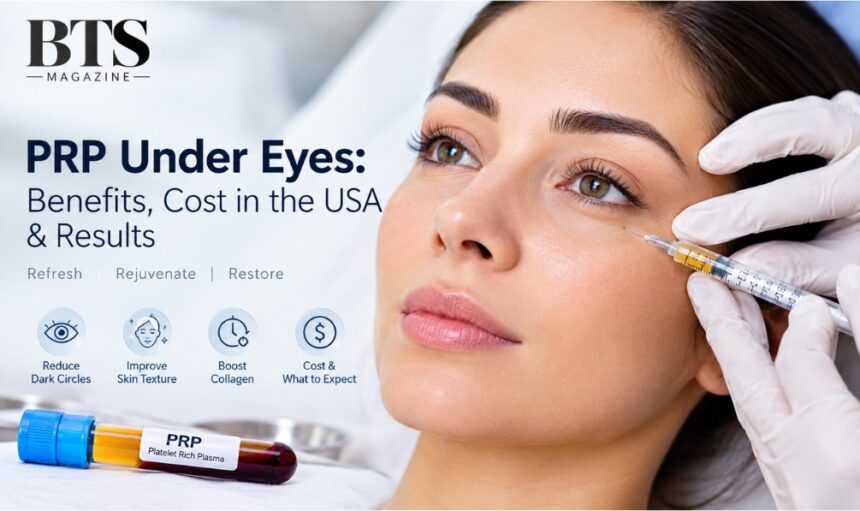
The delicate skin under the eyes is often one of the first areas to show fine lines, thinning skin, pigmentation, crepiness, and signs of fatigue. PRP under eyes has become a popular aesthetic treatment in the United States for people who want to improve the appearance and quality of the under-eye area using material derived from their own blood.
- What Is PRP Under the Eyes?
- PRP Injections vs. Microneedling With PRP
- How Does PRP Work Under the Eyes?
- What Can PRP Under Eyes Treat?
- PRP for Dark Circles
- PRP for Fine Lines
- PRP for Crepey or Thin Under-Eye Skin
- PRP for Under-Eye Hollows
- Benefits of PRP Under Eyes
- PRP Under Eyes Before and After: What Results Can You Expect?
- PRP Under Eyes After 1 Session
- PRP Under Eyes After 2–3 Sessions
- When Do PRP Under-Eye Results Appear?
- How Many PRP Under-Eye Sessions Do You Need?
- What Happens During a PRP Under-Eye Treatment?
- 1. Consultation
- 2. Blood Draw
- 3. PRP Preparation
- 4. Skin Preparation
- 5. PRP Application or Injection
- 6. Post-Treatment Instructions
- Is PRP Under Eyes Painful?
- PRP Under Eyes Recovery and Downtime
- PRP Under Eyes Side Effects and Risks
- Who Is a Good Candidate for PRP Under Eyes?
- Who Should Avoid or Delay PRP Under Eyes?
- PRP Under Eyes vs. Filler: Which Is Better?
- PRP Under Eyes vs. PRF
- How Much Does PRP Under Eyes Cost in the USA?
- How Long Does PRP Under Eyes Last?
- PRP Under Eyes — Is It Worth It?
- PRP Under Eyes Before and After: What Should You Look For?
- FAQs About PRP Under Eyes
- Does PRP under eyes remove dark circles?
- Is PRP good for under-eye hollows?
- How many PRP sessions are needed under the eyes?
- How long does PRP under eyes take to work?
- How long does PRP under eyes last?
- Is PRP under eyes safe?
- How much does PRP under eyes cost in the USA?
- Is PRP better than filler under the eyes?
- Can PRP make under-eye skin thicker?
- What should I avoid after PRP under eyes?
- Can I get PRP under eyes in the USA without a consultation?
- Final Takeaway
PRP, or platelet-rich plasma, contains a concentrated amount of platelets and biologically active substances involved in the body’s natural healing processes. When used around the eyes, PRP is intended to support skin rejuvenation and may improve the appearance of fine lines, skin texture, and certain types of under-eye discoloration.
However, PRP is not a universal solution for every under-eye concern. Dark circles can be caused by pigmentation, visible blood vessels, thin skin, or shadows created by tear-trough hollows. The most appropriate treatment therefore depends on the underlying cause.
Research on PRP for periorbital rejuvenation is promising but not definitive. Recent evidence suggests that many patients report satisfaction with treatment, while objective improvements can vary depending on the concern being treated and the PRP protocol used.
What Is PRP Under the Eyes?
PRP stands for platelet-rich plasma. It is prepared from a small sample of the patient’s own blood.
During a PRP under-eye treatment, a healthcare professional collects blood and processes it to separate the plasma and concentrate platelets. The resulting PRP contains growth factors and other components associated with tissue repair and regeneration.
For under-eye rejuvenation, PRP may be injected into or applied to the delicate skin around the eyes, depending on the treatment technique and the provider’s protocol.
The purpose is different from that of a traditional dermal filler. Rather than creating immediate volume, PRP is generally used as a skin-quality and regenerative treatment with the goal of improving the appearance of fine lines, thin skin, texture, and selected forms of discoloration over time.
Clinical research has reported potential improvements in periorbital skin appearance and patient satisfaction, although researchers continue to note limitations in study quality, treatment protocols, and long-term evidence.
PRP Injections vs. Microneedling With PRP
PRP injections and microneedling with PRP are related but different treatments.
PRP Injections
With PRP injections, the prepared platelet-rich plasma is introduced directly into selected areas of the skin using injections.
Microneedling With PRP
With microneedling, tiny needles create controlled micro-injuries in the skin. PRP may then be applied during or after the procedure.
The technique used should depend on the patient’s skin condition, treatment goals, anatomy, and professional assessment.
How Does PRP Work Under the Eyes?
A typical PRP under-eye treatment in the United States may involve several stages:
- Consultation and assessment: The provider evaluates the under-eye area and determines whether the main concern involves pigmentation, thin skin, wrinkles, hollowing, or a combination.
- Blood collection: A small amount of blood is drawn.
- PRP preparation: The blood is processed, commonly using centrifugation, to separate the platelet-rich component.
- Skin preparation: The under-eye area is cleaned and prepared. A topical numbing product may be used when appropriate.
- PRP application or injection: The provider applies or injects PRP using a technique appropriate for the delicate periorbital area.
- Aftercare: The patient receives instructions regarding skincare, exercise, heat exposure, sun exposure, and other activities.
The theory behind PRP is that platelet-derived growth factors may support biological processes involved in tissue repair and collagen remodeling.
Because these processes take time, PRP under-eye results are generally gradual rather than immediate. Unlike a filler, PRP does not simply place a predetermined amount of volume beneath the skin.
Another important consideration is that PRP preparation methods, platelet concentrations, injection techniques, and treatment schedules can vary between providers and studies. This variability makes it difficult to predict exactly how one person will respond.
What Can PRP Under Eyes Treat?
PRP may be considered for several under-eye concerns, but its effectiveness depends heavily on what is actually causing the problem.
PRP for Dark Circles
“Dark circles” are not one single condition.
Under-eye darkness may be related to:
- Pigmentation
- Thin, translucent skin
- Visible blood vessels
- Vascular changes
- Skin aging
- Tear-trough or midface volume loss
- Facial anatomy and shadows
- A combination of several factors
This distinction is important because PRP may help some skin-quality or pigmentation concerns but should not be expected to correct every cause of dark circles.
If you are searching for PRP under eyes for dark circles, the first step is determining whether your circles are primarily pigmentary, vascular, structural, or related to thin skin.
PRP for Fine Lines
Fine lines are one of the more logical reasons people consider PRP under-eye treatment.
As skin ages, collagen and elastin change, and the under-eye area can become thinner and more wrinkled. PRP may support skin remodeling and potentially soften the appearance of fine lines.
However, PRP should be viewed as a gradual skin-rejuvenation treatment rather than a guaranteed wrinkle-removal procedure.
PRP for Crepey or Thin Under-Eye Skin
Thin or “crepey” skin is another common reason patients explore PRP.
The goal is to improve overall skin quality rather than simply add volume. Research involving PRP and related regenerative treatments around the eyes has reported potential improvements in skin texture, wrinkles, and skin quality, although protocols and outcomes differ between studies.
People with significant skin laxity may require a different treatment approach.
PRP for Under-Eye Hollows
This is an important distinction.
PRP is not a direct replacement for lost volume in the same way as a dermal filler.
If the primary concern is a pronounced tear-trough hollow, the shadow may be caused by structural volume loss rather than poor skin quality.
In these situations, a qualified U.S. aesthetic provider may discuss options such as carefully selected hyaluronic-acid filler, fat-based approaches, or other treatments.
This does not mean filler is automatically better. It means the treatment should match the patient’s underlying anatomy and concern.
Benefits of PRP Under Eyes
Potential benefits of PRP under-eye treatment may include:
- Improved appearance of skin texture
- Softer appearance of fine lines
- Improved overall skin quality
- Support for collagen-related skin remodeling
- Potential improvement in certain forms of under-eye discoloration
- Gradual and generally subtle rejuvenation
- Use of material derived from the patient’s own blood
- No permanent synthetic filler being placed under the eyes
These benefits are not guaranteed for every patient. Current evidence supports potential improvement but also demonstrates variability between studies and individual patients.
PRP Under Eyes Before and After: What Results Can You Expect?
PRP under eyes before and after is one of the most common searches among people researching this treatment.
The most important point is that PRP typically does not produce the same immediate volumizing effect associated with filler.
When improvement occurs, it generally develops progressively as the skin responds to treatment.
PRP Under Eyes After 1 Session
After one session, some people may notice subtle changes in skin texture or overall freshness.
However, it is usually too early to judge the complete result immediately after treatment.
Temporary swelling can also change the appearance of the under-eye area shortly after treatment. This should not be mistaken for the final aesthetic result.
PRP Under Eyes After 2–3 Sessions
Multiple treatment sessions are commonly used in clinical studies, although there is no universal rule that every patient needs exactly three sessions.
Some patients may see noticeable improvement after one treatment, while others may require a series of treatments.
The appropriate number of sessions depends on the patient’s skin condition, treatment goals, response, and provider’s assessment.
When Do PRP Under-Eye Results Appear?
PRP results are generally gradual.
The timing may vary according to:
- Skin condition
- Age
- Treatment technique
- PRP preparation
- Number of sessions
- Underlying cause of the concern
- Individual healing response
There is no scientifically reliable single number of days that can be promised to every patient.
Be cautious of clinics or advertisements claiming that PRP will permanently remove dark circles or produce a guaranteed result within a fixed number of days.
How Many PRP Under-Eye Sessions Do You Need?
There is no single number of PRP sessions that applies to everyone.
Some patients may see useful improvement after one treatment, while others may benefit from a series.
Clinical studies have used different protocols, with treatment frequency and intervals varying considerably.
For this reason, a personalized treatment plan is generally more appropriate than a fixed promise such as “everyone needs three sessions.”
Your provider may also discuss maintenance treatments depending on your response and aesthetic goals.
What Happens During a PRP Under-Eye Treatment?
A typical treatment may follow this process:
1. Consultation
The provider evaluates your under-eye area and identifies whether the main concern is pigmentation, thin skin, fine lines, crepiness, hollowing, or a combination.
2. Blood Draw
A small amount of your blood is collected.
3. PRP Preparation
The blood is processed using a centrifuge or another preparation system to separate the platelet-rich component.
4. Skin Preparation
The treatment area is cleaned. Topical numbing may be used depending on the technique and patient preference.
5. PRP Application or Injection
The prepared PRP is introduced into the selected area using the provider’s chosen technique.
6. Post-Treatment Instructions
You may receive instructions about skincare, sun exposure, exercise, heat, and other activities during the initial recovery period.
Because the skin around the eyes is thin and the area contains important anatomical structures, treatment should be performed by an appropriately qualified medical professional with relevant experience.
Is PRP Under Eyes Painful?
Some discomfort is possible because PRP injections involve needles.
The experience can vary depending on:
- Individual pain sensitivity
- Number and depth of injections
- Treatment technique
- Whether topical numbing is used
Patients may experience brief stinging or pressure during injections, followed by temporary tenderness.
Therefore, PRP under eyes should not be described as completely painless for everyone.
PRP Under Eyes Recovery and Downtime
Recovery is generally relatively short, but individual experiences vary.
Temporary effects may include:
- Mild swelling
- Redness
- Tenderness
- Bruising
- Minor sensitivity around injection sites
Is Swelling Normal After PRP Under Eyes?
Yes. Mild swelling can occur after PRP under-eye treatment, particularly because the skin in this area is delicate.
The amount and duration of swelling vary according to injection technique, individual healing, and the procedure performed.
How Long Does Bruising Last?
Bruising is a possible side effect of injections.
Some patients may have little or no bruising, while others may develop visible discoloration that takes longer to settle.
When Can You Return to Work?
Many people can return to normal activities relatively quickly, but this depends on the amount of swelling or bruising and the nature of their work.
If you have a public-facing job, important event, or photo session, consider scheduling treatment when you have some flexibility in case temporary bruising occurs.
Always follow the specific aftercare instructions provided by your healthcare professional.
PRP Under Eyes Side Effects and Risks
Although PRP is derived from the patient’s own blood, this does not mean the procedure is completely risk-free.
Potential side effects and complications can include:
- Temporary swelling
- Redness
- Bruising
- Tenderness
- Injection-site discomfort
- Infection
- Uneven results
- Limited or disappointing improvement
- Rare procedure-related complications
Risks depend partly on injection technique, sterility, anatomy, and provider experience.
The area around the eyes is particularly sensitive. Anyone considering PRP injections should choose a qualified medical professional who understands periorbital anatomy and has appropriate experience with the procedure.
Evidence generally suggests a favorable short-term safety profile, but available research has limitations and larger, better-standardized studies are still needed.
Who Is a Good Candidate for PRP Under Eyes?
PRP may be worth discussing with a qualified provider if your primary concern involves:
- Fine lines
- Thin or crepey under-eye skin
- Mild skin-quality changes
- Certain forms of under-eye discoloration
- Early signs of periorbital aging
- A preference for a gradual regenerative approach
The most important factor is not simply age. It is the cause of the under-eye concern.
Someone with thin skin and fine lines may be a more suitable candidate than someone whose primary concern is a deep tear trough caused by significant volume loss.
Who Should Avoid or Delay PRP Under Eyes?
Suitability requires an individual medical assessment.
Treatment may need to be delayed or avoided in certain situations, including:
- Active infection around the treatment area
- Significant inflammation or irritation
- Certain bleeding or clotting disorders
- Medical conditions affecting healing
- Factors that increase the risk of complications
- Situations where a provider determines that PRP is unlikely to address the underlying concern
Tell your healthcare professional about your medical history, medications, and supplements before treatment.
PRP Under Eyes vs. Filler: Which Is Better?
Neither treatment is universally better.
The correct choice depends on the underlying cause of the under-eye concern.
| Feature | PRP Under Eyes | Under-Eye Filler |
| Main purpose | Skin quality and regenerative approach | Volume correction |
| Best suited to | Thin skin, fine lines and selected texture concerns | Tear-trough hollows caused by volume loss |
| Results | Gradual | Usually more immediate |
| Adds volume | Not in the same way as filler | Yes |
| Material | Patient’s blood-derived PRP | Usually hyaluronic-acid filler |
| Main mechanism | Supports skin remodeling | Adds or restores volume |
| Reversibility | Not comparable to dissolving HA filler | HA filler can generally be treated with hyaluronidase when clinically appropriate |
Choosing PRP simply because it is “natural” or filler because it is “faster” can oversimplify the decision.
A qualified provider should first determine whether the main issue is skin quality, pigmentation, vascular visibility, structural hollowing, or a combination.
PRP Under Eyes vs. PRF
PRF stands for platelet-rich fibrin.
Like PRP, PRF is prepared from the patient’s blood and is used in regenerative aesthetic treatments.
One basic difference is the preparation process. PRF is generally produced using a different centrifugation approach that creates a fibrin matrix capable of trapping platelets and other cells.
PRF has gained interest for periorbital rejuvenation because of its potential effects on skin texture, wrinkles, and crepiness.
Current research does not establish that PRP or PRF is universally superior. Differences in preparation methods, treatment protocols, and patient populations make direct comparisons difficult.
The decision between PRP and PRF should therefore be based on the patient’s specific concerns and a qualified provider’s assessment.
How Much Does PRP Under Eyes Cost in the USA?
PRP under eyes cost in the USA varies significantly.
The price can depend on:
- Geographic location
- Provider qualifications and experience
- Clinic type
- PRP preparation system
- Number of treatment sessions
- Injection technique
- Whether microneedling is included
- Whether PRP is combined with another treatment
- Complexity of the under-eye concern
As a general U.S. aesthetic-treatment consideration, patients may encounter prices ranging from a few hundred dollars to more than $1,000 per session, depending on the provider, location, and treatment protocol.
Major metropolitan areas and highly experienced specialists may charge more than smaller markets.
Because pricing changes from clinic to clinic, there is no single nationwide price that applies to every patient.
When comparing PRP under eyes cost, do not look only at the advertised price. Ask what is included, who performs the treatment, how the PRP is prepared, how many sessions are recommended, and whether follow-up care is included.
For an accurate price, schedule a consultation with a qualified U.S. provider.
How Long Does PRP Under Eyes Last?
There is no universally guaranteed duration for PRP under-eye results.
PRP does not permanently stop the natural aging process, and the longevity of improvement varies between individuals.
Factors that may influence durability include:
- Age
- Skin condition
- Sun exposure
- Lifestyle
- Treatment protocol
- Number of sessions
- Individual biological response
- Original cause of the under-eye concern
Some clinics advertise specific durations, but current evidence does not justify promising an identical result for every patient.
Maintenance sessions may be considered depending on the individual’s response and goals.
PRP Under Eyes — Is It Worth It?
PRP under eyes may be worth considering if your main concern is skin quality, fine lines, thin or crepey skin, or certain types of discoloration.
It may be particularly appealing to people who prefer a gradual treatment approach using material derived from their own blood.
However, PRP may be less suitable when the primary issue is a pronounced tear-trough hollow caused by volume loss because PRP does not restore volume in the same way as a dermal filler.
Likewise, if pigmentation is the dominant concern, a provider may recommend a treatment specifically targeted toward pigmentation after identifying its cause.
Instead of asking only, “Does PRP work under the eyes?” a better question is:
“Is PRP appropriate for the specific cause of my under-eye concern?”
That distinction can make a significant difference in treatment selection and expectations.
PRP Under Eyes Before and After: What Should You Look For?
When reviewing PRP under-eye before-and-after photos, look for several factors rather than focusing only on whether dark circles appear lighter.
Consider:
- Lighting consistency
- Camera angle
- Facial expression
- Time between treatment and after photo
- Number of sessions
- Whether other treatments were performed
- Changes in skin texture
- Changes in fine lines
- Changes in pigmentation
- Changes in under-eye hollowness
Authentic clinical photographs should be presented with appropriate patient consent and should not be edited in a way that creates misleading expectations.
FAQs About PRP Under Eyes
Does PRP under eyes remove dark circles?
PRP may improve some forms of under-eye discoloration, particularly when skin quality or certain pigmentary factors contribute to the appearance. However, it does not reliably remove every type of dark circle.
Dark circles may also result from pigmentation, visible blood vessels, thin skin, or structural shadows caused by volume loss.
Is PRP good for under-eye hollows?
PRP may improve the quality of the skin over the hollow, but it is not equivalent to a volume-restoring filler.
Significant tear-trough hollows may require a different treatment strategy.
How many PRP sessions are needed under the eyes?
There is no fixed number for everyone.
Some patients may benefit from one treatment, while others may require a series. Clinical studies have used different protocols, so the number of sessions should be individualized.
How long does PRP under eyes take to work?
PRP generally produces gradual rather than instant changes.
The timing varies according to the patient’s skin condition, treatment technique, number of sessions, and underlying concern.
How long does PRP under eyes last?
The duration varies between patients.
Current evidence does not support a guaranteed duration for everyone, and maintenance treatments may be considered depending on the individual’s response.
Is PRP under eyes safe?
PRP generally has a favorable safety profile in published studies, but it is not risk-free.
Potential effects include swelling, redness, bruising, tenderness, infection, and limited improvement.
Because injections are performed close to the eyes, appropriate medical training and knowledge of periorbital anatomy are important.
How much does PRP under eyes cost in the USA?
PRP under-eye prices vary by location, provider, treatment technique, number of sessions, and clinic.
Many U.S. patients may encounter prices ranging from several hundred dollars to more than $1,000 per session, although actual pricing can be higher or lower.
A consultation is the best way to obtain an accurate quote.
Is PRP better than filler under the eyes?
Neither is universally better.
PRP focuses more on skin quality and regenerative treatment, while filler is designed to restore volume.
PRP may be more appropriate for thin skin and fine lines, whereas carefully selected filler may be considered for true tear-trough volume loss.
Can PRP make under-eye skin thicker?
PRP is intended to support skin remodeling and may improve skin quality and texture.
However, “thicker skin” should not be presented as a guaranteed outcome. Research findings vary, and more standardized studies are needed.
What should I avoid after PRP under eyes?
Follow your provider’s specific aftercare instructions.
Depending on the procedure, you may be advised to temporarily avoid strenuous exercise, excessive heat, unnecessary touching of the treatment area, and irritating skincare products.
Do not stop prescribed medication unless your healthcare professional specifically tells you to do so.
Can I get PRP under eyes in the USA without a consultation?
A consultation is strongly recommended before treatment.
An evaluation can help determine whether your under-eye concern is caused by pigmentation, thin skin, vascular visibility, wrinkles, volume loss, or another factor.
That assessment helps determine whether PRP is an appropriate option or whether another treatment may be more suitable.
Final Takeaway
PRP under eyes is a regenerative aesthetic treatment that may help improve fine lines, skin texture, thin or crepey skin, and certain forms of under-eye discoloration.
Its main advantage is that it focuses on skin quality rather than simply adding volume. However, PRP is not a universal solution for dark circles or under-eye hollows.
The underlying cause—pigmentation, vascular visibility, skin thinning, aging, facial anatomy, or volume loss—should guide treatment selection.
Current research is encouraging but still has important limitations, including differences in PRP preparation, treatment protocols, outcome measurements, and long-term evidence.
If you are considering PRP under-eye injections in the United States, choose an appropriately qualified medical professional and have the area assessed before treatment.
A proper consultation can help determine whether PRP, PRF, filler, laser treatment, topical therapy, microneedling, or another approach is more appropriate for your individual anatomy and goals.
Medical References & Further Reading
- PubMed — Platelet-Rich Plasma and Platelet-Rich Fibrin in Periorbital Esthetics: 2026 Systematic Review
- PubMed — Rejuvenating the Periorbital Area Using PRP: Systematic Review and Meta-Analysis
- PMC — Systematic Review of PRP Versus PRF for Periorbital Rejuvenation
- PubMed — PRP for Skin Aging: Systematic Review of Safety and Effectiveness
- PubMed — Recent Systematic Review of Under-Eye Treatments
Read also: Repmold: 5 Practical Applications in Modern Mold Manufacturing