

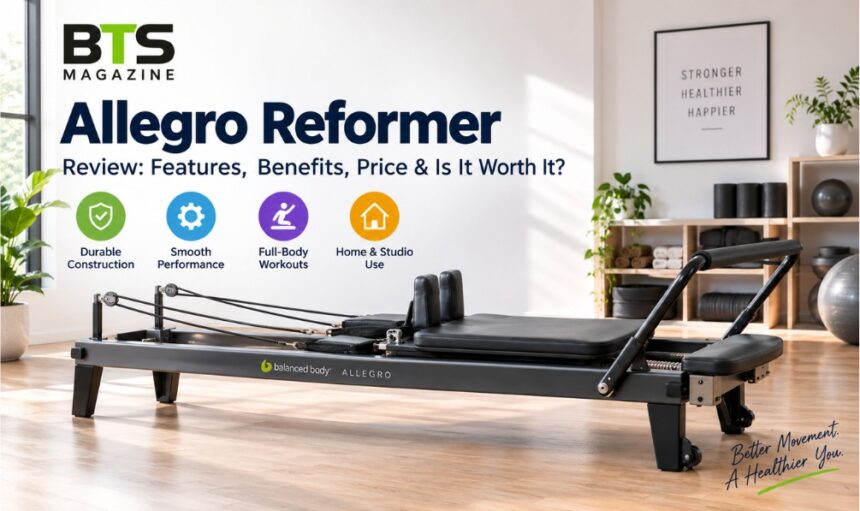
If you are looking for a professional Pilates reformer that can handle regular home workouts as well as demanding studio use, the Allegro Reformer is one of the better-known options to consider. Developed by Balanced Body, the Allegro line focuses on durability, adjustability, smooth carriage movement and a broad range of Pilates exercises.
- What Is the Allegro Reformer?
- Who Makes the Allegro Reformer?
- Is the Allegro Reformer Designed for Home or Studio Use?
- What Makes the Allegro Different From Basic Home Reformers?
- Allegro Reformer at a Glance
- Durable Frame and Construction
- Smooth Carriage Movement
- Adjustable Footbar
- Rope and Strap System
- Shoulder Rests and Carriage Design
- Storage and Portability
- Available Accessories
- Full-Body Pilates Workouts
- Improves Core Strength
- Supports Strength and Flexibility Training
- Helps With Balance and Coordination
- Suitable for Progressive Workouts
- Useful for Both Home and Studio Training
- Is the Allegro Reformer Good for Beginners?
- How Much Space Does It Need?
- Is It Easy to Store?
- Is It Too Heavy for a Home Gym?
- Is It Suitable for Apartments?
- What Accessories Do You Actually Need?
- How Much Does the Allegro Reformer Cost?
- What Is Included in the Base Price?
- How Much Do Accessories Cost?
- Is the Total Cost Higher Than the Advertised Price?
- Pros
- Cons
- What Is Allegro NextGen?
- Allegro 2 vs NextGen Key Differences
- Which One Should You Choose?
- Allegro vs Budget Reformer
- Allegro vs Compact Reformer
- Allegro vs Smart Reformer
- Allegro vs Studio Reformer
- Best For:
- Not Ideal For:
- Yes — If:
- Maybe Not — If:
- Final Verdict
- How much does an Allegro Reformer cost?
- Is the Allegro Reformer good for beginners?
- Is Allegro Reformer good for home use?
- How much space do you need for an Allegro Reformer?
- Can you store the Allegro Reformer upright?
- What is the difference between Allegro and Allegro 2?
- Is the Allegro 2 worth the extra money?
- What accessories can you add to an Allegro Reformer?
- How long does an Allegro Reformer last?
- Does the Allegro Reformer come with classes?
- Is the Allegro Reformer better than a budget reformer?
- Allegro Reformer Review — Editorial Rating
Unlike many entry-level home reformers, the Allegro is designed around long-term use rather than simply offering the lowest possible purchase price. That makes it particularly interesting for serious Pilates practitioners, instructors, studios and home users who expect to use their equipment frequently.
This review looks at the Allegro Reformer’s features, specifications, benefits, home-use practicality, pricing considerations, pros and cons, and how the Allegro compares with the Allegro 2 and newer Allegro NextGen.
Quick Answer: The Allegro Reformer is a professional-grade Pilates reformer designed for both studio and home use. It stands out for its durable construction, smooth carriage movement, adjustable setup and broad exercise versatility. It can be a strong long-term investment for serious Pilates users, but its price, size and lack of built-in digital coaching may make cheaper or smarter reformers more suitable for some buyers.
What Is the Allegro Reformer?
The Allegro Reformer is a spring-based Pilates reformer from Balanced Body, a company known for manufacturing Pilates equipment for professional and home environments.
A reformer typically consists of a moving carriage, springs for resistance, a footbar, shoulder rests and straps or ropes. These components work together to provide adjustable resistance while allowing the user to perform a wide range of controlled movements.
The Allegro platform is designed for more than basic Pilates exercises. Depending on the configuration and accessories, users can expand their exercise options with equipment such as a jumpboard, tower or mat-conversion components.
Balanced Body positions the Allegro 2 as equipment suitable for both professional and home use, with a design intended to withstand demanding everyday use.
Who Makes the Allegro Reformer?
The Allegro Reformer is made by Balanced Body, a Pilates equipment manufacturer based in the United States.
The company produces several reformer families, including the Allegro, Allegro 2, Allegro NextGen and other specialized Pilates equipment.
The Allegro 2, for example, is manufactured by Balanced Body Inc., with product documentation identifying the company’s Sacramento, California location.
Is the Allegro Reformer Designed for Home or Studio Use?
It can be suitable for both.
The important distinction is that the Allegro family is designed with professional-level durability and adjustability in mind, so a home buyer gets equipment that is closer to studio equipment than a lightweight entry-level reformer.
The trade-off is size and weight. A serious reformer needs considerably more space than a compact piece of home fitness equipment.
What Makes the Allegro Different From Basic Home Reformers?
The biggest difference is the overall design philosophy.
Many inexpensive home reformers prioritize portability and lower cost. The Allegro line instead emphasizes:
- Durable construction
- Smooth carriage movement
- Adjustable footbar positioning
- Spring resistance
- Professional-style exercise versatility
- Expandable accessories
- Long-term ownership
That makes it more appropriate for someone who expects to use a reformer regularly.
Allegro Reformer at a Glance
| Feature | Allegro Reformer |
| Brand | Balanced Body |
| Type | Pilates Reformer |
| Use | Home & Studio |
| Frame | Professional-grade construction |
| Carriage | Smooth-gliding carriage |
| Footbar | Adjustable |
| Resistance | Spring-based |
| Storage | Standing/upright storage depending on configuration |
| Accessories | Multiple optional accessories |
| Best For | Beginners to advanced Pilates users |
One important point is that Allegro, Allegro 2 and Allegro NextGen are not identical products. Features, dimensions and configurations vary between generations.
For current purchases, it is therefore better to check the exact model and configuration rather than assuming that every Allegro listing has the same specifications.
Allegro Reformer Features
The feature set is one of the main reasons the Allegro family remains relevant in the premium reformer market.
Durable Frame and Construction
The Allegro platform is designed for repeated use rather than occasional exercise.
The Allegro 2, for example, is described by Balanced Body as being engineered for the demands of commercial fitness while also being suitable for home use.
This matters because a reformer experiences repeated loading from the user’s body weight, springs, carriage movement and transitions between exercises.
A stable frame can also make exercises feel more predictable. Instead of the machine moving around underneath the user, the reformer is intended to provide a consistent platform.
For frequent users, that type of construction can make more sense than replacing a cheaper reformer after a relatively short period.
Smooth Carriage Movement
Carriage movement is one of the most important parts of the reformer experience.
A good carriage should move predictably and smoothly without distracting friction or unnecessary instability.
Balanced Body highlights the Allegro 2’s smooth carriage movement and precision design as part of its overall performance.
For Pilates, this matters because controlled movement is more important than simply moving the carriage quickly.
A smoother carriage can make transitions feel more natural and allows the user to concentrate on movement, alignment and resistance rather than fighting the equipment.
Adjustable Footbar
The footbar is another major advantage of a full-size reformer.
Different exercises require different footbar positions, and users also have different body proportions. An adjustable system therefore provides more flexibility than a fixed footbar.
The Allegro 2 introduced the EasySet Footbar, which Balanced Body designed to make adjustment easier and accommodate different users and exercises.
That adjustability is particularly useful in a household where more than one person uses the reformer.
Rope and Strap System
The rope or strap system connects the user’s hands or feet to the resistance system and plays an important role in many Pilates movements.
The Allegro 2 uses Balanced Body’s SoftTouch Rope System, which is designed to make rope adjustments and transitions easier. Balanced Body also highlights its ability to provide quick and convenient adjustments between exercises.
For someone who performs a varied Pilates routine, small improvements in adjustment speed can make a meaningful difference.
Shoulder Rests and Carriage Design
Shoulder rests help stabilize the upper body during many carriage exercises.
The Allegro 2 uses adjustable shoulder rests, while the carriage includes a padded headrest with multiple adjustment positions. Its shoulder-rest design can also be configured to create different spacing for different users.
This is especially useful when a reformer is shared by people with different body sizes.
Storage and Portability
The Allegro is not a lightweight portable reformer in the same sense as compact entry-level machines.
However, storage is more practical than the machine’s overall size might suggest.
Balanced Body describes the Allegro 2 as capable of rolling, stacking and being stored on end.
That can be useful for home users who need to reclaim floor space after a workout.
Still, buyers should measure their available room before purchasing. A reformer can be long and heavy even when upright storage is possible.
Available Accessories
One of the strongest aspects of the Allegro ecosystem is expandability.
Depending on model and configuration, accessories can include:
- Jumpboard
- Tower
- Mat conversion
- Sitting box
- Platform extender
- Plank bars
- Foot straps
- Other compatible accessories
Balanced Body’s current Allegro 2 support and product material lists accessories such as jumpboards, platform extenders, tower/mat conversion options and other equipment.
The advantage is that you can start with a basic configuration and expand your equipment later instead of buying an entirely new reformer.
Allegro Reformer Specifications
Exact specifications depend on the model and configuration, so buyers should verify the listing before purchasing.
For the Allegro 2, published specifications include the following:
| Specification | Allegro 2 |
| Length | 94 in / 238 cm |
| Width | 25.5 in / 65 cm |
| Height | 9 in / 22.5 cm or 15 in / 37.5 cm with legs |
| Carriage Width | 23 in / 58.4 cm |
| Carriage Length | 33 in / 83.8 cm |
| Footbar Width | 31 in / 79 cm |
| Weight | 140 lb / 64 kg or 146 lb / 66 kg with legs |
| Resistance | Spring-based |
| Weight Limit | Up to 159 kg in the published European specification |
| Storage | Standing/stacking options depending on configuration |
These figures are supported by Balanced Body regional product documentation.
The most important takeaway is that this is a full-size piece of equipment. At roughly 238 cm long, it requires considerably more space than a compact home fitness machine.
Allegro Reformer Benefits
Full-Body Pilates Workouts
A reformer allows users to train multiple areas of the body using resistance and controlled movement.
Depending on exercise selection, workouts can involve the:
- Core
- Legs
- Glutes
- Arms
- Shoulders
- Back
The machine’s adjustable resistance also makes it possible to progress from easier movements to more challenging exercises.
Improves Core Strength
Pilates reformer exercises frequently require users to stabilize the torso while controlling carriage movement.
That makes core engagement an important part of many reformer exercises.
However, it is better to describe the Allegro as supporting strength and movement training rather than making medical promises about treating specific conditions.
Supports Strength and Flexibility Training
The spring system provides adjustable resistance, while the reformer’s range of movement allows users to work through different movement patterns.
This combination can make the Allegro useful for people who want both resistance-based training and mobility-focused Pilates sessions.
Helps With Balance and Coordination
Reformer exercises often require controlled coordination between the arms, legs and torso.
Because the carriage moves underneath the user, maintaining control becomes part of the exercise.
That makes reformer Pilates different from simply performing stationary floor exercises.
Suitable for Progressive Workouts
One advantage of a premium reformer is that it can continue to be useful as the user’s skill level increases.
A beginner can start with basic movements and gradually progress toward more challenging exercises.
This is one reason a high-quality reformer can make more sense for serious long-term users than an inexpensive machine intended primarily for occasional workouts.
Useful for Both Home and Studio Training
The Allegro 2 is explicitly positioned by Balanced Body for professional and home use.
For a home user, that means the equipment can provide a studio-style experience without requiring regular studio visits.
The downside is that the buyer has to provide the space and take responsibility for setup, maintenance and learning the equipment.
Allegro Reformer for Beginners
Is the Allegro Reformer Good for Beginners?
Yes, but beginners should expect a learning curve.
The Allegro can be used by beginners because its resistance and setup can be adjusted. However, a professional-style reformer has more components and exercise possibilities than a basic fitness machine.
A new user needs to understand:
- Spring resistance
- Footbar positioning
- Rope or strap adjustment
- Shoulder-rest positioning
- Basic carriage control
- Proper exercise technique
Balanced Body describes the Allegro 2 as intuitive and easy to use, but that does not mean every exercise is immediately obvious to a first-time Pilates user.
If you have never used a reformer before, instructor-led sessions or reliable instructional material can make the initial learning process much easier.
The best approach is to start with basic movements and gradually learn how different resistance settings affect the exercise.
Allegro Reformer for Home Use
How Much Space Does It Need?
Space is one of the biggest considerations.
An Allegro 2 is approximately 94 inches (238 cm) long and 25.5 inches (65 cm) wide in the published specification.
But the machine itself is not the only thing that needs space.
You also need room around it so that you can safely get on and off the carriage and perform exercises that extend beyond the frame.
Is It Easy to Store?
The Allegro 2 is designed with storage flexibility in mind.
Balanced Body states that the reformer can roll, stack and store on end.
That can help home users who do not want the machine occupying the center of a room permanently.
However, upright storage should not be interpreted as meaning that the reformer is lightweight.
Is It Too Heavy for a Home Gym?
For some homes, yes.
The published Allegro 2 weight is approximately 64 kg without legs or 66 kg with legs.
That is manageable compared with some commercial equipment, but it is not something most people will casually move around several times a day.
If you live in an apartment or have limited floor space, measure doorways, storage areas and the intended workout zone before ordering.
Is It Suitable for Apartments?
It can be, but only if you have sufficient space.
The bigger concern in an apartment is not simply whether the reformer fits physically. You should also consider:
- Ceiling height
- Doorway access
- Storage position
- Workout clearance
- Moving the equipment
- Noise considerations
- Whether accessories require additional room
A compact reformer may make more sense if every square meter matters.
What Accessories Do You Actually Need?
Not everyone needs the complete accessory ecosystem.
For basic reformer training, the machine itself and standard resistance setup may be enough.
More advanced users may benefit from accessories such as a jumpboard, tower or platform extender.
The right choice depends on how you intend to train rather than how many accessories are available.
Allegro Reformer Price
How Much Does the Allegro Reformer Cost?
There is no single universal price that applies to every Allegro configuration and market.
Current Balanced Body regional listings use different pricing approaches. For example, the Australian Balanced Body site currently lists the Allegro 2 as “Contact for Pricing,” while some European listings display pricing or request an inquiry depending on configuration and market.
This means it is better to treat Allegro pricing as configuration- and region-dependent rather than publishing one global number as though it applies everywhere.
What Is Included in the Base Price?
This depends on the exact package.
A standard configuration can include the reformer carriage, frame, footbar, shoulder rests, ropes/straps and springs, while legs, tower systems and other accessories may be configuration-specific.
For example, Balanced Body’s assembly documentation identifies the Allegro 2 carriage and ropes, footbar, shoulder rests, risers, SoftTouch loops and spring set among the equipment components.
Always check the exact product package before comparing prices.
How Much Do Accessories Cost?
Accessories can increase the final cost significantly.
Potential additions include:
- Tower
- Jumpboard
- Platform extender
- Sitting box
- Plank bars
- Mat conversion
- Other specialized accessories
Therefore, comparing a bare reformer price against a fully equipped competitor can produce a misleading result.
Is the Total Cost Higher Than the Advertised Price?
It can be.
Your final purchase cost may depend on:
- Base configuration
- Legs
- Tower
- Accessories
- Upholstery options
- Shipping
- Taxes
- Installation or assembly
For international buyers, shipping and import costs can be particularly important.
Best buying rule: compare the total delivered configuration, not just the headline machine price.
Allegro Reformer Pros and Cons
Pros
- Professional-grade construction
- Smooth carriage movement
- Strong stability
- Broad exercise possibilities
- Suitable for home and studio use
- Designed for long-term ownership
- Large accessory ecosystem
- Adjustable setup
- Multiple configuration possibilities
Cons
- More expensive than entry-level reformers
- Large compared with compact home machines
- Relatively heavy
- Requires dedicated workout/storage space
- Accessories can substantially increase total cost
- Traditional reformer setup does not depend on a built-in touchscreen coaching system
The Allegro 2’s durability, stability and professional positioning are among its biggest strengths, while its physical footprint and traditional equipment-focused approach can be drawbacks for buyers looking for a smart-home-fitness experience.
Allegro Reformer vs Allegro 2
The names can be confusing because Allegro and Allegro 2 are related but distinct generations.
| Feature | Allegro | Allegro 2 |
| Positioning | Original Allegro model | Updated generation |
| Design | Traditional Allegro design | Redesigned platform |
| Footbar | Adjustable | EasySet/infinite-position design |
| Rope System | Traditional system | SoftTouch Rope System |
| Carriage | Smooth carriage | Updated carriage design |
| Accessories | Available | Broad accessory ecosystem |
| Best For | Buyers considering original model | Buyers wanting newer features |
Balanced Body describes the Allegro 2 as a redesigned reformer that introduced features such as the EasySet Footbar and SoftTouch Rope System.
For buyers choosing between an older Allegro and a new Allegro 2, condition, price and included accessories should all be considered.
A discounted original Allegro in excellent condition may make sense for some buyers, while someone wanting the newer adjustment system may prefer the Allegro 2.
Allegro 2 vs Allegro NextGen
What Is Allegro NextGen?
The Allegro NextGen is the newer generation of the Allegro family.
Balanced Body describes it as the next generation of the Allegro Reformer and highlights features such as a smooth, quiet carriage, upright storage and an Infinity Footbar.
Its published dimensions are also different from the Allegro 2.
The NextGen with 14-inch legs is listed at approximately 93 inches long × 34 inches wide × 14 inches high, with a weight of approximately 124 lb (56 kg).
Allegro 2 vs NextGen Key Differences
The NextGen is not simply a cosmetic refresh.
It uses a newer frame and configuration approach and is positioned as the next step in the Allegro product family.
The NextGen also supports accessories such as:
- Tower and mat conversion
- Jumpboard
- Leg kit
- Platform extender
- Head-end extender
Which One Should You Choose?
Choose the Allegro 2 if you want a well-established professional reformer with a proven ecosystem and a large amount of documentation and accessory support.
Consider the Allegro NextGen if you specifically want the newer generation and its updated design features.
The better purchase ultimately depends on availability, local pricing, accessories and the configuration you need.
Allegro Reformer vs Other Home Reformers
Not every buyer needs a premium reformer.
The Allegro sits closer to the professional end of the market, so comparing it with cheaper and technology-focused reformers is useful.
| Factor | Allegro | Budget Reformer | Smart/Digital Reformer |
| Build Quality | High | Low–Medium | Medium–High |
| Digital Features | Limited/None | Usually None | High |
| Durability | High | Variable | Variable |
| Price | High | Low | High |
| Studio Feel | Strong | Variable | Variable |
| Home Use | Yes | Yes | Yes |
| Accessory Options | Broad | Limited/Variable | Model dependent |
| Long-Term Use | Strong | Variable | Variable |
Allegro vs Budget Reformer
The Allegro makes more sense when durability, adjustability and frequent use are priorities.
A budget reformer can be sufficient for someone who is just experimenting with Pilates and is not sure how frequently they will train.
Allegro vs Compact Reformer
Compact machines have the obvious advantage when floor space is limited.
The Allegro’s larger professional-style design, however, provides a more traditional studio-equipment experience.
Allegro vs Smart Reformer
Smart reformers can appeal to users who want screens, guided classes and technology integrated into the workout.
The Allegro takes a more traditional approach: the machine provides the physical equipment, while instruction can come from an instructor, app, video or separate device.
Allegro vs Studio Reformer
The Allegro is already designed with studio-style use in mind, which is one of its major advantages.
For someone setting up a small Pilates studio, the Allegro ecosystem can be especially attractive because of its professional orientation and accessory compatibility.
Who Should Buy the Allegro Reformer?
The Allegro is best suited to buyers who want more than a basic home fitness machine.
Best For:
- Serious Pilates practitioners
- Frequent home users
- Intermediate and advanced users
- People who want studio-style equipment
- Users planning long-term ownership
- Pilates instructors
- Small studios
- Professional environments
- Buyers who value durability over minimum price
If you expect to train several times per week for years, investing in a durable reformer can be easier to justify.
Who Should NOT Buy the Allegro Reformer?
The Allegro isn’t automatically the right choice for everyone.
Not Ideal For:
- Very tight budgets
- Tiny apartments
- Casual users who are unsure about Pilates
- People who specifically want built-in screens and digital classes
- Users looking for an ultra-light portable reformer
- Buyers who prioritize the lowest upfront cost
If you’re still deciding whether you even enjoy reformer Pilates, spending heavily on a professional machine may be premature.
A lower-cost reformer or studio membership can be a better starting point.
Is the Allegro Reformer Worth It?
Yes — If:
- You practice Pilates regularly
- You want durable equipment
- You have enough room
- Your budget supports a premium purchase
- You want a professional-style reformer
- You plan to own the equipment for years
- You want access to a broad accessory ecosystem
Maybe Not — If:
- You’re only testing Pilates
- Your budget is limited
- You have very little space
- You want built-in digital coaching
- Portability is your highest priority
Final Verdict
The Allegro Reformer is worth considering if your priority is long-term equipment quality rather than the cheapest possible entry into Pilates.
Its strongest advantages are its professional positioning, adjustable setup, smooth carriage, sturdy construction and ability to support a wide range of exercises. The Allegro 2 in particular combines a full-size reformer design with features such as the EasySet Footbar, SoftTouch Rope System and multiple accessory options.
The main reasons to hesitate are equally practical: the machine is expensive compared with entry-level reformers, it requires substantial space and additional accessories can increase the total investment.
For a serious Pilates practitioner with sufficient room and budget, however, the Allegro can be a strong long-term choice.
FAQs About Allegro Reformer
What is the Allegro Reformer?
The Allegro Reformer is a professional-style Pilates reformer manufactured by Balanced Body. It uses a moving carriage, spring resistance, footbar, shoulder rests and ropes or straps to support a wide range of Pilates exercises. The Allegro family includes different generations and configurations, so exact features depend on the model.
How much does an Allegro Reformer cost?
The price varies by model, region and configuration. Current regional Balanced Body listings may use contact-for-pricing models, while some European listings provide configuration-specific pricing. It is therefore better to compare the complete delivered configuration rather than rely on one global price.
Is the Allegro Reformer good for beginners?
Yes. Beginners can use the Allegro, but there is a learning curve because a reformer has adjustable springs, footbar positions, ropes and other components. Starting with basic exercises and professional instruction can make the setup easier to understand.
Is Allegro Reformer good for home use?
Yes. The Allegro 2 is specifically positioned for both professional and home use by Balanced Body. The main consideration is space because the reformer is a full-size machine rather than a compact home fitness product.
How much space do you need for an Allegro Reformer?
The Allegro 2 itself is approximately 94 inches long and 25.5 inches wide in the published specification. You should also leave additional clearance around the machine for mounting, dismounting and performing exercises safely.
Can you store the Allegro Reformer upright?
The Allegro 2 is designed to roll, stack and store on end, according to Balanced Body. However, the machine is still relatively heavy, so upright storage should be planned carefully.
What is the difference between Allegro and Allegro 2?
The Allegro 2 is the redesigned generation of the Allegro platform. It introduced features including the EasySet Footbar and SoftTouch Rope System, alongside updated carriage and adjustment features.
Is the Allegro 2 worth the extra money?
It can be if you value the newer adjustment systems, established professional design and long-term use. Whether it is worth the premium depends on the price difference between the specific configurations you are comparing.
What accessories can you add to an Allegro Reformer?
Available accessories can include jumpboards, towers, mat conversions, platform extenders, sitting boxes and other specialized equipment. Exact compatibility depends on the Allegro generation and configuration.
How long does an Allegro Reformer last?
There is no single guaranteed lifespan because durability depends on usage, maintenance, environment and parts replacement. However, the Allegro 2 is specifically engineered for demanding everyday and commercial use, which supports its positioning as a long-term equipment investment.
Does the Allegro Reformer come with classes?
The machine itself is traditional Pilates equipment rather than a touchscreen-based smart fitness platform. Balanced Body does provide workout and instructional resources, including workout videos for Allegro 2 users.
Is the Allegro Reformer better than a budget reformer?
For durability, professional-style construction and long-term use, the Allegro has clear advantages. A budget reformer can still be more appropriate for someone who is new to Pilates, has limited space or simply wants a lower-cost way to try reformer workouts.
Final Verdict
Allegro Reformer Review — Editorial Rating
| Category | Rating |
| Build Quality | 9/10 |
| Performance | 9/10 |
| Versatility | 9/10 |
| Beginner Friendliness | 8/10 |
| Home Use | 8/10 |
| Value | 8/10 |
| Overall | 8.5/10 |
These ratings are an editorial assessment based on the product’s construction, features, usability and positioning; they are not laboratory or manufacturer-issued scores.
The Allegro Reformer earns an 8.5/10 editorial rating because it offers the combination that serious Pilates users generally want: durable construction, adjustable resistance, smooth carriage movement, professional-style design and a broad accessory ecosystem.
Its biggest weakness isn’t performance—it is practicality. The machine takes space, weighs considerably more than compact reformers and can become expensive once accessories, shipping and other costs are included.
For someone committed to Pilates, those disadvantages may be acceptable. For someone casually experimenting with reformer workouts, they may not be.
Overall, the Allegro is best viewed as a long-term Pilates equipment investment rather than a cheap home workout machine.
Official Sources
For current product specifications, configurations and availability, the safest reference is Balanced Body’s official Allegro 2 product page. Balanced Body’s current NextGen information is also available through the official Allegro NextGen page.
Read also: Musol Solvent vs Other Solvents: Key Differences Explained