

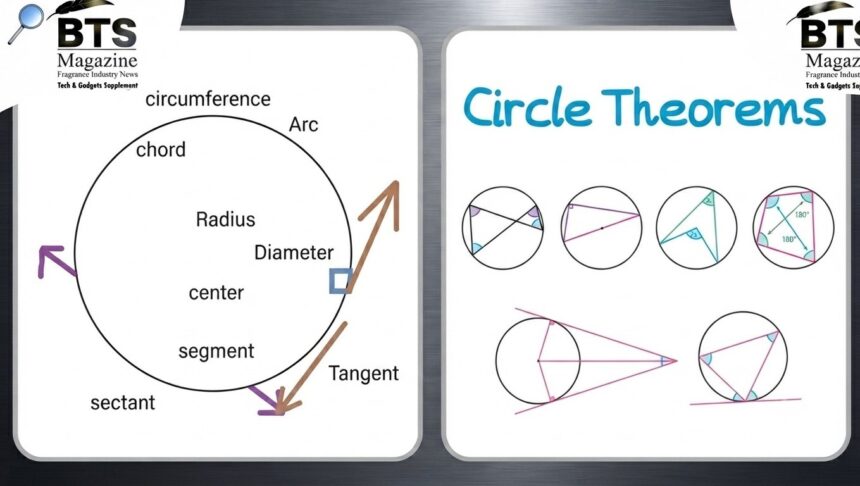
Circle theorems are one of those topics that seem intimidating at first glance—lots of angles, lots of rules, and a whole vocabulary you’ve never seen before. But here’s the thing: once you understand the logic behind each theorem, it all starts to click. This guide breaks everything down in plain English, from what circle theorems actually are to how to tackle them in an exam without second-guessing yourself.
- What Are Circle Theorems?
- A Brief Background on Circle Theorems in Maths
- Why Circle Theorems Matter
- The Main Circle Theorems You Need to Know
- The Inscribed Angle Theorem
- The Angle at the Centre Theorem
- Angles in the Same Segment
- The Cyclic Quadrilateral Theorem
- The Tangent-Radius Theorem
- The Alternate Segment Theorem
- Angles in a Semicircle
- How to Remember Circle Theorems
- Circle Theorems in GCSE Maths
- Common Mistakes Students Make with Circle Theorems
- Tips for Solving Circle Theorem Problems
- Circle Theorems in Real Life
- Practice Questions on Circle Theorems
- Frequently Asked Questions About Circle Theorems
- Final Thoughts
Whether you’re revising for GCSE maths or just want to fill a gap in your geometry knowledge, you’re in the right place. By the end of this post, you’ll know all the key theorems, understand why they work, and have some practical tips for solving problems confidently.
What Are Circle Theorems?
Circle theorems are a set of rules that describe the relationships between angles, lines, and points on or within a circle. Each theorem tells you something specific—for instance, how an angle formed inside a circle relates to the arc it stands on, or how two tangents from the same point behave.
They’re not arbitrary rules someone invented. Each one can be proven using basic geometry, which is part of what makes them so elegant.
A Brief Background on Circle Theorems in Maths
Geometry has been built on the study of circles for thousands of years. Ancient Greek mathematicians, including Euclid and Thales, laid much of the groundwork that underpins what students learn today.
Thales’ theorem—one of the earliest recorded circle theorems—states that any angle inscribed in a semicircle is a right angle. That single observation, made over 2,500 years ago, still appears on GCSE papers today.
Circle theorems as a group were formalised over centuries of mathematical development. They’re now a core part of the GCSE mathematics curriculum in the UK, tested regularly in higher-tier papers.
Why Circle Theorems Matter
Geometry isn’t just abstract. Circles appear in architecture, engineering, physics, and design. Understanding how angles behave inside circles is directly relevant to real-world problem-solving.
For students, circle theorems matter for one very practical reason: they’re almost always on the exam. Knowing them well can be the difference between a Grade 6 and a Grade 9.
They also train a specific kind of mathematical thinking—reasoning from rules to conclusions. That skill transfers to every other area of maths and beyond.
The Main Circle Theorems You Need to Know
Here’s a rundown of the key theorems, explained as clearly as possible.
The Inscribed Angle Theorem
An inscribed angle is one formed by two chords that share an endpoint on the circle. The inscribed angle theorem states that the inscribed angle is always half the central angle that subtends the same arc.
So if the arc spans 100°, the inscribed angle over that arc is 50°. Clean and consistent, every time.
The Angle at the Centre Theorem
This one follows directly from the inscribed angle theorem. The angle at the centre of a circle is twice the angle at the circumference, when both angles are subtended by the same arc.
Think of the centre angle as the “full” version and the circumference angle as the “half” version. That relationship holds no matter where on the circumference the angle is placed.
Angles in the Same Segment
Here’s something that surprises a lot of students: if two angles are inscribed in the same segment of a circle—meaning they sit on the same side of a chord and subtend the same arc—they are equal.
It doesn’t matter how far apart the two points are on the arc. The angles will always be the same. This one is particularly useful when you’re looking at seemingly unrelated angles in a diagram.
The Cyclic Quadrilateral Theorem
A cyclic quadrilateral is a four-sided shape where every corner sits on the circumference of a circle. The rule is simple: opposite angles in a cyclic quadrilateral add up to 180°.
So if one angle is 110°, the angle directly opposite is 70°. This theorem shows up frequently in exam questions, often disguised within a more complex diagram.
The Tangent-Radius Theorem
A tangent is a line that touches a circle at exactly one point. The tangent-radius theorem states that a tangent to a circle is always perpendicular to the radius at the point of contact.
This means the angle between them is always 90°. It’s one of the more visually obvious theorems, but it’s easy to forget to apply it under exam pressure.
The Alternate Segment Theorem
This one trips up a lot of students—but it’s actually quite satisfying once it clicks. The alternate segment theorem states that the angle between a tangent to a circle and a chord drawn from the point of contact equals the inscribed angle on the opposite side of the chord.
Put simply: the angle in the “alternate segment” matches the angle between the tangent and the chord. Drawing a clear diagram really helps with this one.
Angles in a Semicircle
This is Thales’ theorem in modern form. If you draw a triangle inside a circle where one side of the triangle is the diameter, the angle at the opposite vertex is always 90°.
Always. No exceptions. It’s one of the most reliable rules in the entire set, and it tends to be one of the first circle theorems students learn.
How to Remember Circle Theorems
Memorising seven theorems is manageable if you approach it systematically. Here are a few strategies that actually work:
Use diagrams. Don’t just read the rule—draw it. Sketch each theorem from scratch, label the angles, and write the rule underneath. Visual memory is powerful.
Link theorems together. The angle at the centre theorem and the inscribed angle theorem are essentially the same idea. Recognising those connections reduces the number of things you need to memorise from scratch.
Write them out in your own words. If you can explain a theorem the way you’d explain it to a friend, you actually understand it. If you’re just reciting words, you’ll blank under pressure.
Use flashcards. One theorem per card—diagram on the front, explanation on the back. Test yourself regularly in the week before your exam.
Circle Theorems in GCSE Maths
Circle theorems appear on the higher-tier GCSE maths papers in England, Wales, and Northern Ireland. They’re tested by AQA, Edexcel, and OCR, typically in the form of multi-step problems where you need to find missing angles and justify your answers.
That last part matters. Examiners expect you to state which theorem you’ve used. Writing “angle in a semicircle = 90°” isn’t just helpful—it’s often worth a mark on its own.
Questions usually layer multiple theorems in one diagram, so being confident with all of them is important. You can’t afford to know six out of seven and hope the seventh doesn’t come up.
Common Mistakes Students Make with Circle Theorems
Knowing the theorems isn’t always enough. Here are the mistakes that cost students marks most often:
Not identifying the right configuration. Circle theorem problems only apply when the angles and lines are in specific positions. Misidentifying the setup leads to applying the wrong rule entirely.
Forgetting to justify answers. Writing down a correct angle without referencing the theorem that proves it can lose you method marks.
Mixing up the angle at the centre and the inscribed angle. It’s easy to flip them. Always check: is the vertex at the centre or on the circumference?
Assuming all quadrilaterals in a circle are cyclic. For the cyclic quadrilateral theorem to apply, all four vertices must sit on the circle. If one doesn’t, the rule doesn’t hold.
Tips for Solving Circle Theorem Problems
A few practical habits that make a real difference:
- Start by marking what you know. Before attempting to find any angles, label every piece of given information on the diagram.
- Look for key features. Is there a tangent? A diameter? A chord from the centre? Each of these is a signal that a specific theorem might apply.
- Work step by step. Multi-step problems unravel when you try to jump to the answer. Find one angle, justify it, then move to the next.
- Check your answer makes sense. Angles in a triangle add to 180°, angles on a straight line add to 180°—use these as sanity checks throughout.
Circle Theorems in Real Life
You might be wondering when any of this comes up outside a maths classroom.
What’s interesting is that circle geometry is embedded in a surprising number of real-world contexts. Architects use circular geometry when designing arches and domes. Engineers apply tangent and radius relationships when designing gears and rotating parts. Satellite dishes, roundabouts, and even clock faces all involve the kind of geometric reasoning that circle theorems teach.
GPS technology—which triangulates your position using signals from multiple satellites—relies on geometric principles related to circles and their properties.
The theorems themselves might not appear directly, but the spatial reasoning skills they build absolutely do.
Practice Questions on Circle Theorems
Working through practice problems is the best way to solidify your understanding. Here are a few to try:
- O is the centre of a circle. Angle AOB = 130°. Find angle ACB, where C is a point on the major arc.
- ABCD is a cyclic quadrilateral. Angle ABC = 85°. Find angle ADC.
- A tangent is drawn to a circle at point T. The radius OT meets the tangent. What is the angle between OT and the tangent?
- AB is a diameter of a circle. C is a point on the circumference. Find angle ACB.
- A chord PQ divides a circle into two segments. Angle PTQ = 40° (T on the major arc). Find the angle in the alternate segment.
Try solving these before checking answers against your textbook or revision guide. The act of attempting—even getting it wrong—is where the learning happens.
Frequently Asked Questions About Circle Theorems
How many circle theorems are there?
There are typically seven circle theorems taught at GCSE level in the UK. These cover inscribed angles, the angle at the centre, angles in the same segment, cyclic quadrilaterals, tangent-radius relationships, the alternate segment theorem, and angles in a semicircle. Some syllabuses also include additional rules, such as those involving two tangents from an external point.
Are circle theorems hard?
To be honest, most students find circle theorems challenging when they first encounter them—mainly because the diagrams look complex and there are several rules to keep track of. With consistent practice and a solid understanding of why each theorem works (not just what it says), most students find they become much more manageable. The difficulty usually comes from multi-step problems rather than any single theorem being inherently complex.
Final Thoughts
Circle theorems are one of those GCSE topics that reward the students who take time to really understand them, not just memorise them. Once the logic clicks, the rules feel less like arbitrary facts and more like natural consequences of how circles work.
The best approach is straightforward: learn each theorem with a diagram, practice applying them to exam-style questions, and always write down your reasoning. That combination—understanding plus practice plus clear communication—is what separates confident answers from lucky guesses.
For a broader look at the range of theorems associated with circles in mathematics, the Wikipedia page on circle theorems is a useful starting point.
Continue reading: How Old Is Clavicular Bone Development — And Why It Matters More Than You Think