

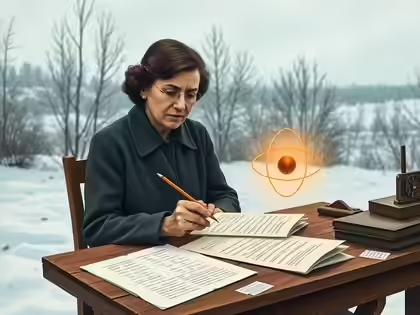
Typed “peitner” into a search bar and ended up a little confused? You’re not alone. Most people who search that word are really after Lise Meitner. The name sounds almost exactly like “peitner” when you say it fast, so the mix-up happens constantly.
- Quick Bio Table
- So Who Is the “Peitner” Everyone Searches For?
- Early Life and Family Background
- Education and First Steps in Physics
- The Work That Made “Peitner” Worth Remembering
- The Big Discovery: Nuclear Fission
- The Nobel Prize Snub
- Personal Life: What We Actually Know
- Later Years and Death
- The Legacy Behind the Name “Peitner”
- Common Questions People Ask
- Final Thoughts
Let me set the record straight. The person hiding behind that misspelling is Lise Meitner, an Austrian-Swedish physicist who helped crack one of the biggest scientific puzzles of the last century. And get this: she barely got any credit for it during her lifetime.
Quick Bio Table
Here’s a fast rundown before we dig into her life.
| Detail | Information |
|---|---|
| Full Name | Elise “Lise” Meitner |
| Born | November 7, 1878, Vienna, Austria |
| Died | October 27, 1968, Cambridge, England |
| Age at Death | 89 years old |
| Nationality | Austrian and Swedish |
| Field | Nuclear physics |
| Known For | Co-explaining nuclear fission |
| Notable Collaborator | Otto Hahn (and her nephew Otto Robert Frisch) |
So Who Is the “Peitner” Everyone Searches For?
The reason “peitner” shows up so much is pretty simple. People hear the name, type what they hear, and the spelling drifts. But the woman they’re actually looking for spent her entire life buried in the study of atoms and radioactivity.
Lise Meitner was one of the earliest scientists to dig into radioactive decay. She wasn’t a side character in physics history. She was front and center.
Early Life and Family Background
Lise came into the world on November 7, 1878, in Vienna. She was the third of eight kids in a Jewish family, so you can imagine the house was never quiet.
Her father believed every one of his children deserved a good education. When little Lise started showing a knack for math, he made sure she got private tutoring. That backing mattered more than anyone could have guessed at the time.
Growing Up in Vienna
Late-1800s Vienna wasn’t exactly welcoming to a girl who dreamed of becoming a scientist. Serious schooling for women was hard to come by.
But Lise didn’t take no for an answer. By 1901 she had made it into the University of Vienna, and that’s where physics grabbed hold of her for good.
Education and First Steps in Physics
Just getting through school took grit. Universities back then weren’t built for women, and she ran into plenty of walls. She climbed over every one of them.
She finished her doctorate in physics, something almost unheard of for a woman in those days. After that, she packed up and headed to Berlin to study under some of the sharpest minds around.
A New Chapter in Berlin
Berlin is where she crossed paths with chemist Otto Hahn. Little did they know they’d spend the next few decades working side by side. Their teamwork turned into one of science’s most well-known partnerships.
There was a catch, though. At first she had to work in a basement workshop because women weren’t truly welcome in the labs upstairs. That one fact tells you everything about the climb she faced.
The Work That Made “Peitner” Worth Remembering
This is where things really get going. For years, Lise and Otto Hahn poked at the secrets of radioactivity, watching how certain elements broke apart and released radiation.
In 1926, she became the first woman to hold a physics professorship in Germany. That wasn’t just a personal win. It cracked open a door for every woman in science who came after her.
Breaking Barriers as a Woman in Science
She battled prejudice her whole career. Being a woman was tough enough, and being Jewish in early-1900s Europe stacked the odds even higher against her.
Even so, the giants of the field respected her. Albert Einstein reportedly called her the “German Marie Curie,” and trust me, he didn’t hand out compliments like that for nothing.
The Big Discovery: Nuclear Fission
Now we reach the part the keyword “peitner” should really stand for. During the late 1930s, Lise and Otto Hahn were firing neutrons at uranium and watching what happened.
The numbers didn’t add up. Hahn handled the chemistry side, but he couldn’t make sense of the results. So he reached out to Lise.
How She Cracked the Puzzle
By that point, Lise had escaped Germany because the Nazi threat was closing in. She was stuck in Sweden, far from her lab, yet she kept chewing on the problem.
Together with her nephew, Otto Robert Frisch, she realized the uranium atom had actually broken into smaller pieces. They gave the process a name: nuclear fission. That moment changed science.
Why It Mattered So Much
This single discovery rewrote physics. It showed how a tiny atom could unleash an enormous burst of energy.
Down the road, that knowledge fed into both nuclear power plants and the atomic bomb. Lise wanted no part of weapons, though. She flat-out refused to help build one.
The Nobel Prize Snub
Here’s the part that still bothers a lot of people. In 1944, Otto Hahn took home the Nobel Prize in Chemistry for discovering nuclear fission.
Lise’s name? Nowhere on it. Plenty of folks back then, and ever since, call it one of the worst snubs in Nobel history. She handed them the explanation, and the prize went elsewhere.
Did She Get Any Recognition?
Some honors did come her way later on. In 1966, she shared the Enrico Fermi Award with Otto Hahn and Fritz Strassmann.
It wasn’t the Nobel, sure, but it proved the scientific world hadn’t forgotten her role. The gap between what she did and what she got, though, never fully closed.
Personal Life: What We Actually Know
A lot of people search for details about her marriage, kids, and family. So let’s keep it honest and straightforward.
Lise Meitner never married. There’s no record of a husband or children anywhere. She poured everything into her work.
Her Closest Family Ties
The tightest bond in her scientific world was with her nephew, Otto Robert Frisch, the same one who helped her explain fission. Family was woven right into her career.
She grew up in a big Jewish family in Vienna, but the names of each parent aren’t clearly confirmed in everyday sources. I’d rather not invent details, so I’ll leave it there.
Later Years and Death
Once the war ended, Lise stayed in Sweden for a good stretch. She kept working and stayed plugged into the physics community.
Eventually she relocated to Cambridge, England, to be closer to family. She passed away there on October 27, 1968, just weeks short of turning 90.
A Fitting Tribute
Her nephew wrote the words on her gravestone, describing her as a physicist who never lost her humanity. For a woman who refused to help make weapons, you couldn’t ask for a truer line.
The Legacy Behind the Name “Peitner”
So why should you still care about that “peitner” search today? Because her fingerprints are all over modern science.
In 1997, scientists named a chemical element after her: meitnerium, element 109. Having an element carry your name is about as high as honors get. Hardly anyone ever earns it.
Honoring Women in Science
These days, Lise Meitner stands as a symbol for the women in research history who got overlooked. Her name turns up in classrooms, books, and documentaries all over the globe.
And here’s the good news: her fame keeps growing, not fading. Bit by bit, the recognition she missed in life is finally catching up.
Common Questions People Ask
Let me knock out a few things people often wonder when they look up “peitner.”
Was Lise Meitner a real scientist? Yes, one hundred percent. She was a top nuclear physicist.
Did she invent the atomic bomb? Nope. She explained fission but turned down any work on weapons.
Why do people spell it “peitner”? It’s just a common misspelling of Meitner, based on how the name sounds.
Final Thoughts
The “peitner” you searched for is Lise Meitner, and her story deserves a lot more attention than it usually gets. She smashed through barriers, made history, and held onto her values even when the world treated her badly.
The Nobel she earned never came, yet her name lives on in physics textbooks and right there on the periodic table. Honestly, that’s a legacy most scientists would trade almost anything for. And now you know exactly who the real “peitner” was.
Continue reading: seo by highsoftware99.com: A Simple Guide to Understanding Its SEO Services