TL;DR
Bitcoin does not have a physical appearance. Unlike a dollar bill or metal coin, Bitcoin is a digital asset recorded on a decentralized network. When people show a picture of a gold-colored coin with a ₿ symbol, they are usually showing the Bitcoin logo or a physical novelty representation—not an actual Bitcoin.
You may see Bitcoin as:
- The orange-and-white ₿ Bitcoin logo
- A balance such as 0.005 BTC inside a wallet
- A Bitcoin address made of letters and numbers
- A QR code used to receive a payment
- A transaction displayed on a blockchain explorer
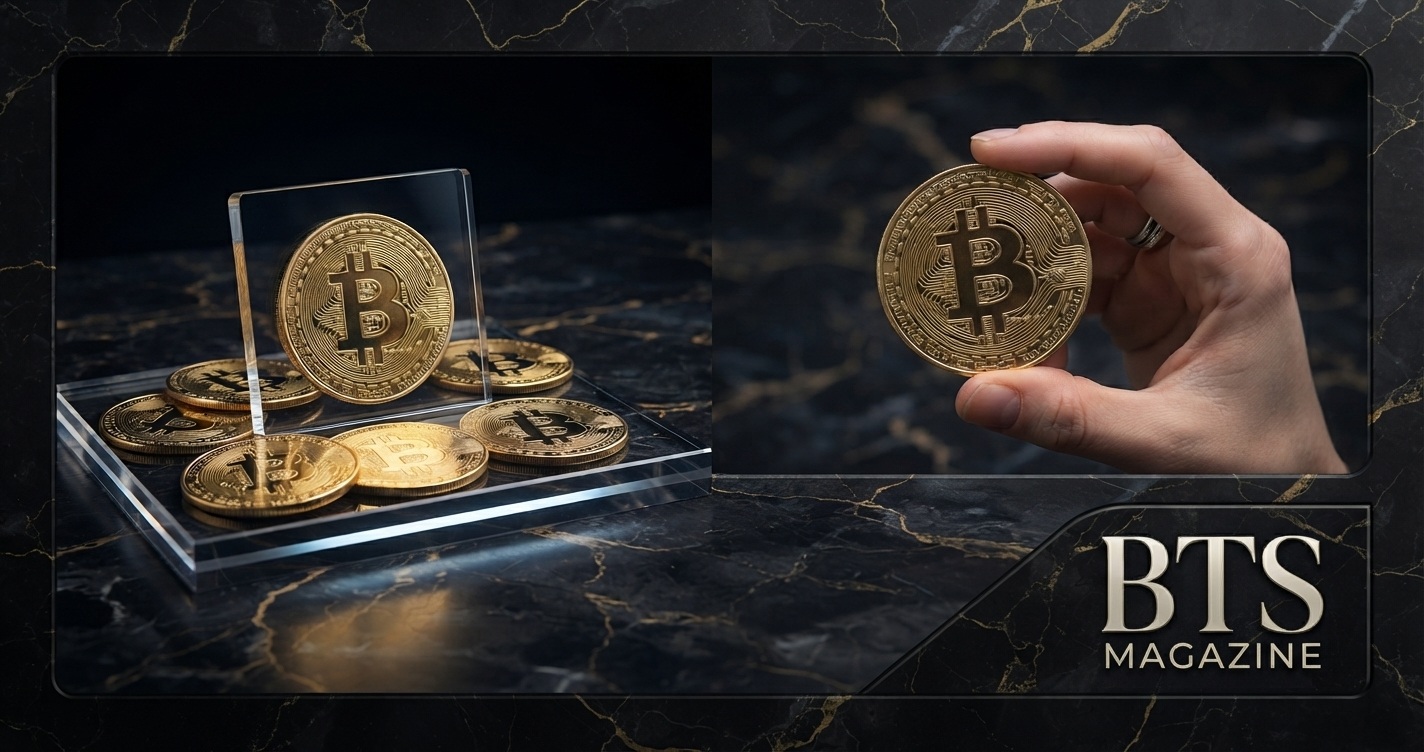
- A physical souvenir coin featuring the Bitcoin symbol
The important distinction is simple: the picture of Bitcoin is not Bitcoin itself.
Featured Snippet: What Does Bitcoin Look Like?
Bitcoin does not look like a traditional physical coin because it is a digital cryptocurrency. There is no official physical Bitcoin that exists as money in the way a dollar bill or metal coin does. Bitcoin is represented digitally through wallet balances, transaction records, addresses, QR codes, and the familiar ₿ symbol. Physical Bitcoin-themed coins sold as collectibles are representations of Bitcoin, not the Bitcoin recorded on the network. Bitcoin.org describes Bitcoin as a digital form of money operating through a peer-to-peer network rather than a central bank.
What Is Bitcoin?
Before answering what Bitcoin looks like, it helps to understand what Bitcoin actually is.
Bitcoin is a decentralized digital currency and payment network. It was introduced in 2008 through the Bitcoin white paper published under the name Satoshi Nakamoto, with the network becoming operational in 2009.
Unlike cash, Bitcoin isn’t printed by a government or manufactured at a mint. There is no central company producing physical Bitcoin coins.
Instead, Bitcoin exists through a combination of:
- A distributed network of computers
- A public blockchain
- Cryptographic signatures
- Digital wallet software
- Transaction records
- A consensus system used to verify transactions
Bitcoin.org explains that the network operates without a central authority or bank, with transactions and issuance managed collectively by the network.
So when someone asks, “What does Bitcoin look like?”, the most accurate answer is that it depends on what part of the Bitcoin system they mean.
What Does a Bitcoin Coin Look Like?
The most recognizable image of Bitcoin is a gold-colored coin bearing the letter ₿.
This image has become a visual shortcut for cryptocurrency. You will find it in news stories, exchange websites, advertisements, wallet applications, financial articles, and social media posts.
But there is an important catch.
That gold coin is not an actual Bitcoin.
It is an illustration or physical representation used to help people visualize something that otherwise has no physical form.
A typical Bitcoin-themed coin may have:
| Feature | What You Usually See |
|---|---|
| Color | Gold, bronze, or orange |
| Main symbol | ₿ |
| Shape | Round like a traditional coin |
| Purpose | Visual representation or collectible |
| Actual Bitcoin value | Usually none unless separately connected to a specific arrangement |
| Digital Bitcoin | Exists on the Bitcoin network, not inside the metal |
This distinction is especially important for beginners. Buying a decorative coin with the Bitcoin logo does not mean you have purchased BTC.
What Does the Bitcoin Logo Look Like?
The Bitcoin symbol is one of the most recognizable cryptocurrency symbols in the world.
It is written as ₿, with a capital B and vertical strokes running through it.
You may also see BTC, which is Bitcoin’s commonly used ticker symbol.
The symbol appears in many places, including:
- Cryptocurrency exchanges
- Mobile wallets
- Financial websites
- Price charts
- News articles
- Payment screens
- Bitcoin merchandise
- Educational graphics
The ₿ symbol represents Bitcoin, but the symbol itself is not a unit of Bitcoin.
Think of it like the dollar sign $. The symbol helps identify the currency, but the symbol itself isn’t money.
Does Bitcoin Have a Physical Form?
No—not in its normal form.
Bitcoin is a digital asset. You cannot hold one Bitcoin in your hand in the same way you can hold a $100 bill.
Bitcoin.org specifically addresses this point, explaining that Bitcoin is virtual and that its balances are maintained across a distributed network. Physical representations can exist, but they are not the same thing as the Bitcoin recorded on the network.
This is one of the easiest ways to understand Bitcoin:
A Bitcoin image is a representation. A Bitcoin balance is a digital record.
That difference matters when buying, sending, or storing BTC.
What Does Bitcoin Look Like in a Wallet?
For most Bitcoin users, this is what Bitcoin actually “looks like.”
Open a Bitcoin wallet and you might see something similar to:
Bitcoin Balance: 0.025 BTC
Under that balance, the wallet could display its equivalent value in a traditional currency.
For example:
0.025 BTC
Bitcoin address: bc1...
Receive: QR code
Send: payment address
The exact design depends on the wallet.
Bitcoin wallets can be mobile apps, desktop applications, hardware devices, or other forms of software. Bitcoin.org lists mobile, desktop, and hardware wallet options and notes that wallets provide different combinations of convenience, control, validation, privacy, and security.
So if you’ve never seen Bitcoin before, don’t expect to find a digital picture of a coin sitting inside the wallet.
You’ll normally see numbers, addresses, transaction records, and QR codes.
What Does Bitcoin Look Like on a Phone?
On a smartphone, Bitcoin often appears as a simple balance and payment interface.
A typical Bitcoin wallet may show:
- Your BTC balance
- A fiat-currency estimate
- A “Send” button
- A “Receive” button
- A QR code
- Your transaction history
- One or more Bitcoin addresses
For receiving money, the wallet can display a QR code that another person scans.
Bitcoin.org describes this scan-and-pay approach as one of the ways Bitcoin can be used for mobile payments.
This is probably the closest everyday answer to what Bitcoin looks like for someone who actually uses it.
What Does a Bitcoin Address Look Like?
A Bitcoin address looks nothing like a bank account number in a traditional banking app.
It is a string of letters and numbers used to identify where a payment can be sent.
Modern Bitcoin addresses can begin with combinations such as:
- bc1q
- bc1p
- 1
- 3
The exact format depends on the type of address.
For security reasons, users should never assume that an address is something they can casually modify. A single character error can cause serious problems when sending cryptocurrency.
Bitcoin.org also warns that Bitcoin payments are generally irreversible and recommends taking care when making transactions.
What Does a Bitcoin QR Code Look Like?
A Bitcoin QR code looks much like other QR codes: a square pattern made from small black and white blocks.
The difference is what the QR code represents.
A Bitcoin wallet can turn payment information into a QR code so another person can scan it instead of manually typing a long address.
This is especially useful for:
- In-person payments
- Shops accepting Bitcoin
- Donations
- Mobile-to-mobile transfers
- Reducing typing mistakes
The QR code is not Bitcoin itself. It is simply a convenient visual way of sharing payment information.
What Does Bitcoin Look Like on the Blockchain?
This is where Bitcoin becomes very different from ordinary money.
On the blockchain, Bitcoin appears through transaction records and blocks, rather than pictures of coins.
A transaction may contain information such as:
- Inputs
- Outputs
- Amounts
- Transaction identifiers
- Digital signatures
- Confirmation status
- Block information
The Bitcoin blockchain is a public distributed ledger. Bitcoin’s design allows network participants to independently verify transaction history rather than relying on a central bank or payment company.
In other words, the technical “appearance” of Bitcoin is closer to structured computer data than to a physical object.
Why Do People Picture Bitcoin as a Gold Coin?
This is mostly a matter of visual communication.
Bitcoin is abstract. You can’t photograph a digital balance in the same way you photograph a banknote.
A gold coin with a ₿ symbol solves that visual problem.
It gives readers an immediate image associated with:
- Money
- Value
- Cryptocurrency
- Digital finance
- Bitcoin
The image has become so familiar that people sometimes mistakenly believe Bitcoin actually exists as a physical coin.
It doesn’t.
The gold Bitcoin image is simply the easiest visual shorthand for something that lives digitally.
Physical Bitcoin Coins: Are They Real?
You can buy physical objects that look like Bitcoin.
Some are souvenirs, decorative coins, novelty products, or collectibles. Others have been created as physical Bitcoin-related products with different designs and purposes.
But you should not confuse these objects with BTC on the Bitcoin network.
Bitcoin.org notes that Bitcoin can be represented in physical form through products such as physical coins, while emphasizing that ordinary Bitcoin use remains digital.
A physical Bitcoin-shaped object does not automatically contain Bitcoin.
If someone tries to sell you a physical coin claiming it is “one Bitcoin,” verify exactly what you are buying before paying.
What Does Bitcoin Look Like Compared With Regular Money?
The differences become much clearer when Bitcoin is placed next to traditional money.
| Feature | Bitcoin | Traditional Cash |
| Physical object | No | Yes |
| Digital form | Yes | Increasingly common |
| Central issuer | No central Bitcoin authority | Usually central bank/government |
| Symbol | ₿ | Depends on currency |
| Transactions | Recorded on blockchain | Physical or electronic systems |
| Wallet | Digital wallet | Physical or bank wallet |
| Divisibility | Up to 8 decimal places on Bitcoin’s base unit | Depends on currency |
| Public transaction ledger | Yes | No public ledger for ordinary cash transactions |
Bitcoin.org states that Bitcoin uses peer-to-peer technology without a central authority or bank.
That doesn’t mean Bitcoin is simply “digital cash.” Its technical structure is different, particularly because transactions are recorded on a public blockchain.
What Is the Smallest Amount of Bitcoin You Can See?
You don’t need to own one whole Bitcoin.
Bitcoin can be divided into very small units.
The smallest commonly recognized unit is called a satoshi, equal to 0.00000001 BTC.
That means:
1 BTC = 100,000,000 satoshis
Bitcoin.org notes that Bitcoin can be divided to eight decimal places, making small-value transactions possible even though the total supply is limited.
This is another reason the physical-coin comparison can be misleading.
There isn’t a collection of tiny physical coins representing every fraction of BTC. The amount exists as digital accounting within the Bitcoin system.
Does Every Bitcoin Look the Same?
Not exactly.
If you’re talking about the Bitcoin logo, you’ll generally recognize the familiar orange branding and ₿ symbol.
If you’re talking about how Bitcoin appears in a wallet, the appearance depends entirely on the application or device.
If you’re talking about blockchain data, Bitcoin appears as transactions and cryptographic information.
So there are several visual versions of Bitcoin:
- Logo: ₿
- Illustration: Usually an orange or gold coin
- Wallet: BTC balance and transaction information
- Payment: QR code and address
- Blockchain: Digital transaction records
- Physical merchandise: Bitcoin-themed coin or object
None of these should be confused with Bitcoin being a physical object.
How Does Bitcoin Exist If You Cannot See It?
This is probably the biggest question behind the search “What does Bitcoin look like?”
The answer is that many things people use every day are represented digitally.
For example, money in an online bank account isn’t a stack of physical banknotes sitting inside your phone.
Bitcoin takes the concept further.
Bitcoin uses a decentralized network to maintain records of transactions. Copies of the blockchain are maintained by network participants, and cryptographic methods help secure ownership and transactions.
So you don’t need a physical Bitcoin sitting somewhere.
What matters is the valid record of ownership and the ability to authorize a transaction.
What Does Bitcoin Look Like When You Buy It?
When you purchase Bitcoin through a cryptocurrency platform, you normally won’t receive a physical coin.
Instead, your account may show:
BTC purchased: 0.01 BTC
The platform may also display:
- Purchase price
- Current market value
- Transaction history
- Deposit and withdrawal information
- Bitcoin address
- Network status
If you withdraw Bitcoin to a wallet you control, the wallet then displays your balance and transaction information.
This is why the experience can initially feel strange to someone accustomed to cash.
You bought something called Bitcoin, but nothing arrives in the mail.
That’s normal.
What Does Bitcoin Look Like When You Send It?
Sending Bitcoin usually involves a digital transaction.
The sender enters or scans the recipient’s Bitcoin address, chooses the amount, reviews the network fee, and authorizes the transaction.
The wallet then broadcasts the transaction to the Bitcoin network.
The recipient does not receive a gold coin.
Instead, the Bitcoin transaction changes the network’s accounting records so that the recipient can control the relevant funds.
Bitcoin’s original white paper describes the system as a peer-to-peer electronic cash system based on cryptographic proof rather than dependence on a trusted financial intermediary.
Common Misconceptions About What Bitcoin Looks Like
Bitcoin Is Not a Gold Coin
The gold coin is an illustration.
Bitcoin Is Not Stored Inside Your Phone
Your wallet provides tools for managing your Bitcoin. The Bitcoin itself is recorded through the network.
A Bitcoin QR Code Is Not Bitcoin
It’s a convenient representation of payment information.
A Bitcoin Logo Is Not a Bitcoin
The ₿ symbol identifies Bitcoin but has no monetary value by itself.
Physical Bitcoin Merchandise Is Not Automatically Cryptocurrency
A collectible coin can look authentic without representing actual BTC ownership.
These distinctions are worth remembering, especially when shopping online or dealing with someone who claims to sell “physical Bitcoin.”
What Does Bitcoin Look Like in Simple Terms?
If you want the simplest possible mental picture, imagine three layers.
Layer 1: The symbol
₿
This is the recognizable visual identity of Bitcoin.
Layer 2: The wallet
0.015 BTC
This is how a user’s Bitcoin balance may appear.
Layer 3: The network
A collection of transactions recorded and verified across a decentralized blockchain.
Put these three ideas together and Bitcoin becomes much easier to understand.
Is Bitcoin Anonymous Because You Cannot See It?
No.
This is another common misunderstanding.
Bitcoin is not automatically anonymous simply because it is digital.
Bitcoin.org explains that Bitcoin transactions are publicly recorded and that Bitcoin addresses do not inherently reveal a person’s real-world identity. However, information can sometimes connect an address to a person.
This is why Bitcoin is often better described as pseudonymous rather than completely anonymous.
The public can inspect blockchain activity, but the identity behind an address may not be immediately obvious.
What Should Beginners Look for When They See Bitcoin Online?
When you see an image of Bitcoin online, ask what it actually represents.
Is it:
- A logo?
- A stock image?
- A collectible coin?
- A wallet balance?
- A Bitcoin address?
- A QR code?
- A blockchain transaction?
This quick check can prevent a lot of confusion.
It’s especially useful because cryptocurrency websites frequently use coin graphics simply because they are visually easier to understand than cryptographic data.
Key Takeaways
- Bitcoin is digital, not a physical coin.
- The familiar ₿ symbol is Bitcoin’s visual identity.
- Gold-colored Bitcoin coins are generally illustrations, souvenirs, or collectibles.
- Bitcoin appears in wallets as BTC balances, addresses, QR codes, and transaction histories.
- Bitcoin transactions are recorded on a public blockchain.
- One Bitcoin can be divided into 100 million satoshis.
- A physical Bitcoin-themed coin does not automatically represent real BTC.
- Bitcoin operates through a decentralized peer-to-peer network rather than a central bank.
FAQ: What Does Bitcoin Look Like?
Does Bitcoin look like a real coin?
No. Bitcoin is digital. The familiar gold-colored coin with the ₿ symbol is a visual representation rather than the cryptocurrency itself.
What color is Bitcoin?
There is no official physical color for Bitcoin. Its branding is commonly associated with orange, while many illustrations depict it as a gold coin.
What does one Bitcoin look like?
One Bitcoin doesn’t have a physical appearance. Digitally, it can be represented as 1 BTC in a wallet or as part of transaction records on the Bitcoin network.
Can I hold a Bitcoin in my hand?
Not as a normal Bitcoin. You can hold a physical object designed to represent Bitcoin, but the actual cryptocurrency exists digitally.
What symbol represents Bitcoin?
The most recognizable symbol is ₿, while BTC is the commonly used ticker abbreviation.
What does Bitcoin look like in a wallet?
It generally appears as a numerical BTC balance alongside transaction history, addresses, QR codes, and payment controls.
Is a physical Bitcoin worth money?
Not automatically. A physical Bitcoin-themed coin may be a souvenir or collectible. Its appearance alone does not prove that it contains or represents actual BTC.
Final Thoughts
So, what does Bitcoin look like? The honest answer is that Bitcoin doesn’t look like anything physical. The famous orange or gold coin is simply a visual representation that makes an invisible digital asset easier to understand. In everyday use, Bitcoin looks more like a balance in a wallet, a long address, a QR code, and a collection of blockchain transaction records. Understanding this distinction is one of the first steps toward understanding how cryptocurrency actually works. For a deeper background on Bitcoin’s history, technology, symbol, and development, see the Bitcoin article on Wikipedia.