
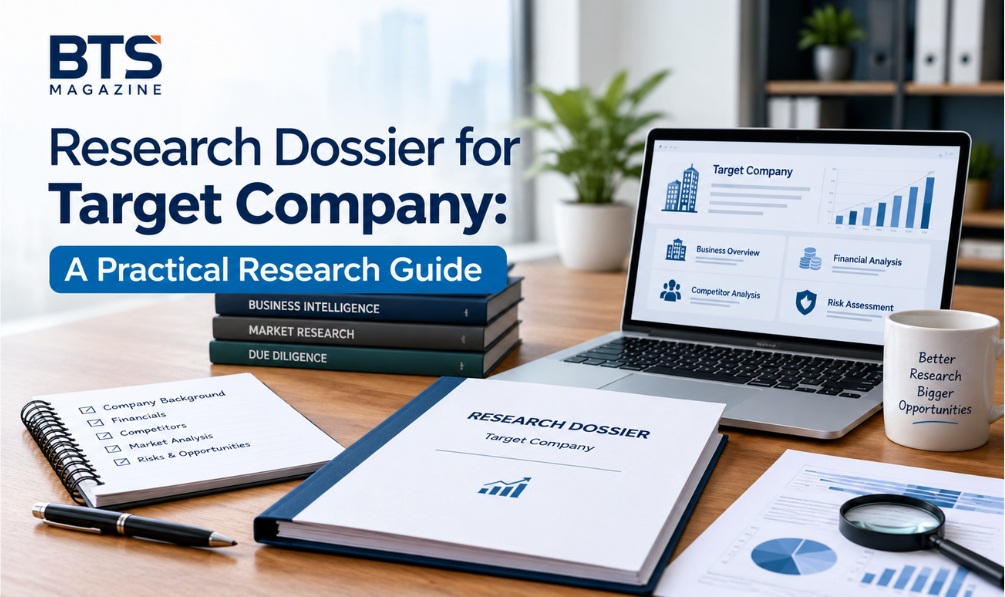
A Research Dossier for a Target Company is a structured report that brings together essential information about a business, including its background, ownership, financial performance, leadership, competitors, and potential risks. It helps investors, business owners, sales teams, consultants, and researchers make informed decisions before entering a business relationship or evaluating an opportunity.
Preparing a reliable dossier involves more than collecting information from a company website. You need to verify important claims, review credible sources, compare market data, and separate confirmed facts from estimates or assumptions.
In this guide, you will learn what a research dossier should include, how to prepare one step by step, which tools and sources can support your research, and how to use a practical template to organise your findings efficiently.

What Is a Research Dossier for a Target Company?
A Research Dossier for a Target Company is a detailed business research document created to investigate a specific organisation.
The word “target” simply identifies the company being researched. It does not necessarily refer to Target Corporation. The target could be a startup, private business, public company, supplier, competitor, potential customer, acquisition candidate, or strategic partner.
Depending on the purpose of the research, a dossier may contain:
- Company history and background
- Ownership and corporate structure
- Products and services
- Business model
- Financial performance
- Market and industry information
- Competitor research
- Leadership details
- Legal and regulatory information
- Technology and intellectual property
- Customer reputation
- Risks and opportunities
The scope should match the reason for the research. An investor may need more financial information, while an acquisition team may require detailed legal, tax, operational, and commercial research.
Before collecting information, define the decision the dossier needs to support. A supplier assessment, for example, may focus on delivery capacity, financial stability, and compliance. A competitor analysis may place more emphasis on products, pricing, market position, and customer groups.
For additional business and research-related reading, explore BTS Magazine.
What Is the Difference Between a Company Profile and a Research Dossier?
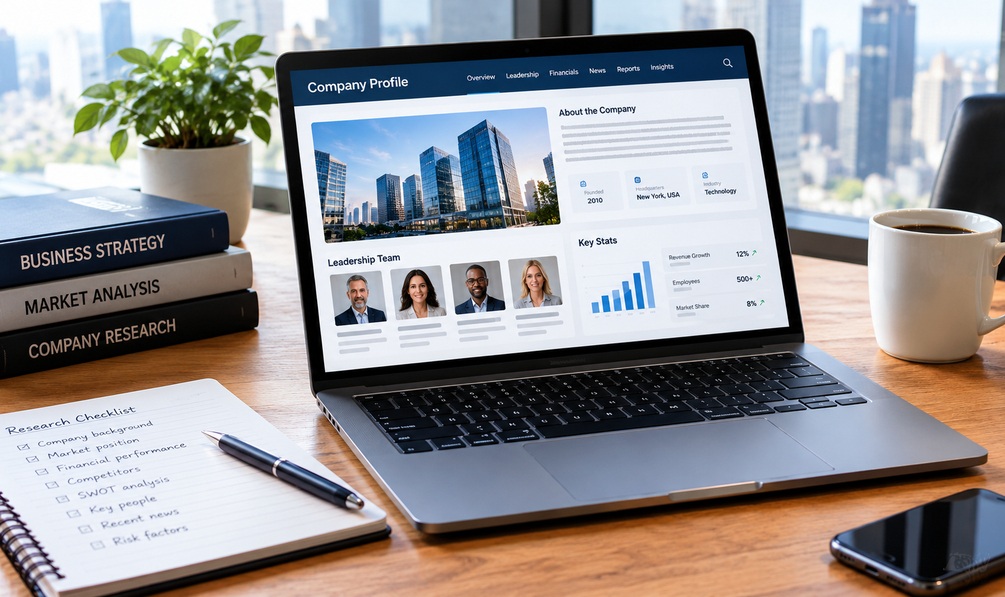
A company profile provides a general overview of a business, including its history, products, services, location, and leadership. A research dossier goes further by examining the company’s financial position, market performance, ownership structure, competitors, reputation, and potential risks.
A company profile is useful when someone needs a quick introduction to an organisation. A research dossier is more suitable for investors, business development teams, consultants, and decision-makers who need detailed information before taking action.
The main difference is depth. A profile explains what a company does, while a research dossier helps explain how the company operates, where it stands in the market, and what opportunities or risks may require further investigation.
A dossier is also different from formal due diligence. It can help organise preliminary findings, but a major investment, acquisition, or legal commitment may require specialist financial, legal, tax, or operational checks.
When assessing a company’s performance, researchers may need to interpret financial data rather than simply collect figures. For example, the BTS Magazine guide to cumulative abnormal return calculation explains a specific method used in financial research. Such analysis is relevant only when it fits the research objective; it is not necessary for every company dossier.
Research Dossier Template: Information to Include
A consistent template makes company research easier to organise, compare, and update. The following structure can be adapted for due diligence, sales prospecting, competitor analysis, investment research, or partnership evaluation.
1. Company Overview
Record the basic information needed to identify the organisation accurately.
- Registered company name and trading names
- Official website and relevant domains
- Registration number, where applicable
- Headquarters and operating locations
- Industry and main business activities
- Year established, if verified
- Products and services
- Main customer groups
Use the registered name and company number where available. Businesses can have similar names, and a trading name may differ from the legal entity.
2. Ownership and Leadership
Record publicly available information about the people and entities responsible for the company.
- Founders and current executives
- Parent company or subsidiaries
- Publicly disclosed ownership information
- Board members and relevant leadership experience
- Documented leadership changes
- Relationships between related businesses, where verified
Distinguish current leadership from former executives. Do not assume that a person owns a company merely because they founded it or appear in an older article.
3. Financial Information
Include financial data relevant to the purpose of the dossier.
- Reported revenue and profitability, where available
- Recent financial statements or annual reports
- Funding history and publicly disclosed investments
- Debt, liquidity, and other relevant financial indicators
- Reporting period and currency for each figure
- Important limitations in the available financial data
Do not present estimates as audited or reported figures. If a private company does not publish a particular number, mark it as unavailable unless a reliable source supports an estimate.
4. Market and Competitor Analysis
Examine the company’s position in its market.
- Main products and customer groups
- Direct and indirect competitors
- Pricing and distribution models
- Market position and documented competitive advantages
- Industry trends affecting future performance
- Barriers to entry or dependence on key suppliers
Competitor comparisons should use similar products, time periods, and measurement methods. A company’s own marketing claims can be useful leads, but they should not automatically be treated as independent proof of market leadership.
5. Reputation and Risk Assessment
Record evidence that could affect the company’s reliability, performance, or suitability for the intended relationship.
- Relevant legal or regulatory disclosures
- Credible reporting about major disputes
- Publicly documented operational or financial risks
- Customer complaints supported by reliable evidence
- Cybersecurity or data-protection issues, where documented
- Important gaps in available information
A complaint or allegation is not the same as a proven finding. Record the status of a dispute accurately and look for official decisions or reliable reporting before drawing conclusions.
6. Sources and Verification
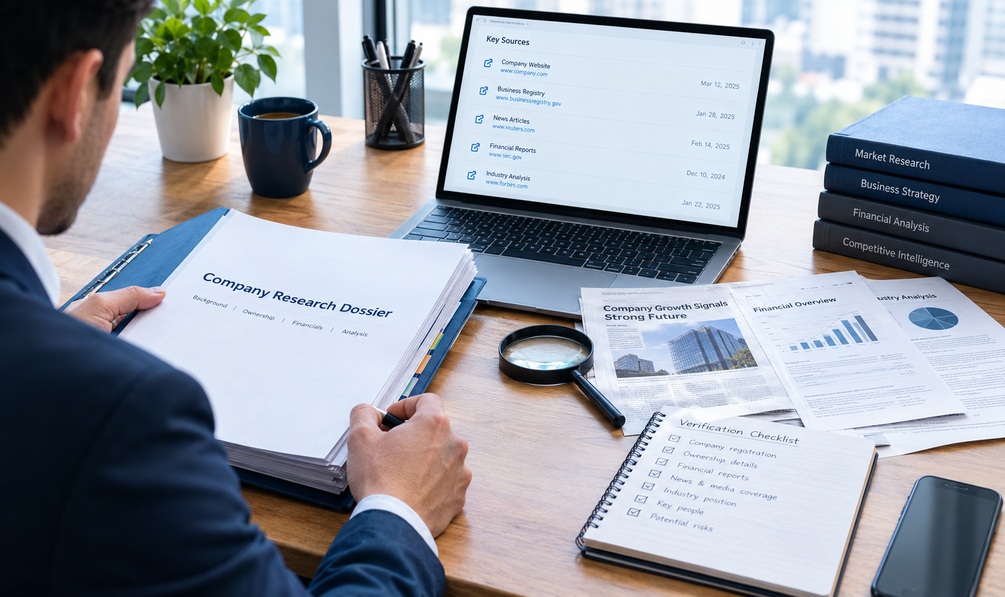
For each significant claim, record the source URL, publication date, date accessed, and verification status.
Use labels such as:
- Confirmed: Supported by an appropriate primary source or strong corroborating evidence.
- Reported: Published by a source that may be credible but is not the original record.
- Estimated: Calculated or inferred using a stated method and available evidence.
- Disputed: Conflicting evidence or unresolved claims exist.
- Unavailable: No sufficiently reliable information has been found.
These labels are a practical research method, not a universal legal standard. Explain your criteria so other readers can understand how conclusions were reached.
Free Tools and Official Sources for Company Research
The quality of a research dossier depends on the reliability of its sources. Start with original records wherever possible, then use reputable secondary sources to add context.
Official Company Websites
Review the company’s About page, leadership information, product pages, press releases, policies, and published reports. These sources can establish what the company says about itself, but independent verification may still be necessary.
Company Registries
Check registration details, filed accounts, directors, and ownership information where publicly available. The type of information available depends on the jurisdiction and the company’s legal structure.
For UK businesses, the Companies House register provides access to company records and filed documents. Companies House also states that it does not check the accuracy of the information filed, so registry information should not be treated as proof that every statement is correct.
Regulatory Filings
For companies required to report to the US Securities and Exchange Commission, the SEC EDGAR database provides free access to public filings. These may include annual reports, quarterly reports, registration statements, and other disclosures.
Use the correct regulator for the company’s country, listing status, and industry. Not every business will have SEC filings or publicly available financial statements.
Government and Statistical Websites
Use official statistics to understand the industry and market in which the company operates. Relevant data may include employment, trade, business activity, population, or economic indicators.
Make sure the figures relate to the correct country, industry classification, and reporting period.
Reputable Business News
Established news organisations can help identify acquisitions, leadership changes, disputes, product launches, and other important developments. Use news coverage to find leads, then check original documents or official statements where possible.
Company and Industry Databases
Commercial and free databases can help compare business information, identify potential competitors, and find leads for further research. Their records may be incomplete or outdated, so confirm important claims against original sources when possible.
For another example of research involving business conditions, stakeholders, and potential risks, see the BTS Magazine article about OTR Advisors and its research approach.
Remember that public information varies by jurisdiction and company type. Private businesses may not disclose the same level of financial detail as publicly listed companies.
How to Prepare a Research Dossier Step by Step
A repeatable workflow helps prevent important gaps and reduces the risk of including unsupported information.
Step 1: Define the Research Objective
Decide why you are investigating the company. Is the purpose to assess a supplier, identify a sales prospect, evaluate an investment, understand a competitor, or prepare for a possible acquisition?
Write down the key questions the report must answer. This keeps the research focused and prevents time being spent collecting irrelevant details.
Step 2: Confirm the Company’s Identity
Identify the correct legal entity before gathering detailed information. Check its official website, registered name, registration number, location, and any known parent or subsidiary companies.
If several businesses use similar names, keep their records separate until a reliable source confirms a relationship.
Step 3: Collect Primary Sources
Start with official filings, company reports, regulatory records, court or regulator publications where relevant, and original company announcements.
Save the source URL and date accessed. If the document is long, note the page, section, or filing reference that supports the claim.
Step 4: Add Independent Context
Use reputable news coverage, industry research, and credible databases to understand the wider business environment. Secondary sources can provide context, but they should not replace original records when the original evidence is available.
Step 5: Verify Important Claims
Compare material claims with the best available evidence. If two sources disagree, record the conflict instead of silently choosing the more convenient version.
A useful research habit is to separate what a source directly states from what you infer from it.
Step 6: Analyse Findings and Risks
Explain what the evidence means for the original research objective. For example, a change in revenue may matter to an investor, while delivery delays may be more important to a prospective customer.
Avoid presenting correlation, speculation, or an unverified allegation as a proven cause or fact.
Step 7: Write the Summary and Record Gaps
Summarise the most important findings, the evidence supporting them, and the questions that remain unanswered. A useful dossier does not need to make every uncertainty disappear; it needs to make those uncertainties visible.
Source Verification Table: A Practical Example
A verification table allows another person to review your work without repeating the entire research process.
| Claim or question | Source to check | Verification status | Next action |
|---|---|---|---|
| Legal company name | Official company registry | Confirmed only if the record matches the entity | Record registration number |
| Current executive | Company website and recent filings | Verify date and role | Check for newer announcements |
| Annual revenue | Filed accounts or official financial report | Record reporting period and currency | Compare with prior periods |
| Major legal dispute | Court or regulator records and credible reporting | Distinguish allegations from findings | Check the latest case status |
| Market position | Independent industry data and competitor evidence | May be an estimate or interpretation | State the method and limitations |
The entries above are examples of how to structure a dossier, not findings about a specific company.
For every important claim, ask three questions: Is the source appropriate for this claim? Is the information current enough? Does the evidence support the exact wording used in the report?
How to Assess Company Risks
Risk assessment helps researchers decide which issues need more attention. It should be based on evidence and the purpose of the dossier, not on assumptions about a company.
A simple method is to assess each risk using two separate questions:
- Likelihood: How plausible is the risk based on the available evidence?
- Impact: If it occurs, how seriously could it affect the decision being considered?
You can use a low, medium, or high rating for each dimension. If you choose to calculate a combined score, explain the scale and how the score is used. A score is a prioritisation aid, not proof that a risk will occur.
Potential areas to review include:
- Financial stability and payment concerns
- Dependence on a small number of customers or suppliers
- Regulatory or contractual obligations
- Operational capacity and supply-chain disruption
- Leadership or ownership uncertainty
- Reputation and documented legal issues
- Data security and privacy practices
- Gaps in critical information
Record the evidence behind each rating, the possible consequence, and any follow-up action. Avoid labelling a company as fraudulent, unsafe, or financially distressed without adequate evidence.
Practical Example of a Target Company Research Dossier
Consider a fictional business called Northstar Office Solutions, which supplies office equipment and workplace technology to small and medium-sized businesses.
A preliminary dossier might record the following findings:
- Business model: Supplies office equipment and related services to business customers.
- Customer groups: Small businesses, professional offices, and corporate buyers.
- Competitor research: Compare pricing, product range, delivery options, service agreements, and customer support with similar providers.
- Financial review: Examine published accounts or verified financial disclosures, if available.
- Reputation checks: Review credible customer feedback, relevant public records, and substantiated news reports.
- Outstanding questions: Record any missing financial figures, unclear ownership details, or unverified claims.
- Next steps: Identify which unanswered questions must be resolved before choosing a supplier or entering a contract.
This example illustrates the research process rather than making claims about a real company. In an actual dossier, every material finding should be supported by a source, and missing information should be clearly labelled instead of guessed.
How to Use AI for Company Research Without Trusting Unverified Claims
AI tools can help researchers organise notes, identify gaps, summarise lengthy documents, and develop questions for further investigation. However, AI-generated answers should not automatically be treated as verified company information.
Use AI to assist with research, not to replace source checking. Whenever a tool produces a financial figure, ownership claim, legal detail, or statement about a company’s performance, locate the original document or another credible source before including it in the final dossier.
A practical workflow is to:
- Collect source documents and record where each came from.
- Ask an AI tool to organise notes or identify unanswered questions.
- Check each important claim against the original evidence.
- Correct unsupported, outdated, or conflicting statements.
- Review the final report manually before sharing it.
Avoid uploading confidential business information, personal data, contracts, or non-public financial records to tools that are not approved for handling them. Follow your organisation’s data-protection rules and any relevant contractual obligations.
AI can speed up the organisation of research, but it cannot guarantee that a claim is true simply by presenting it confidently.
Privacy, Ethics, and Legal Boundaries in Company Research
Company research should rely on information you are entitled to access and use. Public availability does not automatically mean that every use of information is lawful or appropriate.
Use official records, legitimate databases, published company material, and reputable reporting. Respect applicable privacy and data-protection laws, website terms, copyright, and confidentiality obligations.
Do not attempt to access private accounts, bypass security controls, obtain confidential records without permission, or misrepresent your identity to obtain information. If the research involves personal data, sensitive commercial material, or a proposed transaction, seek appropriate professional guidance where necessary.
A well-prepared dossier should also minimise unnecessary personal information. Include only details relevant to the research objective and document any limitations that affect the conclusions.
How to Keep a Company Research Dossier Updated
A dossier can become outdated when a company changes its leadership, publishes new financial results, enters another market, or faces a significant legal or regulatory development.
To keep the report useful:
- Record when each source was accessed.
- Add the reporting period to financial figures.
- Review official company announcements and new filings periodically.
- Recheck important facts before major business decisions.
- Maintain a change log showing what was updated and why.
- Clearly distinguish historical information from current findings.
- Revisit unresolved questions when new evidence becomes available.
The review schedule should reflect the purpose of the dossier. A high-priority acquisition assessment may require frequent updates, while a general background report may need less frequent reviews.
Do not change the report date merely to make an old dossier look current. Update it when the underlying research has actually been reviewed or materially changed.
Copy-Ready Research Dossier Template
Use the following structure to create a first draft for a real company. Replace the bracketed fields with verified details and mark unavailable information clearly.
Target company: [Registered company name]
Trading name: [If applicable]
Official website: [Verified URL]
Registration number and jurisdiction: [If available]
Research purpose: [Investment, supplier review, competitor analysis, partnership, or other purpose]
Prepared on: [Date]
Last reviewed: [Date]
Executive Summary
- Main findings: [Summarise the most important verified points]
- Opportunities: [Evidence-supported opportunities]
- Key risks: [Evidence-supported risks]
- Important unknowns: [Information still missing]
- Recommended next steps: [Actions linked to the research objective]
Company Background
- Business activities: [Verified description]
- Products and services: [Details]
- Operating locations: [Verified locations]
- Ownership and leadership: [Documented details]
Financial and Market Review
- Financial information available: [Figures, currency, reporting period, and source]
- Main customer groups: [Evidence]
- Competitors: [Names and comparison criteria]
- Market context: [Relevant data and dates]
Risk Assessment
- Risk description: [Specific issue]
- Supporting evidence: [Source and date]
- Likelihood: [Low, medium, or high, with reasoning]
- Potential impact: [Low, medium, or high, with reasoning]
- Follow-up action: [What should be checked next]
Source Log
- Claim: [Exact claim being assessed]
- Source URL: [Link]
- Publication or filing date: [Date]
- Date accessed: [Date]
- Status: [Confirmed, reported, estimated, disputed, or unavailable]
- Notes: [Limitations, conflicts, or follow-up required]
This template is a starting point, not a substitute for specialist due diligence. Add or remove sections according to the company, jurisdiction, and decision being evaluated.
Frequently Asked Questions
What is a research dossier for a target company?
A research dossier for a target company is a structured report containing information about a business’s background, ownership, leadership, financial performance, competitors, reputation, and risks. It helps people evaluate a company before making business decisions.
What should a company research dossier include?
It should include a company overview, ownership and leadership details, financial information, market and competitor analysis, relevant legal or regulatory information, risk assessment, source records, and a summary of important findings and unknowns.
How do you research a target company?
Start by defining the purpose of your research. Confirm the company’s identity, review its official website, check relevant company registries and regulatory filings, examine its market and competitors, investigate credible news coverage, and verify important claims using reliable sources. Organise the findings into a structured report.
Which tools are useful for preparing a research dossier?
Official company registries, regulatory filing databases, government statistics, company websites, reputable news sources, and business intelligence platforms can all be useful. AI tools can assist with summarising and organising information, but important claims should be independently verified.
Can AI create a research dossier for a company?
AI can help prepare an initial draft, organise research notes, identify information gaps, and summarise documents. However, it can produce inaccurate or outdated information. Researchers should verify financial figures, ownership details, legal claims, and other important facts against credible sources.
How often should a research dossier be updated?
The schedule depends on the purpose of the report. Update it when significant changes occur, such as new financial results, leadership appointments, acquisitions, or regulatory developments. Review important information before relying on the dossier for a major decision.
Is a research dossier the same as due diligence?
No. A research dossier organises available information about a company, while due diligence is a more focused investigation carried out before a transaction, investment, acquisition, or other important commitment. A dossier can support due diligence, but it may not replace legal, financial, or specialist professional checks.
Can you prepare a dossier on a private company?
Yes, but the available information may be more limited than it is for a publicly listed company. Use legitimate public records, company disclosures, credible reporting, and other authorised sources. Clearly mark unavailable details rather than guessing or presenting estimates as confirmed facts.
What should you do if company information is conflicting?
Record the conflicting claims, identify the source and date of each, and look for primary evidence that can resolve the difference. If the conflict cannot be resolved, state that the information remains disputed and explain how it affects the conclusions.
Conclusion
A research dossier for a target company helps turn scattered business information into a clear, organised picture of an organisation. By reviewing company background, ownership, financial performance, competitors, reputation, and potential risks, researchers can make better-informed decisions and identify questions that require further investigation.
The most reliable dossiers combine official records, credible reporting, practical analysis, and transparent source verification. Use a consistent template, record when information was collected, and distinguish confirmed facts from estimates or unknown details.
Whether you are evaluating a potential partner, researching a competitor, or preparing for a business transaction, a well-maintained dossier provides a useful starting point for deeper analysis. Keep the information relevant to your objective and verify important findings before making consequential decisions.