

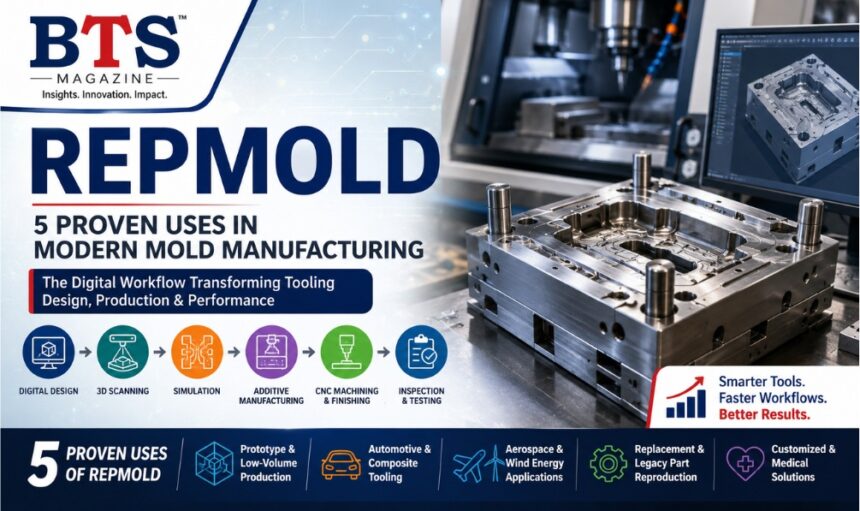
Repmold can be viewed as an emerging, informal term for a digitally integrated approach to creating, reproducing, evaluating, modifying, and manufacturing molds or molded components. Rather than describing one specific machine or manufacturing process, the concept brings several technologies together, including CAD modeling, 3D scanning, simulation, additive manufacturing, CNC machining, inspection, and production data management.
- What Is Repmold?
- Repmold Is a Workflow, Not a Single Manufacturing Process
- 1. Establish the Production Requirements
- 2. Generate or Capture the Geometry
- 3. Develop the Mold Design
- 4. Select the Manufacturing Method
- 5. Finish, Inspect, and Validate the Tool
- 1. Prototypes and Low-Volume Manufacturing
- 2. Automotive and Composite Tooling
- 3. Aerospace and Wind-Energy Applications
- 4. Replacement and Legacy Components
- 5. Customized and Medical Products
- Treating Repmold as a Specific Machine
- Selecting a Tool Only by Purchase Price
- Copying a Worn Component
- Ignoring Simulation
- Underestimating Finishing
- Accepting Unsupported Performance Claims
- Is Repmold a Real Manufacturing Technology?
- Is Repmold the Same as Injection Molding?
- Can Repmold Be Used for Mass Production?
- What Materials Can Be Used in Repmold Projects?
- Is Repmold Cheaper Than Traditional Mold Making?
- Related Wikipedia Resources
Unlike established processes such as injection molding, compression molding, or rotational molding, repmold is not currently a standardized technical process name. Instead, it is better understood as an umbrella concept related to recognized fields such as rapid tooling, additive tooling, digital manufacturing, and reverse engineering.
For background, see the relevant Wikipedia resources on additive manufacturing, computer-aided design, reverse engineering, and injection molding.
In practical terms, repmold describes a workflow in which digital information is used to develop, reproduce, repair, validate, or improve tooling.
What Is Repmold?
The meaning of repmold varies depending on the source or industry using the term. Some interpretations associate it with reproducing molds from existing master patterns, while others use it in connection with smart tooling, mold repair, rapid prototyping, or digitally controlled manufacturing.
A practical definition is:
Repmold is a digitally connected mold-development workflow that combines design, reproduction, modification, manufacturing, inspection, and validation to make tooling more flexible and efficient.
The process can begin in several ways. Engineers might start with a new CAD model, an existing mold, a physical master pattern, or a finished component that needs to be reproduced.
Depending on the project, the final result could be a prototype mold, a short-run production tool, a replacement insert, a casting pattern, a repaired mold section, or a digitally documented replacement tool.
Repmold Is a Workflow, Not a Single Manufacturing Process
One of the most important points is that repmold should not be confused with a specific manufacturing technique.
For example, injection molding is a production process in which material is injected into a mold. CNC machining removes material using computer-controlled equipment. 3D printing builds objects layer by layer. Reverse engineering reconstructs design information from an existing object.
Repmold can connect these technologies within one project.
| Technology or Concept | Primary Purpose | Possible Role in a Repmold Workflow |
| Injection molding | Producing parts inside a mold | Final manufacturing process |
| Rapid tooling | Creating usable tooling quickly | Core related concept |
| 3D printing | Producing objects directly from digital data | Making molds, patterns, or inserts |
| CNC machining | Precision material removal | Manufacturing and finishing tooling |
| Reverse engineering | Recovering geometry from existing objects | Creating starting design data |
| Repmold | Connecting digital tooling activities | Coordinates several methods |
The best approach depends on production volume, material, tool life, accuracy, pressure, temperature, and cost.
A polymer mold may be perfectly adequate for a small prototype run, while hardened steel may be necessary when a tool must survive hundreds of thousands of production cycles.
How a Repmold Workflow Operates
1. Establish the Production Requirements
The process should begin with the actual manufacturing requirement rather than with a particular technology.
Important factors include:
- Required dimensions and tolerances
- Molded material
- Expected production quantity
- Surface-finish requirements
- Operating temperature
- Injection or forming pressure
- Expected tool life
- Regulatory requirements
- Acceptable production cost
- Required delivery time
Without these specifications, it is difficult to determine whether a proposed tooling solution is genuinely faster or less expensive.
A low-cost mold that wears out after a few production cycles may ultimately cost more than a durable conventional tool.
2. Generate or Capture the Geometry
New products normally begin with a CAD model. Existing products, damaged tools, or legacy components may require dimensional inspection or 3D scanning.
Scanning can be especially useful when original design files are unavailable. However, a scan should not automatically be treated as a perfect representation of the intended design.
A worn edge, deformation, repair, or surface defect can become part of the digital model if it is copied without analysis.
Engineers therefore need to determine which characteristics represent the original design and which are the result of wear, damage, or previous modifications.
3. Develop the Mold Design
Once the geometry is established, it must be converted into appropriate tooling.
Depending on the molding process, the design may require:
- Draft angles
- Shrinkage allowances
- Parting lines
- Gates and runners
- Venting
- Ejector systems
- Cooling channels
- Inserts
- Clamping features
Simulation can then be used to identify potential manufacturing problems before the physical tool is produced.
Mold-flow analysis may help identify issues such as incomplete filling, air entrapment, weld lines, sink marks, uneven cooling, and warpage.
This type of virtual testing can reduce the number of physical iterations required during tooling development.
4. Select the Manufacturing Method
There is no single fabrication route for every repmold project.
Depending on the application, tooling can be:
- CNC-machined from aluminum
- Machined from steel
- Printed using polymer materials
- Additively manufactured using metals
- Produced from printed patterns
- Built as hybrid tooling
- Manufactured as modular inserts inside a conventional mold base
Additive manufacturing can sometimes eliminate intermediate pattern-making stages. For example, digitally produced sand molds and cores can be manufactured directly from CAD data.
Large-format additive manufacturing has also been investigated for applications such as composite tooling and wind-energy molds.
However, a successful result depends on much more than simply printing the geometry. Material selection, reinforcement, machining, sealing, heating, surface treatment, and inspection can all become important.
5. Finish, Inspect, and Validate the Tool
Newly printed or roughly machined tooling may require additional processing.
Typical finishing operations can include:
- Milling
- Sealing
- Coating
- Polishing
- Heat treatment
- Installation of inserts or hardware
Surface quality is particularly important because imperfections in the mold can transfer directly to the finished component.
Initial production trials provide another important checkpoint. Engineers can compare the physical results against the approved digital model and record dimensional deviations, defects, process conditions, and tool wear.
A well-managed digital record should ideally include the final CAD revision, machine settings, inspection results, material information, maintenance records, and documented changes.
This makes future repair and reproduction considerably easier.
Five Practical Areas Where Repmold Can Be Useful
1. Prototypes and Low-Volume Manufacturing
Rapid or hybrid tooling can be particularly useful when a product design is still changing or when expected production quantities are relatively small.
A company conducting an engineering trial, limited launch, or market test may not need an expensive mold designed for millions of cycles.
A shorter-life tool can provide real molded components while the product design continues to evolve.
This can reduce the financial risk of committing to permanent tooling too early.
2. Automotive and Composite Tooling
Automotive manufacturing uses tooling for prototypes, interior components, composite structures, forming applications, fixtures, and other production activities.
Digitally connected tooling can provide several potential advantages. A design can be revised digitally, damaged sections can potentially be reproduced, and replacement tooling can sometimes be manufactured closer to the location where it is required.
For composite applications, large-format additive manufacturing can also provide an alternative to traditional pattern and tooling methods.
The benefit is therefore not limited to faster production. Digital tooling can also support lighter structures, modular components, easier design revisions, and more controlled replacement processes.
3. Aerospace and Wind-Energy Applications
Large composite structures can require substantial tooling and long development cycles.
Additively manufactured tooling has been investigated for applications involving wind-turbine blades, aerospace components, and other large composite structures.
These applications demonstrate why repmold should not simply be interpreted as desktop 3D printing.
Industrial tooling may require:
- Large-format manufacturing equipment
- Reinforced materials
- Precision machining
- Protective coatings
- Heating systems
- Autoclave compatibility
- Dimensional verification
- Extensive testing
The appropriate solution depends heavily on the actual loads and environmental conditions the mold must withstand.
4. Replacement and Legacy Components
One particularly useful application is reproducing tooling or components for which original digital files no longer exist.
A company may still manufacture a product even though the original mold has become damaged, obsolete, or unavailable.
A repmold-style workflow can combine scanning, reverse engineering, redesign, modern tooling methods, and inspection to create a controlled replacement.
However, directly copying an old component can introduce problems.
For example, a molded component may have changed dimensions because of years of wear. Scanning it exactly could reproduce that wear instead of the intended geometry.
The replacement design therefore needs to consider:
- Original design intent
- Material shrinkage
- Mating surfaces
- Functional tolerances
- Clearances
- Wear
- Manufacturing requirements
This is where engineering judgment becomes more important than simply reproducing a digital surface.
5. Customized and Medical Products
Digital manufacturing can be valuable when tooling or components need to accommodate different users, dimensions, or designs.
Potential applications include customized supports, prosthetic components, dental models, positioning devices, and other limited-production products.
However, digital manufacturing does not automatically make a medical product safe or compliant.
Medical applications may require appropriate:
- Material traceability
- Validation
- Biocompatibility assessment
- Sterilization controls
- Quality systems
- Documentation
- Regulatory approval
Therefore, the manufacturing workflow must be evaluated together with the applicable medical and regulatory requirements.
Advantages and Limitations of Repmold
A well-designed repmold workflow can shorten design iterations, preserve tooling knowledge, simplify certain repairs, and make complex or customized tooling easier to manage.
Another advantage is digital revision control.
Instead of physically modifying a pattern without maintaining a clear record, engineers can update the approved model, simulate the change, manufacture the revised tool, inspect the result, and retain the revision history.
Nevertheless, digital and additive tooling have limitations.
Depending on the material and manufacturing process, printed tools may have lower:
- Pressure resistance
- Thermal stability
- Dimensional accuracy
- Surface quality
- Wear resistance
- Production life
For high-volume production, traditional tooling can remain more economical and reliable.
| Factor | Rapid or Hybrid Repmold | Conventional Tooling |
| Best application | Prototypes, repairs, bridge production, changing designs | Stable high-volume production |
| Initial lead time | Often shorter, depending on finishing | Often longer for complex tooling |
| Design modifications | Relatively flexible | Can become expensive after machining |
| Tool life | Depends on material and application | Can be engineered for very long service |
| Surface finish | May require additional finishing | Mature finishing methods available |
| Cost advantage | Often stronger at lower volumes | Often stronger at high production volumes |
| Major concern | Overestimating tool durability | Higher initial investment |
A Simple Five-Question Repmold Assessment
Before choosing this type of workflow, consider five questions:
- Is the product design still evolving?
- Is production volume relatively low, uncertain, or urgent?
- Can the selected tool material tolerate the required temperature, pressure, chemicals, and number of cycles?
- Can the important dimensions and surfaces be properly inspected?
- Can design files, revisions, process settings, and maintenance records be controlled?
A project that answers yes to the first two questions may be a strong candidate for rapid or hybrid tooling.
However, if the project cannot satisfy the final three requirements, the manufacturing strategy needs further evaluation.
This approach helps prevent organizations from choosing technology simply because it appears modern.
Cost, Speed, and Sustainability Considerations
There is no universal price for a repmold project.
The final cost can depend on:
- Tool size
- Geometry complexity
- Material
- Printing time
- Machining time
- Finishing
- Inserts
- Inspection
- Trial runs
- Expected service life
A more useful calculation is total delivered cost rather than the initial tooling price.
That calculation can include engineering labor, tooling, redesigns, scrap, downtime, maintenance, shipping, production efficiency, and launch delays.
Speed should also be evaluated from beginning to end.
A mold that can be printed within a short period may not provide a real advantage if it then requires extensive sealing, machining, polishing, repairs, and repeated trial runs.
Sustainability requires the same broad perspective.
Additive manufacturing can sometimes reduce material waste, eliminate intermediate tooling steps, reduce tool weight, or support localized production. However, the complete environmental impact also depends on energy consumption, failed builds, feedstock, finishing operations, service life, and disposal.
For that reason, claims about sustainable manufacturing should consider the entire lifecycle rather than focusing only on the fabrication stage.
Common Repmold Mistakes to Avoid
Several mistakes can reduce the value of a digitally connected tooling strategy.
Treating Repmold as a Specific Machine
Repmold should not automatically be interpreted as a proprietary machine, material, or single manufacturing system.
It is better understood as a workflow that can combine multiple established technologies.
Selecting a Tool Only by Purchase Price
The cheapest tool is not necessarily the least expensive solution.
Service life, maintenance, cycle time, quality, and replacement frequency all affect total cost.
Copying a Worn Component
A scan of an old part can capture defects and wear.
Engineers should distinguish between intended geometry and damage before using the scan to create replacement tooling.
Ignoring Simulation
Skipping flow, thermal, or structural analysis can lead to avoidable tooling problems.
Virtual analysis can identify many issues before physical manufacturing begins.
Underestimating Finishing
A mold can closely resemble the CAD model and still produce poor parts because of rough surfaces, inadequate venting, poor cooling, weak features, or unsuitable release conditions.
Accepting Unsupported Performance Claims
Suppliers should be able to explain the baseline behind claims involving reduced cost, shorter lead times, lower waste, or increased productivity.
A result demonstrated on one large composite mold should not automatically be presented as proof that the same improvement will occur with every injection-molding insert.
What Does the Future of Repmold Look Like?
The long-term value of repmold is less about the terminology and more about connecting different stages of the manufacturing process.
Future workflows are likely to place greater emphasis on:
- Digital mold records
- Automated design checks
- Hybrid tooling
- Modular inserts
- Conformal cooling
- Sensor-based monitoring
- Automated inspection
- Predictive maintenance
- Digital repair histories
Research into additively manufactured tooling is already exploring ways to integrate additional functionality directly into molds.
For manufacturers, the bigger opportunity is treating tooling information as a long-term digital asset.
A useful record could contain the approved geometry, material specifications, manufacturing parameters, inspection results, repair history, maintenance schedule, and known wear areas.
This information can make future reproduction or repair considerably more predictable.
Ultimately, the advantage will come from selecting and validating the right combination of technologies—not simply from adopting the term “repmold.”
FAQs
Is Repmold a Real Manufacturing Technology?
Repmold is best described as an emerging or non-standard term rather than a universally recognized manufacturing process. Related established concepts include rapid tooling, additive tooling, digital manufacturing, and reverse engineering.
Is Repmold the Same as Injection Molding?
No.
Injection molding is a specific manufacturing process used to produce parts by injecting material into a mold.
Repmold describes a broader workflow for designing, reproducing, modifying, repairing, manufacturing, and validating tooling.
Can Repmold Be Used for Mass Production?
It can support high-volume manufacturing when the resulting mold or insert is engineered to withstand the required temperature, pressure, wear, and production cycle count.
However, conventional steel tooling may remain the better option for very large production volumes.
What Materials Can Be Used in Repmold Projects?
Depending on the application, projects may involve:
- Tool steel
- Aluminum
- Printed metals
- Reinforced polymers
- Resins
- Silicone
- Sand-based mold systems
- Composite materials
The correct choice depends on the manufacturing process and expected tool conditions.
Is Repmold Cheaper Than Traditional Mold Making?
Sometimes.
It can be financially attractive for prototypes, repairs, design changes, bridge production, and relatively small production quantities.
For stable, high-volume manufacturing, conventional tooling can provide better economics because of its long service life and established production capabilities.
What to Do Next
The best way to evaluate repmold is to treat it as a decision-making framework rather than a guaranteed cost-saving technology.
Begin by defining the part requirements, production volume, material, expected tool loads, tolerances, and validation requirements.
Then compare possible approaches, including CNC machining, additive manufacturing, casting, conventional tooling, and hybrid solutions.
Before selecting a supplier, request clear information about:
- Proposed tool material
- Expected cycle life
- Tolerance strategy
- Surface-finishing method
- Inspection procedure
- Revision-control process
- Maintenance requirements
- Comparable project experience
These details provide a much better basis for selecting a tooling solution than broad claims about smart or next-generation molding.
Related Wikipedia Resources
For readers who want to understand the established technologies behind the repmold concept, these Wikipedia resources provide useful background:
- 3D Printing / Additive Manufacturing
- Computer-Aided Design (CAD)
- Computer Numerical Control (CNC)
- Reverse Engineering
- Injection Moulding
- Composite Material
- Rapid Prototyping
Read also: 7 Best Travel Investing Strategies to Grow Your Money