

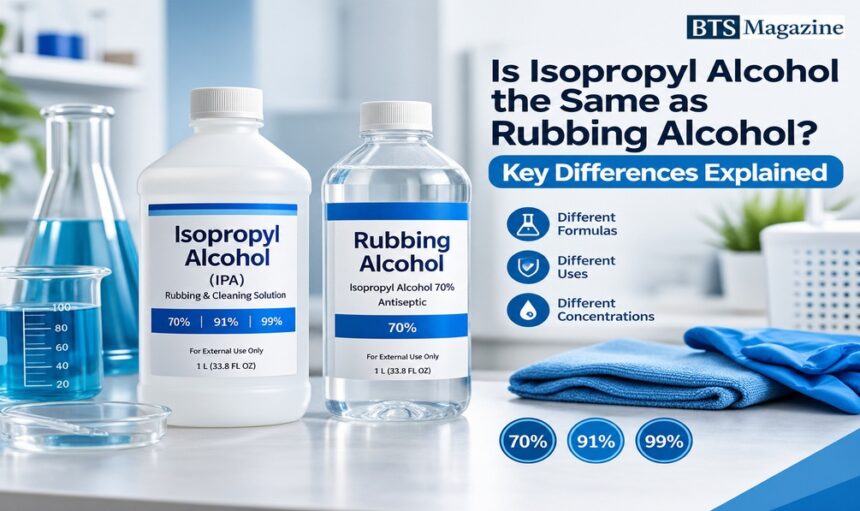
If you have ever compared bottles of isopropyl alcohol and rubbing alcohol, you may have wondered whether they are actually the same product. The names are often used interchangeably, but there is an important distinction between the chemical itself and the finished product sold as rubbing alcohol.
- What Is Isopropyl Alcohol?
- What Is Rubbing Alcohol?
- Is Isopropyl Alcohol the Same as Rubbing Alcohol?
- Is 70% Isopropyl Alcohol the Same as 70% Rubbing Alcohol?
- Why Is 70% Alcohol Commonly Used?
- Is 91% or 99% Isopropyl Alcohol Rubbing Alcohol?
- Common Uses of Isopropyl Alcohol
- Common Uses of Rubbing Alcohol
- Is Rubbing Alcohol Safe on Skin?
- Isopropyl Alcohol vs. Rubbing Alcohol: Quick Comparison
- Safety Tips When Using Either Product
- Frequently Asked Questions
- Can I use isopropyl alcohol instead of rubbing alcohol?
- Is 70% isopropyl alcohol rubbing alcohol?
- Is rubbing alcohol always made with isopropyl alcohol?
- Is 99% isopropyl alcohol better than 70%?
- Can you drink rubbing alcohol?
- Final Answer: Are They the Same?
In many cases, rubbing alcohol contains isopropyl alcohol mixed with water, often at a concentration such as 70%. However, rubbing alcohol can also contain additional ingredients, and its exact formulation depends on the product.
So, is isopropyl alcohol the same as rubbing alcohol? Not always. Isopropyl alcohol is a specific chemical, while rubbing alcohol is generally a prepared product that may contain isopropyl alcohol.
What Is Isopropyl Alcohol?
Isopropyl alcohol, also called isopropanol or 2-propanol, is a clear, flammable chemical alcohol. You can learn more about its chemical properties and uses on Wikipedia’s Isopropyl Alcohol page. It is widely used in manufacturing, cleaning products, disinfectants, cosmetics, and other applications.
Pure or highly concentrated isopropyl alcohol is much stronger than the rubbing alcohol commonly sold for household use. It is normally diluted for many practical applications.
One important point is that isopropyl alcohol is not the same type of alcohol found in alcoholic drinks. Beverage alcohol is ethanol, whereas isopropyl alcohol is a different chemical compound.
What Is Rubbing Alcohol?
Rubbing alcohol is a prepared alcohol-based product intended primarily for cleaning, disinfecting, and other practical applications.
Many rubbing alcohol products contain isopropyl alcohol and water. Some formulations may also include additional ingredients depending on their intended purpose. Medical News Today notes that many common rubbing alcohol products contain around 70% isopropyl alcohol.
The exact concentration should always be checked on the product label because rubbing alcohol is available in different strengths.
Is Isopropyl Alcohol the Same as Rubbing Alcohol?
Not exactly.
The easiest way to understand the difference is:
- Isopropyl alcohol = a specific chemical substance.
- Rubbing alcohol = a formulated product that commonly contains isopropyl alcohol plus water and sometimes other ingredients.
- 70% rubbing alcohol = typically 70% isopropyl alcohol and about 30% other components, commonly water.
- Some rubbing alcohol products can use different alcohol formulations, so the label matters.
This means the terms should not automatically be treated as exact synonyms.
At the same time, everyday usage can make the distinction confusing. Cleveland Clinic describes rubbing alcohol as a mixture of isopropyl alcohol and water and notes that it is available in several strengths.
Is 70% Isopropyl Alcohol the Same as 70% Rubbing Alcohol?
They can be very similar, but you should still check the label.
If a bottle specifically says 70% isopropyl alcohol, it means the product contains isopropyl alcohol at that concentration.
A bottle labeled 70% rubbing alcohol commonly uses isopropyl alcohol as its active alcohol, with the remainder primarily consisting of water and potentially other ingredients.
Therefore, two products with the same percentage may have similar uses, but their formulations are not necessarily identical.
Why Is 70% Alcohol Commonly Used?
Higher alcohol concentration does not automatically mean better disinfecting performance.
For many disinfection applications, alcohol works effectively within a particular concentration range because water can help the alcohol interact with microorganisms. Cleveland Clinic notes that rubbing alcohol commonly comes in strengths ranging from 50% to 90% and identifies 70% as a useful concentration for many household applications.
The appropriate concentration depends on what you are cleaning and the instructions provided for the specific product.
For this reason, simply choosing the strongest alcohol available is not always the right approach.
Is 91% or 99% Isopropyl Alcohol Rubbing Alcohol?
This depends on how the product is labeled and formulated.
91% and 99% isopropyl alcohol are highly concentrated forms of isopropyl alcohol. They are commonly sold for cleaning, technical, laboratory, manufacturing, or electronics-related purposes.
A product does not automatically become “rubbing alcohol” simply because it contains isopropyl alcohol. The term refers to the formulation and intended product category.
Always read the bottle’s label before using a high-concentration product on skin, household materials, or electronic equipment.
Common Uses of Isopropyl Alcohol
Isopropyl alcohol has many applications, including:
- Cleaning certain hard surfaces
- Manufacturing and industrial processes
- Producing cosmetics and personal-care products
- Cleaning some equipment and components
- Serving as an ingredient in disinfecting products
- Certain laboratory applications
Its suitability depends heavily on its concentration and the material being cleaned.
For example, alcohol can damage some finishes, coatings, plastics, or other sensitive materials. Cleveland Clinic specifically cautions that alcohol may damage certain surfaces, including some porous materials.
Common Uses of Rubbing Alcohol
Rubbing alcohol is commonly kept in homes for practical cleaning and disinfecting tasks.
Depending on the product label, potential uses include:
- Cleaning certain household surfaces
- Disinfecting appropriate objects
- Cleaning some tools
- Cleaning certain electronic-device surfaces when manufacturer instructions permit it
- General household cleaning
Cleveland Clinic lists applications involving items such as thermometers, tools, phones, keyboards, and other household objects, while also emphasizing appropriate precautions.
However, not every rubbing alcohol product is suitable for every surface or purpose.
Is Rubbing Alcohol Safe on Skin?
This is where extra caution is important.
Rubbing alcohol can cause dryness, irritation, and discomfort, particularly when used repeatedly or on sensitive skin. It should not be treated as a general-purpose skin-care product.
More importantly, rubbing alcohol should never be swallowed and should not be used as a home treatment for fever. Cleveland Clinic warns that applying rubbing alcohol to the body for fever can lead to dangerous alcohol absorption and poisoning.
For any medical or first-aid use, follow the product’s directions or advice from a qualified healthcare professional.
Isopropyl Alcohol vs. Rubbing Alcohol: Quick Comparison
| Feature | Isopropyl Alcohol | Rubbing Alcohol |
|---|---|---|
| What is it? | A specific chemical alcohol | A formulated alcohol product |
| Chemical name | Isopropanol / 2-propanol | Usually contains isopropyl alcohol |
| Typical formulation | Can be highly concentrated | Usually diluted with water |
| Common strengths | 70%, 91%, 99%, and others | Varies by product |
| Household use | Depends on concentration and label | Common household cleaning uses |
| Additional ingredients | May be absent in simple formulations | May contain water and other ingredients |
| Safe to drink? | No | No |
Safety Tips When Using Either Product
Both isopropyl alcohol and rubbing alcohol are flammable. Keep them away from cigarettes, flames, sparks, and high-heat sources.
Follow these basic precautions:
- Read the label before use.
- Use alcohol products in a well-ventilated area.
- Keep them away from children and pets.
- Never drink or ingest them.
- Avoid contact with the eyes.
- Do not use them near an open flame.
- Do not assume that a high concentration is appropriate for every job.
- Check manufacturer instructions before applying alcohol to electronics or delicate surfaces.
Cleveland Clinic also warns against mixing rubbing alcohol with bleach because this combination can produce dangerous toxic fumes.
Frequently Asked Questions
Can I use isopropyl alcohol instead of rubbing alcohol?
Not automatically. Check the concentration, ingredients, and intended use of the product first. A high-concentration isopropyl alcohol product may not be an appropriate substitute for a formulated rubbing alcohol product.
Is 70% isopropyl alcohol rubbing alcohol?
A 70% isopropyl alcohol product may be sold as rubbing alcohol, but the terms describe slightly different things. Isopropyl alcohol is the chemical, while rubbing alcohol is a formulated product.
Is rubbing alcohol always made with isopropyl alcohol?
No. The formulation can vary, so check the product label to determine which alcohol it contains.
Is 99% isopropyl alcohol better than 70%?
Not necessarily. The appropriate concentration depends on the intended application. Higher concentration does not automatically mean better disinfecting performance.
Can you drink rubbing alcohol?
No. Rubbing alcohol is not beverage alcohol and can cause serious poisoning if swallowed. Keep it away from children and use it only according to the product instructions.
Final Answer: Are They the Same?
So, is isopropyl alcohol the same as rubbing alcohol?
No, not exactly. Isopropyl alcohol is a specific chemical, while rubbing alcohol is a prepared product that commonly contains isopropyl alcohol diluted with water. Many household rubbing alcohol products use around 70% isopropyl alcohol, but formulations and concentrations can vary.
The safest approach is to read the product label rather than relying on the name alone. The concentration, ingredients, and intended use determine whether a particular alcohol product is suitable for cleaning, disinfecting, or another purpose.
Read also: Research Dossier for a Target Company: A Practical Guide to Business Research