

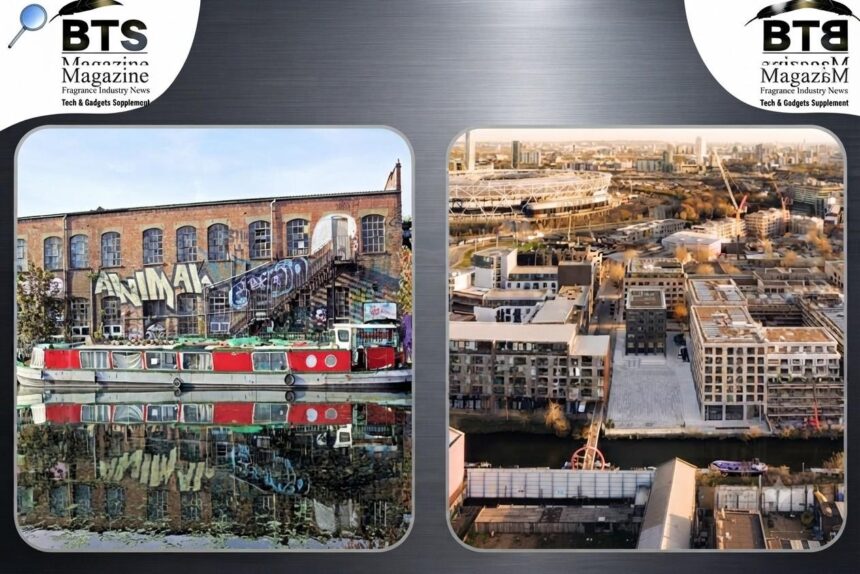
Fish Island London doesn’t get nearly enough attention. Tucked into a bend along the River Lea in east London, it’s the kind of place that rewards the curious — layered with history, buzzing with creativity, and quietly transforming before everyone’s eyes. This post covers everything you need to know: where it is, how it got its unusual name, what it’s like to live there, and why it’s genuinely worth a visit.
- Where Exactly Is Fish Island London?
- A Brief History of Fish Island
- Why Is It Called Fish Island?
- Fish Island and the London Borough of Tower Hamlets
- Fish Island as a Conservation Area
- The Connection Between Fish Island and Hackney Wick
- The Creative Scene in Fish Island London
- Street Art and Culture in Fish Island
- Living in Fish Island London
- Things to Do in Fish Island London
- Getting to Fish Island London
- Fish Island and the Olympic Legacy
- Why Fish Island London Is Worth Visiting
- Final Thoughts: A Neighbourhood That Earns Its Reputation
- Frequently Asked Questions About Fish Island London
Whether you’re a Londoner who’s never ventured past Hackney Wick or a visitor trying to get off the tourist trail, this guide has you covered.
Where Exactly Is Fish Island London?
Fish Island sits in the London Borough of Tower Hamlets, roughly 4.5 miles southwest of Charing Cross. Its boundaries are defined by a mix of water and road infrastructure — the River Lea runs along its eastern edge, the A12 separates it from Bow to the west, and the Hertford Union Canal marks part of its northern boundary.
The area falls within the E3 and E20 postcode districts and borders the Queen Elizabeth Olympic Park to the east — which is a big part of why it’s seen so much investment and attention over the past decade or so.
Here’s the thing most people get wrong: Fish Island is not actually in Hackney. It’s often grouped with neighbouring Hackney Wick, but the two areas sit in different boroughs. Fish Island is firmly Tower Hamlets territory.
A Brief History of Fish Island
The land that would become Fish Island has been inhabited for a very long time. Archaeological evidence points to Roman settlements in the area, with finds including pottery, coins, animal bones, and burial sites recorded by the London and Middlesex Archaeological Society (LAMAS). The Roman road linking London to Colchester — known as Pye Road — likely crossed the River Lea right around where Fish Island now sits.
By the time of the Domesday Book in 1086, the wider area was recorded as Old Ford and listed as part of the Manor of Stepney.
From Marshland to Industrial Powerhouse
Fast forward to the late 18th and early 19th centuries: the Hackney Cut and the Hertford Union Canal were carved into the local marshes, and railway lines followed. That’s when things really took off. Crown Wharf — the area’s oldest industrial site — was developed from 1853 onwards, initially hosting a wallpaper works and then an ironworks.
By the end of the 19th century, Fish Island London had become one of London’s largest waterside industrial areas. The waterways were essential — raw materials arrived by canal, and finished goods headed out the same way. Processing plants for crude oil and coal tar lined the Hertford Union Canal, followed by factories producing printing ink, rubber, and dry cleaning materials.
The area had around 6,000 residents at its peak — mostly workers and their families living in poor conditions.
War Damage and Post-War Decline
World War II hit Fish Island hard. Many buildings were destroyed or seriously damaged during the Blitz. After the war, industrial activity shifted toward low-employment uses like waste disposal, timber yards, and warehousing. Most of the population left. By the 1970s, the area was almost entirely light industrial and largely abandoned.
The Artist Influx
Then came the 1990s — and everything changed. Artists started moving in, converting neglected warehouses into studios and live-work spaces. The rents were low, the spaces were vast, and the location was surprisingly well-connected. Fish Island London and neighbouring Hackney Wick became known for having one of the highest densities of artists in Europe, with around 600 artists’ studios recorded in the area by 2009, according to the London Legacy Development Corporation.
Why Is It Called Fish Island?
This is one of the most common questions people ask — and the answer is genuinely interesting.
Fish Island is not, despite what the name might suggest, an actual island. The “island” part comes from the fact that local residents historically referred to the area as “the Island” — likely because it was bounded on multiple sides by waterways and railway lines, giving it a geographically isolated feel.
The “fish” part? That came from the Gas Light and Coke Company, which purchased a 30-acre plot of surplus railway land in 1865 and used it to build a small factory town complete with housing and multi-storey factories. The network of new roads they built were given the names of freshwater fish — Dace Road, Bream Street, Roach Road — and over time, the combination of “the Island” and the fishy street names gave birth to the name Fish Island.
Fish Island and the London Borough of Tower Hamlets
Administratively, Fish Island falls within the London Borough of Tower Hamlets and the parliamentary constituency of Stratford and Bow. The electoral ward it sits within is Bow East.
What’s interesting is that the council’s Fish Island Area Action Plan considers part of the Queen Elizabeth Olympic Park — specifically the portion belonging to Tower Hamlets — as part of Fish Island, making it the northeasternmost section of the borough.
Tower Hamlets has been central to shaping the area’s recent regeneration through planning documents like the Fish Island Area Action Plan (2012), which identified the neighbourhood as a key regeneration zone.
Fish Island as a Conservation Area
Fish Island is one of 58 designated conservation areas in the London Borough of Tower Hamlets. That status matters. It reflects the area’s significance to Britain’s industrial heritage — even if there are no formally listed buildings within it.
The conservation area designation means development is more carefully controlled, and the character of the historic warehouse buildings is protected. Many of those Victorian and Edwardian brick structures are the same ones that once housed ink manufacturers, rubber processors, and ironworks. Today, they’re studios, galleries, restaurants, and apartments.
It’s that tension between preservation and regeneration that makes Fish Island so visually compelling. Old and new sit side by side in a way that feels organic rather than forced.
The Connection Between Fish Island and Hackney Wick
Fish Island and Hackney Wick share a lot — similar character, overlapping creative culture, and a shared story of transformation from industrial decline to creative renaissance. They border each other, and the boundary between them can feel invisible on the ground.
But here’s the key distinction: Hackney Wick sits in the London Borough of Hackney, while Fish Island belongs to Tower Hamlets. Despite being separated by nothing more than a canal and an administrative line on a map, they operate under different local authorities.
The confusion is understandable — and common. Fish Island is often described as part of Hackney Wick, but they are technically distinct neighbourhoods. What they share is a history, an aesthetic, and a reputation as one of east London’s most creatively fertile corners.
The Creative Scene in Fish Island London
The creative energy in Fish Island London is hard to overstate. What started as artists taking advantage of cheap warehouse space in the 1990s has evolved into a fully fledged cultural ecosystem.
The London Centre for Book Arts has been based at the Britannia Works building — part of Space Studios — since 2012. It promotes book arts and artist-led publishing, offering printing, binding, and publishing facilities that are genuinely rare in a city where space comes at such a premium.
Fish Island Labs, launched in 2014 as a partnership between tech hub The Trampery and the Barbican Centre, brought together 40 to 50 participants to share affordable workspace for arts and technology projects over a ten-month period.
Heritage with a Creative Twist
The Heath Studio is another example of the area’s layered character. The site dates back to 1853 — originally a wallpaper works, then a paper staining operation, later an ironworks. Today it functions as a premier venue and gallery space used for photography, fashion, commercial, and film projects. The walls have stories.
Street Art and Culture in Fish Island
Walk along Dace Road or cut through the canal paths and you’ll see it immediately — Fish Island London is an outdoor gallery. Murals stretch across entire warehouse facades. Tags, paste-ups, and large-scale works cover almost every available surface.
The area has attracted internationally recognised street artists over the years, drawn by the same qualities that attracted studio artists before them: space, freedom, and a community that values creative expression.
It’s also worth noting that Channel 4’s The Big Breakfast was broadcast from the Lock Keeper’s Cottage at Fish Island from 1992 to 2002 — a piece of TV history most people don’t associate with the area at all.
Living in Fish Island London
Regeneration from 2016 onwards brought significant residential development to Fish Island. Large mixed-use buildings went up, more are planned, and property prices followed the trajectory that comes with this kind of transformation. The Daily Telegraph called Fish Island London “the new Shoreditch” in 2016 — a comparison that draws on Shoreditch’s own gentrification story from the late 1990s.
To be honest, that label cuts both ways. On one hand, it signals that the area has arrived — it’s desirable, well-connected, and culturally rich. On the other, it raises familiar concerns about displacement of the artists and working communities that made it attractive in the first place.
Living here means being close to Victoria Park, the Queen Elizabeth Olympic Park, and Hackney Wick’s busy food and drink scene. The canal paths provide genuinely beautiful walking routes. It’s not quiet, but it has a grounded, neighbourhood feel that newer developments in the city often lack.
Things to Do in Fish Island London
There’s more to do here than many people realise:
- Explore the canal towpaths along the Hertford Union Canal and the River Lea — great for cycling and walking
- Visit the London Centre for Book Arts for workshops, exhibitions, and a look at genuine craft in action
- Check out The Heath Studio for gallery events and exhibitions in a beautifully historic space
- Street art hunting along Dace Road and surrounding streets
- Head to nearby Hackney Wick for independent coffee shops, breweries, and weekend food markets
- Walk to the Queen Elizabeth Olympic Park — it’s right on the doorstep
The area rewards wandering. Some of the best discoveries happen when you stop following a map.
Getting to Fish Island London
The closest railway station is Hackney Wick on the London Overground. From there it’s a short walk across the canal into Fish Island proper.
For those coming from central London, the journey is straightforward — the Overground runs frequently, and the area is also accessible by bus via the A12 corridor. Cyclists will find the canal routes pleasant and direct, particularly from Stratford, Victoria Park, or Bethnal Green.
Driving into the area is possible but not the most practical option — the A12 creates barriers, and parking is limited near the canal-side areas.
Fish Island and the Olympic Legacy
The 2012 London Olympics fundamentally shaped the modern identity of Fish Island. The proximity of the Queen Elizabeth Olympic Park brought council attention, investment, and regeneration planning that completely restructured what the area looked like and who lived there.
Fish Island and Hackney Wick were both identified by local councils as key regeneration zones in the lead-up to the Games. Infrastructure improved, new residential and commercial buildings went up, and the area’s profile rose dramatically.
The Olympic legacy is visible everywhere — not just in the London Stadium visible from Dace Road across the River Lea, but in the quality of public realm, the new bridges and footpaths, and the mixed-use developments that now define parts of the neighbourhood.
Why Fish Island London Is Worth Visiting
A lot of London’s most interesting neighbourhoods get talked about until they lose what made them interesting. Fish Island hasn’t quite reached that point.
The industrial heritage is still legible in the bones of the buildings. The creative community is still active. The canal paths are still peaceful in the early morning. And the sense that you’re seeing a place in real-time transformation — rather than one that’s already been fully packaged — gives it an energy that’s genuinely hard to find.
What’s interesting is how much is packed into such a small area: Roman history, Victorian industry, post-war decline, a 1990s artist exodus, Olympic regeneration, and an ongoing creative scene. Most London neighbourhoods have one good story. Fish Island has about six.
Final Thoughts: A Neighbourhood That Earns Its Reputation
Fish Island London sits at an unusual crossroads — historic enough to be protected as a conservation area, yet dynamic enough to be reshaping itself in real time. It’s not trying to be anything other than what it is, and that authenticity is exactly what makes it worth your time.
If you want to go deeper on the area’s history, geography, and administrative detail, the Wikipedia entry for Fish Island, London is a solid reference point that covers the ground thoroughly.
Go soon. Bring comfortable shoes, a willingness to get a little lost, and an appetite — Hackney Wick’s food scene is right next door.
Frequently Asked Questions About Fish Island London
Is Fish Island actually an island?
No — Fish Island is not a literal island. The name evolved from locals calling the area “the Island” due to its geographic isolation by waterways and railway lines, combined with the fish-named streets (Dace Road, Bream Street, Roach Road) laid out by the Gas Light and Coke Company in the 1860s.
What borough is Fish Island in?
Fish Island is in the London Borough of Tower Hamlets, not Hackney. It falls within the Bow East electoral ward and the parliamentary constituency of Stratford and Bow.
Is Fish Island the same as Hackney Wick?
No, they are two distinct neighbourhoods. Fish Island belongs to the London Borough of Tower Hamlets, while Hackney Wick is in the London Borough of Hackney. They share a similar character and creative scene and border each other closely, which often leads to them being grouped together.
What is Fish Island conservation area?
Fish Island is one of 58 designated conservation areas in the London Borough of Tower Hamlets. The designation protects the area’s industrial heritage buildings — mainly Victorian and Edwardian brick warehouses — even though there are no formally listed buildings within the area.
How do I get to Fish Island London by public transport?
The easiest route is via Hackney Wick station on the London Overground, which is a short walk from Fish Island. The area is also accessible by bus and is well-served by cycling routes along the canal towpaths.
When did Fish Island become popular?
Fish Island began attracting artists in the 1990s when cheap warehouse rents made it accessible for creative communities. Its profile rose significantly in the early 2000s with regeneration linked to the 2012 London Olympics, and it gained widespread media attention from around 2016 onwards when outlets began calling it “the new Shoreditch.”
Continue reading: What Is Sustainable Fashion and Why Does It Actually Matter?