
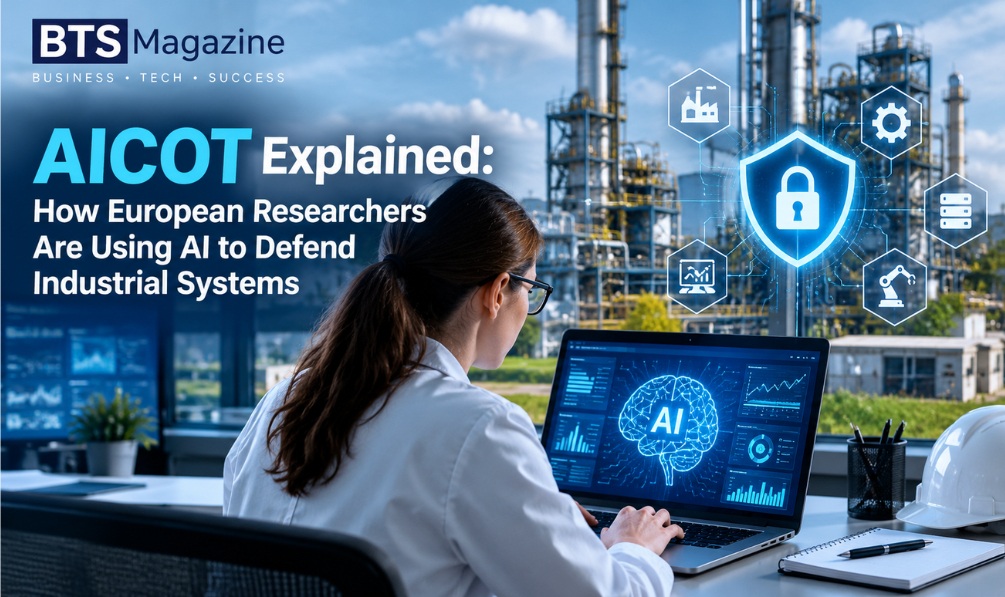
Critical infrastructure quietly keeps daily life running. Power grids supply electricity, water networks serve homes and cities, factories produce essential goods, and transport links connect people with work and trade. However, many of these services rely on aging digital equipment that was never designed to face today’s cyber threats.
AICOT is a European research project created to tackle this weakness. Its purpose is to build an AI-powered defense platform for Operational Technology (OT). The platform should help operators catch threats early, make sense of strange behavior, and react without disrupting the industrial processes they depend on.
The project brings together artificial intelligence, security monitoring, threat intelligence, and analysis tailored to OT. Its core idea is straightforward: protection for critical systems must be built by people who understand how real machines, industrial networks, and physical processes behave.
What Exactly Is AICOT?
AICOT is a cyber defense initiative that uses AI to protect OT environments within critical infrastructure. It targets systems where software directly controls or monitors physical equipment.
Operational technology covers pumps, turbines, control panels, sensors, production machinery, and industrial controllers. You will find these across the energy, water, transport, and manufacturing sectors.
The work is financed by the European Union’s Digital Europe Programme under grant agreement number 101249826. It also supports wider European ambitions for stronger cyber resilience and greater digital independence.
Why OT Demands Its Own Security Approach
Conventional IT security focuses on laptops, servers, cloud platforms, and corporate networks. OT security carries a different responsibility, because it must safeguard physical systems that often cannot afford to stop.
A manufacturer cannot simply halt a production line every time a patch becomes available. A grid operator cannot manage a control network the way an office manages its computers. At every stage, safety, availability, and predictable machine behavior come first.
Many industrial sites also run legacy devices and specialized protocols, and some equipment stays in operation for decades. That creates weak points which ordinary IT tools often fail to handle properly.
The Role of Artificial Intelligence in AICOT
The project applies AI to help security teams recognize patterns that might indicate an attack. Machine learning models can study how a network normally behaves and flag shifts that depart from routine operations.
This is valuable against threats that fixed rules struggle to catch. An odd command, unexpected device behavior, or irregular data flow can look minor in isolation, and AI-driven analysis can link such clues together.
AICOT also investigates generative and adversarial AI to improve detection. One of its stated aims is to uncover stealthy attacks and potential zero-day threats before they spread further.
Anomaly Detection
Anomaly detection searches for activity that departs from a known normal baseline. In an industrial setting, that could be a device communicating at the wrong moment, an uncommon command, or a sudden jump in traffic.
Context gives this method its strength. An event that seems harmless on a regular office network may be far more dangerous inside a plant or control system.
SIEM and Security Data
AICOT builds upon existing SIEM and data analytics capabilities. SIEM stands for Security Information and Event Management, and it gathers security data so teams can examine alerts, logs, and suspicious events in a single location.
The project layers OT-specific intelligence on top of this process. That addition is important because industrial environments use protocols and devices that standard business networks rarely encounter.
When security logs are merged with OT data, operators should gain a clearer picture of what is going on. This can lead to quicker detection and sounder decisions during an incident.
OT Protocol Analysis
Industrial equipment commonly communicates through protocols like Modbus, DNP3, PROFINET, and IEC 61850. These standards allow machines, controllers, and other devices to exchange information.
An effective OT defense platform has to understand this traffic. It must know what ordinary commands look like and recognize when a deviation may signal misuse.
Safeguarding Critical Infrastructure
AICOT focuses on sectors where a cyberattack can produce physical consequences and affect the public. Official project material names energy, transport, water, and manufacturing as key OT environments.
A successful attack in these fields can do far more than steal information. It might halt production, interrupt a public service, damage equipment, or put people’s safety at risk.
This is why early detection carries so much weight. Security teams need enough advance notice to investigate a threat before it travels across connected systems.
Secure Sharing of Cyber Threat Intelligence
Cyber Threat Intelligence (CTI) lets organizations learn from past attacks, indicators, tools, and adversary behavior. When this knowledge is shared, everyone’s defenses improve.
Trust is the obstacle. Operators may hold sensitive details about their networks, incidents, or vulnerabilities, and they are often reluctant to reveal them to outsiders.
To address this, AICOT intends to enable privacy-focused CTI sharing through blockchain-based techniques. The project presents this as a route to greater trust, auditability, and safe exchange between organizations.
Why European Digital Sovereignty Matters
Europe also wants firmer control over the technologies that protect its essential services. Heavy reliance on vendors from outside the region can expose it to supply chain, policy, and strategic risks.
AICOT advances this aim by concentrating on cybersecurity technology developed within Europe. The project seeks tools that are interoperable, reusable, and matched to European needs.
Digital sovereignty is not about isolation. It means building strong domestic capability, relying on trusted technology, and keeping more options open when designing critical security systems.
Real-World Testing and Pilot Validation
A security platform meant for industry must perform beyond the laboratory. It has to cope with genuine equipment, authentic network behavior, and strict operational boundaries.
AICOT intends to trial its platform in realistic OT pilot environments. According to official project goals, the target is Technology Readiness Levels 7 to 8, which means the work is aimed at a system able to function under demanding, near real-world conditions.
Testing also lets teams gauge scalability and ease of use. A tool may spot threats accurately, yet operators still need understandable alerts and workable response options.
What Security Teams and Operators Stand to Gain
The project could give security teams much better visibility across industrial networks. This matters because OT sites often contain numerous older, specialized, vendor-specific devices.
AI-based detection may also lessen the dependence on fixed signatures alone. As a result, teams could notice behavior that has never appeared on any known threat list.
AICOT might further simplify connecting OT defense with existing security operations. A modular design would let organizations add new capabilities without replacing every tool already in place.
Challenges AICOT Has to Overcome
AI is helpful, but it is no magic shield. Industrial security tools require accurate data, clear explanations, and thorough testing. A false alarm wastes valuable time, while a missed event can cost much more.
OT environments also vary widely between sites. A water treatment plant, a rail network, and a factory may each use different devices, protocols, and operating rules. A practical platform must adjust to each without introducing fresh risk.
Data is another hurdle. AI models learn from relevant examples, yet labelled OT attack data is scarce. To help train and evaluate its detection methods, the project plans to use domain-specific data along with synthetic and adversarial samples.
AICOT and the Future of OT Cybersecurity
AICOT mirrors a broader trend in industrial security. Operators are moving away from basic perimeter defense and toward continuous monitoring, richer threat intelligence, and faster detection.
AI can drive this change most effectively when it works alongside human expertise. Security teams must still weigh risk, understand operations, and choose how to respond.
The most promising model will probably pair automation with clear human oversight. In safety-critical settings, speed counts, but trust and explainability count as well.
Conclusion
AICOT addresses one of Europe’s most pressing security challenges: defending the digital systems that run real-world infrastructure. Its method blends AI, OT protocol analysis, SIEM data, threat intelligence, and secure information sharing.
The project also serves a larger goal. It aims to build European cyber capability while producing tools that can hold up in demanding industrial conditions.
Should its pilots succeed, the platform could become a practical template for more proactive OT defense. The real measure will be whether it can detect threats early while remaining dependable, transparent, and safe for critical operations.
Read also: Понуде in English: Meaning, Uses, and the Best Translations