

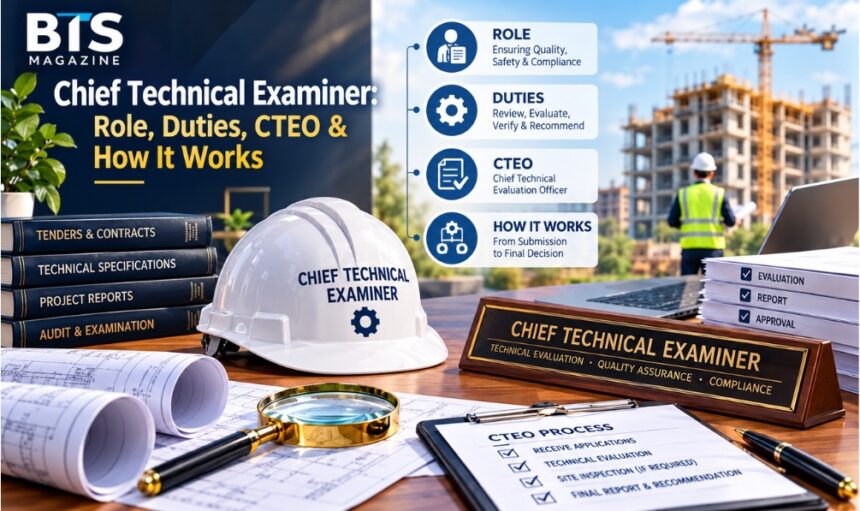
A Chief Technical Examiner (CTE) is a senior technical officer associated with India’s public procurement and vigilance framework. The position is mainly concerned with examining government contracts, procurement procedures, project quality, costs, measurements, and the use of public funds.
- What Is a Chief Technical Examiner?
- History of the Chief Technical Examiners’ Organisation
- How CTEO Works Under the Central Vigilance Commission
- CTEO Structure and Technical Teams
- Main Duties of a Chief Technical Examiner
- What Types of Contracts Can CTEO Examine?
- What Is an Intensive Examination?
- How Are Contracts Selected for Examination?
- How a CTE Examination Works
- Review Before Tendering
- Review of Tendering and Contract Award
- Examination During Contract Execution
- Bills, Payments, and Completion
- Common Problems Found During Technical Examination
- What Happens After a CTE Examination?
- Chief Technical Examiner vs Chief Vigilance Officer
- Role in Vigilance and Procurement Prevention
- Skills and Knowledge Required
- Challenges in Technical Examination
- Why the Chief Technical Examiner Role Matters
- Bottom Line
- Frequently Asked Questions
Many people search for the meaning of Chief Technical Examiner because they want to understand the Chief Technical Examiners’ Organisation (CTEO) and its connection with the Central Vigilance Commission (CVC). The role involves detailed technical reviews of selected procurement cases and can cover everything from project planning and tendering to execution, billing, and final acceptance.
This guide explains what a Chief Technical Examiner does, how the CTEO developed, what types of contracts it examines, how Intensive Examination works, and what happens after technical observations are made.
What Is a Chief Technical Examiner?
A Chief Technical Examiner is a senior technical officer associated with the Chief Technical Examiners’ Organisation, which functions as the technical arm of the Central Vigilance Commission.
The main responsibility is to provide specialist technical examination of selected government procurement and contract cases. Depending on the case, an examination can cover the original estimate, technical approvals, tender process, contract award, execution, measurements, quality, bills, and payments.
The position should not be confused with the engineer who directly manages a project. A project engineer may be responsible for construction or technical supervision, while a procurement official may handle the tendering process. The Chief Technical Examiner provides an additional technical review, particularly from a vigilance and procurement perspective.
The role is also not restricted to construction sites. Technical examination may involve specifications, contract conditions, rates, quantities, measurements, testing, payments, and procurement procedures.
The basic objective is to determine whether public procurement was carried out properly and whether the organisation received the goods, services, or work for which it paid.
History of the Chief Technical Examiners’ Organisation
The Chief Technical Examiners’ Organisation (CTEO) was established in 1957 under the then Ministry of Works, Housing and Supply.
Initially, its technical examination activities were mainly associated with projects undertaken by the Central Public Works Department (CPWD). The broader objective was to encourage economy in government expenditure and strengthen technical and financial controls.
Over time, the organisation’s responsibilities expanded.
The Santhanam Committee, which considered measures for preventing corruption, recommended strengthening the technical examination system and widening its scope beyond its original area of activity.
In 1964, the CTEO came under the administrative control of the Central Vigilance Commission. As government procurement became larger and more complex, another Chief Technical Examiner position was created in 1979.
Public procurement has changed substantially since the organisation was established. Government bodies now purchase sophisticated equipment, software, IT systems, professional services, consultancy, machinery, and many other products and services.
As a result, CTEO’s technical work is no longer limited to conventional civil engineering projects. Its examination can extend across works, goods, supplies, services, and other forms of public procurement.
How CTEO Works Under the Central Vigilance Commission
The Central Vigilance Commission forms an important part of India’s vigilance framework for organisations falling under its jurisdiction. The CTEO provides the specialist technical knowledge required by the Commission.
This technical expertise can be useful when an issue cannot be understood completely from financial or administrative records alone.
For example, a payment may appear correctly recorded in an organisation’s accounts. A physical inspection, however, could reveal that the quantity completed at a site is lower than the quantity recorded in the bill. Similarly, supplied materials may not meet contractual specifications, or tender requirements may have unnecessarily restricted competition.
The CTEO can examine procurement cases involving central government ministries and departments and other organisations covered by the applicable CVC framework. This can include certain central public sector organisations and public-sector financial institutions.
In this way, technical examination can help determine whether an apparent issue is simply an administrative or technical matter or whether it requires additional attention within the vigilance system.
For broader background on India’s vigilance framework, readers can also refer to the Central Vigilance Commission on Wikipedia.
CTEO Structure and Technical Teams
The available material describes the CTEO as being headed by two Chief Technical Examiners holding the rank of Chief Engineer.
The organisation’s work is broadly divided according to technical fields. One stream primarily handles civil and horticulture procurement, while another can deal with electrical and mechanical matters, supply contracts, IT procurement, consultancy, services, and transport-related contracts.
A Chief Technical Examiner does not personally perform every technical check. The organisation has technical officers and supporting personnel who assist with document reviews, field inspections, measurements, testing records, and other examination activities.
The technical structure may include:
- Technical Examiners (TEs)
- Assistant Technical Examiners (ATEs)
- Junior Technical Examiners (JTEs)
- Supporting staff
Different types of procurement require different forms of technical knowledge. A building inspection involves different checks from an IT system, medical device, industrial machine, or consultancy contract.
This division of technical expertise allows examination teams to focus on the requirements relevant to the procurement being reviewed.
Main Duties of a Chief Technical Examiner
The central responsibility of a Chief Technical Examiner is to oversee and support the technical examination of selected public procurement cases.
An examination can begin at the planning stage. The team may review whether the estimated quantities are reasonable, whether specifications are appropriate, and whether the rates used in an estimate have adequate support.
Technical sanctions and approvals may also be compared with the work eventually tendered and executed. This can help identify major changes that lack sufficient technical justification or approval.
The tender process is another important area. A technical examination may consider:
- Tender conditions
- Technical specifications
- Bid requirements
- Price comparisons
- Evaluation of bids
- Contract award
- Negotiations, where applicable
After the contract is awarded, the examination may continue into actual execution. Depending on the nature of the contract, officers can review:
- Contract scope
- Approved rates
- Quantities and measurements
- Materials
- Workmanship
- Testing records
- Site documentation
- Variations and changes
- Bills and payments
- Completion records
- Acceptance documents
For construction contracts, physical inspection can be particularly useful. Technical officers may compare drawings, measurements, test results, materials, and workmanship with the information contained in official records.
The Chief Technical Examiner may also review significant observations prepared by technical examination teams before they move through the relevant vigilance process.
Another important function is preventive vigilance. If an examination identifies a weakness in an organisation’s procurement procedures, the organisation may be able to improve its tendering, documentation, testing, or contract-management practices and reduce the chance of similar issues occurring again.
What Types of Contracts Can CTEO Examine?
The scope of CTEO is considerably broader than traditional civil construction.
Depending on the procurement case and applicable framework, technical examination can involve:
- Civil works
- Horticulture works
- Electrical contracts
- Mechanical contracts
- Supply and store purchases
- IT procurement
- Consultancy
- Professional services
- Transport contracts
- Equipment and machinery
The specific examination depends on what the government organisation purchased.
For a civil engineering project, officers may concentrate on physical measurements, construction materials, drawings, workmanship, testing, and progress.
For machinery or equipment, the focus may shift toward technical specifications, supply documentation, testing, installation, acceptance, and whether the delivered product matches the contractual requirements.
An IT or service contract may require examination of agreed deliverables, service levels, scope, acceptance records, and other contractual conditions.
This broad coverage reflects the changing nature of public expenditure, where government organisations purchase far more than buildings, roads, and other physical infrastructure.
What Is an Intensive Examination?
An Intensive Examination is a detailed technical review of a selected procurement case or contract by the CTEO.
It is more comprehensive than simply checking whether documents are present in a file. Depending on the contract, the examination can cover estimates, technical sanctions, tendering, contract agreements, materials, measurements, bills, site records, and physical execution.
The process can combine:
- Document examination
- Technical analysis
- Financial review
- Contract review
- Physical inspection
- Testing and measurement
Suppose a contract specifies a particular quantity or grade of material. The examination team may compare the contractual requirement with purchase records, test reports, measurements, and the material actually found at the site.
If differences appear, they can become technical observations requiring clarification.
The checks vary according to the procurement category. Equipment, IT systems, consultancy assignments, and services each have different requirements and therefore require different examination methods.
Importantly, an observation identified during an Intensive Examination does not by itself establish corruption. A difference can have a technical, contractual, administrative, or financial explanation. The purpose of the examination is to establish relevant facts and seek clarification or appropriate corrective action where necessary.
How Are Contracts Selected for Examination?
The CTEO does not have the resources to examine every government procurement contract in detail. Large numbers of contracts are awarded across government organisations, so cases must be selected according to relevant criteria.
One source of information is the Quarterly Progress Report (QPR). Chief Vigilance Officers provide information about significant procurement activities through these reports, which can help the CTEO identify cases for Intensive Examination.
Selection can consider several factors, including:
- Contract value
- Nature of procurement
- Importance of the project
- Potential risks
- Delays
- Cost overruns
- Time overruns
- Complaints or specific concerns
Reporting thresholds can differ between procurement categories, so smaller contracts may not be covered in exactly the same way as major procurements.
According to the material based on the CVC Annual Report 2024, 371 organisations submitted QPRs to the CTEO in 2024.
Selection for examination should not itself be treated as proof of wrongdoing. It means the procurement case has been chosen for technical review and that its records, execution, or other relevant aspects may need closer examination.
How a CTE Examination Works
The exact examination procedure depends on the contract and the issues involved. However, technical review can cover several stages of the procurement lifecycle.
Review Before Tendering
Potential problems can originate before a tender is even published.
The examination may review project estimates, quantities, specifications, technical approvals, drawings, and planning documents.
Estimated rates should have a reasonable basis, while the requirements should be sufficiently clear for prospective bidders to understand what is required.
Technical officers may also examine whether tender conditions unnecessarily restrict competition. Highly specific or poorly justified requirements can create concerns if they prevent otherwise eligible bidders from participating.
Effective planning matters because unclear requirements, weak designs, or unrealistic estimates can contribute to delays, variations, and additional costs later.
Review of Tendering and Contract Award
The tender process should operate according to the applicable procurement rules and provide eligible bidders with a fair opportunity to compete.
Technical examination can include review of:
- Tender notices
- Eligibility requirements
- Bid timelines
- Specifications
- Bid evaluation
- Price comparisons
- Award decisions
Rejected bids may also be examined when there is a question about whether the stated tender requirements were applied correctly.
Where negotiations are permitted, the relevant procedure and approvals can also be reviewed.
The examination is therefore not limited to asking whether the lowest quoted price was selected. It can also consider whether the award process followed the applicable requirements and whether the evaluation was consistent with the tender conditions.
Examination During Contract Execution
Once a contract has been awarded, the examiner can compare actual performance with the signed agreement.
For construction projects, this may include reviewing:
- Materials
- Workmanship
- Measurements
- Drawings
- Test reports
- Site records
- Physical progress
Recorded quantities may be compared with actual quantities found during inspection.
Contract variations are another important area. Changes in quantities, specifications, design, or scope can occur during major projects, but significant changes generally require an appropriate reason and the required approval.
For IT, equipment, and service contracts, examination may instead concentrate on technical specifications, deliverables, testing, acceptance, and compliance with the agreed scope.
Bills, Payments, and Completion
Payments should correspond with the work, goods, or services actually provided under the contract.
Technical examination may compare bills with measurements, approved rates, quantities, test results, supporting documents, and relevant approvals.
This can help identify issues such as excess quantities, unsupported payments, incorrect rates, duplicate claims, or work that does not correspond with the contractual requirements.
Completion and acceptance documents are also important because they provide evidence that the organisation received and accepted the contracted work, goods, equipment, or services.
Common Problems Found During Technical Examination
Technical examinations can identify a wide range of irregularities. However, an irregularity does not automatically establish fraud or corruption.
A poorly prepared estimate is one possible issue. Quantities or rates may lack adequate supporting information.
Tender conditions can also create concerns where requirements unnecessarily restrict competition.
Quality problems may arise when materials or completed work fail to meet contractual specifications. Inadequate testing or missing records can make it difficult to establish whether the required standards were achieved.
Measurement discrepancies can have direct financial consequences. If records show that more work was completed than actually exists, payments may need closer examination.
Other possible findings include:
- Unapproved changes
- Unsupported variations
- Excess payments
- Duplicate payments
- Missing records
- Poor contract management
- Delays
- Cost overruns
- Quality deficiencies
- Non-compliance with applicable requirements
The reason behind an irregularity matters. Mistakes, poor planning, weak documentation, and contract-management failures can also produce problems. Further evidence and explanations are therefore important before deciding what action is appropriate.
What Happens After a CTE Examination?
Technical examination continues beyond the inspection or document review.
Important observations are compiled in an Intensive Examination Report. Findings can concern tendering, measurements, quality, payments, contract administration, delays, costs, or other technical matters.
After the relevant approval by the Chief Technical Examiner, observations may be sent to the organisation’s Chief Vigilance Officer (CVO) for comments and further action.
The concerned organisation may then be asked to provide explanations, supporting documents, or clarification.
Where appropriate, an Action Taken Report may also be requested through the applicable vigilance process.
If the explanation adequately addresses an observation, the matter may be closed or dropped. Other findings can require corrective measures, such as rectification of defective work, examination of an excess payment, improvements in procurement procedures, or other action permitted under the relevant rules and contract.
Where an issue has a vigilance dimension, it can be considered through the appropriate vigilance mechanism.
The CTEO’s primary function remains technical examination. It is not a replacement for a criminal investigation agency.
Chief Technical Examiner vs Chief Vigilance Officer
A Chief Technical Examiner (CTE) and a Chief Vigilance Officer (CVO) perform different functions.
The CTE provides specialist technical examination through the CTEO. This work can involve engineering, specifications, estimates, rates, tendering, contracts, measurements, quality, and payments.
The CVO, meanwhile, manages and coordinates vigilance-related responsibilities within the concerned organisation. A CVO can also be involved in responding to observations raised by the CTEO and following up on relevant vigilance matters.
The two functions can therefore interact, but they are not identical.
Because the CTEO cannot technically examine every significant procurement case, CVOs can also undertake CTE-type Intensive Examinations within their organisations under the applicable CVC framework.
Based on CVC reporting for 2024, the supplied material states that CVOs from 299 organisations reported 1,845 CTE-type examinations during 2024.
Role in Vigilance and Procurement Prevention
Technical examination provides specialist evidence that may not be visible from financial records alone.
For example, an accounting record may confirm that a payment was entered correctly. It may not establish whether the material installed at a construction site met the contractual standard or whether the quantity recorded in a measurement book was actually completed.
Technical officers can investigate these aspects.
Their findings can provide information about rates, measurements, specifications, materials, equipment, tender requirements, and contract compliance. Where necessary, those findings can support additional vigilance action.
The CTEO also contributes to preventive vigilance.
An examination may reveal that an organisation has a recurring weakness in tender preparation, testing, documentation, cost control, or contract management. Addressing that weakness can improve future procurement processes.
The organisation may also provide technical assistance in vigilance matters requiring specialist engineering or procurement knowledge, including matters connected with other investigative authorities. Its core function, however, remains technical examination rather than criminal investigation.
Skills and Knowledge Required
A Chief Technical Examiner needs strong technical expertise. Engineering knowledge is particularly relevant because many examinations involve complex projects, equipment, specifications, measurements, and technical standards.
However, technical education alone is not sufficient.
The role also requires familiarity with:
- Public procurement
- Government contracts
- Project costs
- Rates and estimates
- Technical specifications
- Quality control
- Contract administration
- Applicable procedures
An examiner needs to understand official records and compare them with actual execution. This makes inspection and measurement skills important.
Report writing is another key ability. A useful technical observation should clearly explain what was found, why it matters, and which documents, measurements, tests, or other evidence support the finding.
Professional objectivity is also important. Findings should be based on available evidence rather than assumptions.
Some procurement cases require specialist expertise. Complex software, medical equipment, power systems, industrial machinery, or specialised services may require input from officers with knowledge in the relevant field.
Challenges in Technical Examination
One major challenge is the sheer volume of government procurement.
The CTEO has limited resources and cannot conduct a detailed examination of every contract. Careful case selection and sampling are therefore important.
Documentation can create another challenge. Records may be incomplete, inconsistent, unclear, or different from the conditions observed at a project site. Obtaining responses and supporting documents can also take time.
Some technical questions cannot be resolved through visual inspection alone. Laboratory tests, samples, measurements, specialist assessments, or additional documentation may be necessary.
Modern government procurement creates further complexity.
Public bodies increasingly purchase cloud services, software, advanced equipment, consultancy, digital systems, and other specialised services. These contracts require examination methods that differ from traditional civil works.
The technical examination system therefore needs to adapt as procurement practices and technologies change.
Why the Chief Technical Examiner Role Matters
Government procurement can involve substantial public expenditure.
Technical examination provides a mechanism for checking whether public money corresponds with the work, goods, and services required under a contract.
The process can identify issues involving quality, payments, measurements, tender conditions, contract variations, cost control, and procurement procedures. It can also help organisations strengthen their systems.
According to the supplied material based on the CVC Annual Report 2024, the CTEO conducted 81 Intensive Examinations covering 64 organisations in 2024. The procurement cases examined reportedly had a combined value of more than ₹33,514.68 crore.
These figures represent the reported value of procurement cases examined; they should not be interpreted as meaning that the entire amount involved irregularities.
The broader purpose of technical examination is to support accountability, proper procurement, quality control, and responsible management of public funds.
Bottom Line
A Chief Technical Examiner is a senior technical officer associated with the Chief Technical Examiners’ Organisation under India’s Central Vigilance Commission.
The role extends far beyond checking construction quality. Technical examinations can cover estimates, specifications, tendering, contracts, materials, measurements, quality, bills, payments, IT procurement, supplies, consultancy, equipment, and services.
The CTEO applies specialist technical knowledge to selected public procurement cases. Its examinations can identify technical, financial, contractual, or procedural concerns and can also highlight weaknesses that organisations may need to correct.
Most importantly, a technical observation should not automatically be treated as proof of corruption. The examination process is designed to establish facts, review evidence, obtain explanations, and support appropriate action where required.
Frequently Asked Questions
What is the full form of CTE?
CTE stands for Chief Technical Examiner. It refers to a senior technical role associated with government procurement and vigilance examination.
What is CTEO?
CTEO means Chief Technical Examiners’ Organisation. It functions as the technical wing associated with the Central Vigilance Commission.
Is the Chief Technical Examiner part of the CVC?
Yes. The CTEO operates under the administrative framework of the Central Vigilance Commission and provides specialist technical support for selected procurement and vigilance matters.
What does a Chief Technical Examiner inspect?
A CTE can examine government contracts, tenders, estimates, specifications, measurements, quality, materials, bills, payments, project records, and other procurement-related matters.
What is a CTE Intensive Examination?
It is a detailed technical examination of a selected procurement case or contract. Depending on the case, it can involve document review, technical analysis, financial checks, measurements, testing, and physical inspection.
Does a CTE observation mean corruption?
No. A technical observation may identify an error, irregularity, quality issue, documentation problem, or contractual difference. Additional evidence and explanation are required to determine what further action is appropriate.
What is the difference between a CTE and a CVO?
A CTE focuses primarily on technical and procurement examination, while a CVO coordinates vigilance responsibilities within the concerned organisation.
Can CTEO examine IT and service contracts?
Yes. The scope of technical examination can include IT procurement, consultancy, supply contracts, services, electrical and mechanical work, equipment, and civil construction.
Read also: Hrmtaila Explained: How AI, Automation, and Human Resources Are Coming Together