
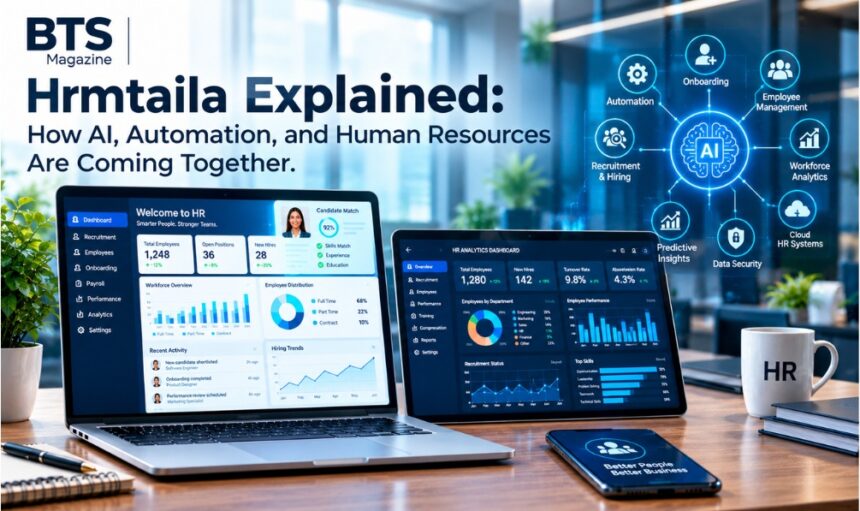
Hrmtaila is a developing term associated with the growing connection between artificial intelligence, automation, workforce data, and human resource management. The idea represents a shift from traditional HR software that mainly stores employee information toward intelligent systems that can automate routine activities, analyze workforce data, and help HR teams make better-informed decisions.
- What Does Hrmtaila Mean?
- How Is AI Transforming Human Resources?
- Hrmtaila for Recruitment and Employee Onboarding
- Workforce Analytics and Hrmtaila
- AI for Payroll, Employee Records, and HR Support
- Can AI Support Performance Management?
- Privacy, Bias, and AI Governance in HR
- What Are the Potential Benefits of Hrmtaila?
- What Could the Future of Hrmtaila Look Like?
- Why Is Hrmtaila Relevant to Modern Businesses?
- Frequently Asked Questions About Hrmtaila
- What is Hrmtaila?
- Is Hrmtaila an HR software platform?
- How can AI help HR departments?
- Can AI replace HR professionals?
- What are the biggest risks of AI in HR?
- Final Thoughts
Modern human resources covers many areas, including recruitment, employee onboarding, payroll, attendance, training, performance management, employee support, and workforce planning. Because many of these processes involve repetitive tasks and large volumes of information, AI can help reduce administrative workloads while allowing HR professionals to spend more time on people-focused responsibilities.
What Does Hrmtaila Mean?
Hrmtaila can be viewed as a broader concept surrounding AI-powered human resource management. It brings together technologies such as artificial intelligence, HR automation, cloud-based HR platforms, workforce analytics, and digital employee services.
The term does not currently have a clearly established public identity as a major HR software brand or widely documented standalone platform. Therefore, it is more appropriate to understand Hrmtaila as a developing concept rather than assign specific software features to it without verification.
At its core, the idea reflects how HR technology is evolving. Earlier HR systems were largely designed to store employee records and handle basic administrative processes. Modern platforms can go further by analyzing information, identifying patterns, automating workflows, and helping HR teams respond to workforce needs.
How Is AI Transforming Human Resources?
Traditional HR platforms can store information such as employee names, job titles, salaries, leave records, and performance information. Artificial intelligence adds an analytical and automation layer to these systems.
AI can process large amounts of information quickly and help identify patterns that may otherwise require significant manual effort. Common applications include applicant screening, employee support chatbots, workforce analysis, document processing, and workflow automation.
For a basic introduction to the technology behind these systems, see Artificial Intelligence on Wikipedia.
The purpose is not simply to make HR software more advanced. AI can potentially allow HR professionals to spend less time on repetitive administration and more time on recruitment strategy, employee development, workplace support, and long-term workforce planning.
Hrmtaila for Recruitment and Employee Onboarding
Recruitment is one of the areas where automation can have a noticeable effect. Large organizations may receive hundreds or even thousands of applications for particular positions. Digital systems can help organize applications, compare candidate information with job requirements, schedule interviews, and manage communication.
However, recruitment decisions should not depend entirely on automated systems. Hiring can directly affect someone’s career and income, so human review remains important. AI can assist recruiters with information processing, but important employment decisions require appropriate human oversight.
The same concept can be applied to employee onboarding. Automated workflows can guide new employees through forms, training, policy acknowledgments, account setup, and other initial requirements.
AI-powered assistants can also answer routine questions about workplace policies, benefits, training programs, or internal procedures. This can give new employees quicker access to basic information while reducing the number of repetitive questions handled manually by HR teams.
Workforce Analytics and Hrmtaila
Another important part of this concept is workforce analytics. HR departments generate large amounts of information about employees and business operations. This can include turnover, attendance, hiring activity, skills, workforce costs, performance information, and training participation.
AI-based analytics can help organize and examine this information more efficiently. Instead of looking at isolated figures, HR teams can use connected data to identify broader workforce patterns.
For example, analytics might reveal:
- Changes in employee turnover
- Skills that are becoming difficult to find
- Departments with increased hiring needs
- Changes in workforce costs
- Trends in employee participation
- Recruitment process delays
Predictive analytics can also identify signals that may deserve attention. For example, a system could identify patterns associated with employee turnover or potential skill shortages.
These predictions should not be treated as guaranteed outcomes. They are indicators that require human interpretation and additional context.
AI for Payroll, Employee Records, and HR Support
Payroll and employee administration involve many repetitive processes. Payroll information may include attendance, overtime, leave, salary details, deductions, and other employment-related data.
HR automation can help transfer information between connected systems, reduce repetitive data entry, and identify unusual records that may need review.
Employee records can also benefit from cloud-based systems. Instead of keeping information across disconnected spreadsheets and databases, organizations can use centralized platforms to manage employee information and control access based on roles.
Another useful application is the HR chatbot or virtual assistant. Employees may use these tools to find answers about:
- Leave policies
- Payroll dates
- Benefits
- Training requirements
- Company policies
- Internal forms
- HR procedures
These systems are particularly useful for straightforward questions. More complicated or sensitive situations should generally be directed to an HR professional.
Can AI Support Performance Management?
Performance management involves goals, feedback, manager reviews, project results, and employee development. AI can help organize this information and identify patterns that might be useful to managers.
For example, analytics may highlight areas where additional training could be useful or show whether employees are meeting specific goals over time.
However, employee performance cannot always be understood through numerical data. Some important factors—such as teamwork, unusual project circumstances, communication challenges, or personal situations—may not appear clearly in a dataset.
For that reason, a responsible AI-based performance management approach should support managers rather than replace them. Human conversations, clear objectives, meaningful feedback, and professional judgment remain important parts of performance evaluation.
Privacy, Bias, and AI Governance in HR
The use of AI in HR also creates important responsibilities. Employee systems can contain sensitive information, including personal details, salary records, job applications, attendance data, and performance information.
Organizations therefore need clear policies covering data access, storage, security, retention, and appropriate use.
AI bias is another important issue. If an AI model is trained on incomplete or historically biased information, its outputs may reproduce or reinforce those patterns. This can become particularly important when AI is used for recruitment, employee evaluation, promotion, or other high-impact decisions.
A strong governance process can include:
- Regular review of AI systems
- Appropriate human oversight
- Data-quality checks
- Access controls
- Security protections
- Clear accountability
- Testing for potentially unfair outcomes
HR, IT, legal, security, and management teams may all have a role in establishing appropriate controls.
What Are the Potential Benefits of Hrmtaila?
The central benefit of combining AI and HR technology is greater efficiency. Automation can take care of repetitive processes while analytics can help teams understand workforce information more quickly.
Potential benefits include:
- Less manual administrative work
- Faster access to workforce information
- More consistent HR workflows
- Better organization of employee records
- Faster responses to common employee questions
- Improved workforce planning
- Greater visibility into workforce trends
- More time for strategic HR activities
Another potential advantage is connected information. If recruitment, onboarding, attendance, payroll, and reporting systems work together, organizations may spend less time moving the same information between separate tools.
However, technology alone does not guarantee better HR outcomes. Poor data, unclear processes, weak security, or inappropriate automation can create additional problems.
What Could the Future of Hrmtaila Look Like?
The next generation of HR technology may combine AI agents, predictive analytics, cloud platforms, automation, and workforce intelligence into more connected systems.
Instead of using separate tools for every HR activity, organizations may increasingly use systems capable of completing multiple related tasks. An AI assistant, for example, could potentially help answer an employee question, locate the relevant policy, initiate a workflow, and direct complex cases to a human HR professional.
This does not necessarily mean that human HR teams will disappear. HR involves communication, trust, leadership, conflict resolution, empathy, and judgment—areas where human involvement remains important.
The bigger change may be that HR professionals use AI as a productivity and decision-support tool while remaining responsible for important decisions.
Why Is Hrmtaila Relevant to Modern Businesses?
Businesses need effective ways to recruit employees, manage costs, retain skills, develop workers, and provide reliable employee support. Human resources connects many of these activities.
Modern human resource technology can help organizations manage these responsibilities with greater structure and efficiency. AI can add another layer by helping analyze information, automate repetitive work, and support workforce planning.
The most useful approach is to begin with a genuine business or HR problem rather than adopting AI simply because it is a popular technology. Organizations also need reliable data, appropriate security measures, measurable objectives, and clear processes.
Viewed this way, Hrmtaila represents a broader direction in HR technology: bringing together AI in HR, workforce analytics, talent management, employee experience, automation, and cloud-based systems.
Frequently Asked Questions About Hrmtaila
What is Hrmtaila?
Hrmtaila can be understood as a developing concept associated with using AI, automation, analytics, and cloud technology in human resource management. It is better treated as a broader idea than as a verified standalone HR software product.
Is Hrmtaila an HR software platform?
There is not enough established public information to describe Hrmtaila as a specific, widely documented HR software platform. The term is more safely understood as a concept related to intelligent HR technology.
How can AI help HR departments?
AI can help HR teams automate repetitive activities, organize workforce information, answer common employee questions, support recruitment workflows, analyze workforce trends, and assist with decision-making.
Can AI replace HR professionals?
AI can automate certain HR tasks, but many HR responsibilities require human communication, judgment, context, and accountability. AI is generally more useful as a support tool than as a complete replacement for HR professionals.
What are the biggest risks of AI in HR?
Important risks include data privacy problems, security weaknesses, biased outputs, inaccurate predictions, excessive automation, and decisions being made without sufficient human review.
Final Thoughts
Hrmtaila represents the broader movement toward combining artificial intelligence, automation, analytics, and human resource management. The approach can support activities ranging from recruitment and onboarding to workforce analytics, employee support, payroll administration, and performance management.
The real value comes from using technology for the right tasks while maintaining strong human oversight. HR decisions can affect people’s careers, compensation, privacy, and workplace experience, so automation should not remove accountability.
A practical approach combines smart automation, secure data, responsible AI governance, reliable information, and human judgment. As HR technology continues to develop, this balance will determine how effectively AI can support the future of human resource management.
Read also: TechNewsOutlets.com USA: A Simple Guide to Finding the Best Tech News Sites