
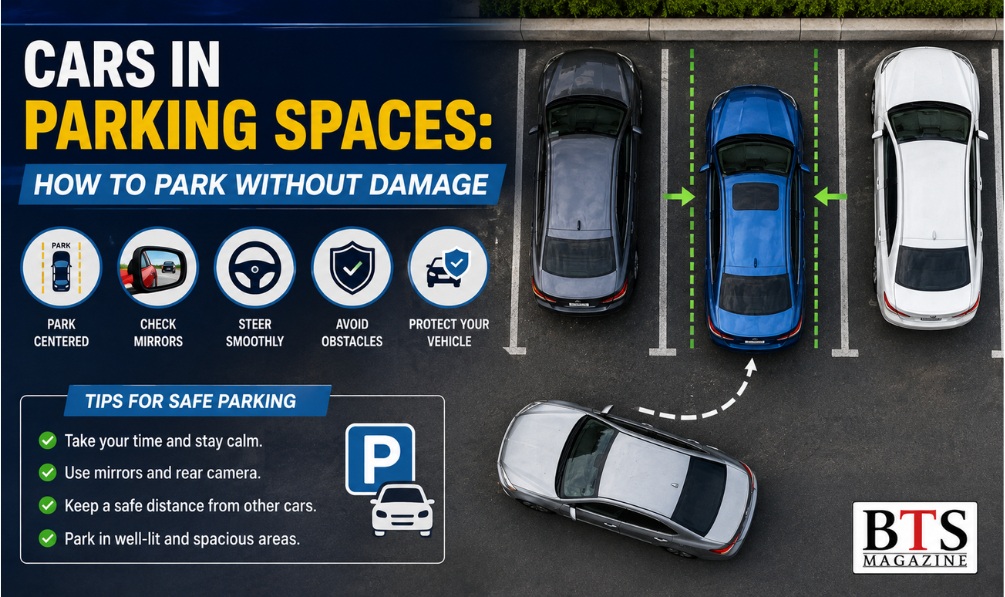
Parking looks easy until the space is tight, another car is parked too close, or you have to reverse into a busy spot. Knowing how to handle cars in parking spaces properly can help prevent scratches, dents, broken mirrors, and other expensive damage.
Whether you are a new driver or simply want to become better at parking, the most important things are patience, low speed, good positioning, and awareness of your surroundings. In this guide, you will learn how to park without damaging your vehicle or nearby cars.
For more useful automotive and lifestyle guides, you can also explore BTS Magazine.
What Are Cars in Parking Spaces?
Cars in parking spaces refers to vehicles positioned inside designated areas in parking lots, garages, streets, shopping centers, workplaces, and other parking facilities.
Parking correctly means keeping your vehicle within the marked lines while maintaining enough distance from nearby cars, walls, poles, curbs, and pedestrians.
The goal is not simply to fit your car into a space. A good parking job keeps your vehicle centered, protects nearby vehicles, and leaves enough room for everyone to move safely.
Why Is Proper Car Parking Important?
Correct parking is important because even a small mistake can cause expensive damage. A careless turn can scratch a bumper, hit another vehicle, or damage a side mirror.
Proper parking also makes it easier for other drivers to enter and leave their vehicles.
Good parking helps you:
- Reduce the risk of scratches and dents
- Avoid hitting nearby vehicles
- Protect mirrors and bumpers
- Make it easier to leave the space
- Give neighboring vehicles enough room
- Reduce stress in crowded parking lots
- Improve your overall driving confidence
For example, imagine entering a busy shopping-center parking lot. You find a space between two large SUVs. Instead of rushing into it, you slow down, check both sides, and carefully adjust your position. Those extra few seconds could prevent an expensive repair.
Key Benefits of Parking Cars Correctly
1. Protects Your Vehicle
One of the biggest benefits of good parking is reducing the chance of damage.
Bumpers, doors, mirrors, wheels, and body panels are common areas that can be damaged in crowded parking spaces.
2. Protects Other Cars
Parking correctly is not only about protecting your own vehicle.
If you park too close to another car, the other driver may not be able to open their door comfortably. Keeping your vehicle centered helps everyone use the parking area safely.
3. Makes Leaving Easier
A poorly positioned vehicle can be difficult to reverse or drive out later.
Parking near the center of the marked space gives you more room when leaving.
4. Improves Safety
Parking lots can contain pedestrians, children, shopping carts, bicycles, poles, barriers, and other hazards.
Driving slowly and checking your surroundings helps reduce the chance of an accident.
5. Reduces Parking Stress
When you have a simple parking routine, crowded parking areas become much easier to handle.
Instead of guessing, you can follow the same steps every time.
Step-by-Step Guide: How to Park Without Damage
Step 1: Slow Down Before Entering
Do not enter a parking space at normal driving speed.
Slow down before you begin turning. A low speed gives you more time to react if another vehicle or pedestrian suddenly appears.
Parking should be controlled, not rushed.
Step 2: Check the Space
Before turning into a parking space, look carefully at the area.
Check for:
- Other vehicles
- Parking lines
- Concrete barriers
- Poles
- Shopping carts
- Pedestrians
- Curbs
- Low objects
- Narrow spaces
If the space looks too tight, there is nothing wrong with choosing another one.
Step 3: Position Your Vehicle
Your starting position can make parking much easier.
For a standard parking space, give yourself enough room to make the turn without moving too close to the neighboring vehicle.
Keep checking your side mirrors while positioning the car.
Step 4: Turn Smoothly
Turn the steering wheel gradually.
Avoid making sudden steering movements because they can cause your vehicle to move too close to another car.
If you notice that your position is not correct, slow down and make a controlled adjustment.
Step 5: Use Your Mirrors
Mirrors are extremely useful when dealing with cars in parking areas.
Check both side mirrors and the rearview mirror during the maneuver.
If your vehicle has a backup camera or parking sensors, use them as additional tools. However, do not depend on technology alone.
Step 6: Straighten the Car
Once most of your vehicle is inside the space, straighten the steering wheel.
Try to position the car approximately in the center of the marked area.
Avoid leaving one side extremely close to another vehicle.
Step 7: Stop and Check
Before leaving the vehicle, take a quick look around.
Make sure:
- Your car is between the lines
- You are not blocking another space
- Your vehicle is not too close to another car
- You have enough room around the vehicle
- Your mirrors are clear
- You are not blocking a driving lane
This final check can prevent small parking mistakes from becoming bigger problems.
How to Park Cars in Tight Spaces
Tight parking spaces can make even experienced drivers nervous.
The best approach is to slow down and make small adjustments instead of trying to complete the maneuver quickly.
If you cannot clearly judge the distance between your vehicle and another object, stop and reassess.
Helpful techniques include:
- Use your side mirrors frequently.
- Make small steering corrections.
- Keep your speed very low.
- Use your backup camera if available.
- Watch both the front and rear of your vehicle.
- Stop if visibility becomes uncertain.
- Choose another parking space when necessary.
You do not need to prove that you can fit your vehicle into the smallest space available.
Reverse Parking vs. Forward Parking
Both forward and reverse parking have situations where they can be useful.
The safest method depends on the parking environment, the vehicle, the driver’s experience, and local traffic conditions.
Forward Parking
Forward parking is often easier for beginners.
It can work well when the parking space is wide and there is plenty of room to maneuver.
Advantages include:
- Simple maneuver
- Easy to understand
- Convenient in open parking lots
- Often quick in spacious areas
Reverse Parking
Reverse parking requires more control and awareness.
Some drivers prefer it because they may have a clearer path when leaving the parking space.
However, reversing requires careful observation.
Always check your surroundings before moving backward and watch for pedestrians and other vehicles.
Common Car Parking Mistakes to Avoid
Parking Too Close to Another Vehicle
One of the most common mistakes is leaving very little space between cars.
Even if your vehicle fits, the driver next to you may struggle to open their door.
Ignoring Parking Lines
Parking across a line can take up part of another parking space.
Always use the painted lines as a guide and try to keep your vehicle centered.
Turning Too Quickly
Fast steering can cause your vehicle to swing toward another car, wall, or pole.
Slow down and make gradual movements.
Relying Only on a Backup Camera
A backup camera is helpful, but it does not always show every object around your vehicle.
Use the camera together with your mirrors and direct observation.
Forgetting the Front of the Vehicle
When reversing or making a sharp turn, some drivers focus entirely on the rear.
Remember that the front of your vehicle can also move into the path of another object.
Parking Too Close to Poles or Walls
Fixed objects can be difficult to judge from the driver’s seat.
Whenever possible, leave a reasonable safety margin.
Expert Tips for Safer Cars in Parking Areas
Tip 1: Choose an Easier Space
If you have several options, choose a space with more room.
A little extra space can make parking much easier and reduce the chance of damage.
Tip 2: Do Not Let Other Drivers Rush You
Sometimes another driver waits behind you while you are parking.
Do not allow that pressure to make you rush.
Your priority should always be safe vehicle control.
Tip 3: Practice in an Empty Area
If you are still learning how to park, practice in a quiet parking area.
You can practice:
- Forward parking
- Reverse parking
- Steering control
- Judging vehicle width
- Using mirrors
- Correcting your position
Practice makes parking feel more natural.
Tip 4: Understand Your Vehicle’s Size
Every vehicle behaves differently.
A small sedan, SUV, pickup truck, and large vehicle have different dimensions and turning characteristics.
Knowing the approximate size and turning behavior of your vehicle makes parking easier.
Tip 5: Watch for Pedestrians
Parking lots are shared spaces.
People can walk between parked vehicles and may suddenly appear in front of your car.
Keep your speed low and stay alert.
For additional official information about vehicle and road safety, drivers can consult the National Highway Traffic Safety Administration (NHTSA).
What Should You Do If a Parking Space Is Too Small?
If a parking space is so narrow that you cannot confidently enter it without risking contact with another vehicle, the safest option is to find another space.
Do not force your car into a difficult position simply because it is the closest available spot.
A slightly longer walk is usually better than dealing with a damaged bumper, scratched door, or insurance claim.
How Can You Avoid Scratches and Dents in Parking Lots?
You can reduce parking-related damage by following a few simple habits:
- Park slowly.
- Keep your vehicle centered.
- Maintain space from neighboring cars.
- Avoid extremely tight spaces.
- Check mirrors before turning.
- Look for poles and barriers.
- Watch for shopping carts.
- Be careful when opening doors.
- Check your surroundings before reversing.
- Do not rush because another driver is waiting.
These habits are simple, but they can make a significant difference.
FAQs About Cars in Parking Spaces
What is the safest way to park a car?
The safest way to park is to approach slowly, check the parking space and surrounding area, use your mirrors, make controlled steering movements, and keep enough clearance from nearby vehicles and objects.
How do I park without hitting another car?
Slow down before entering the space and carefully monitor both sides of your vehicle. Use your mirrors and make small steering adjustments. If the space feels too narrow, choose another parking spot.
Should my car be in the middle of the parking space?
Yes. Whenever possible, your vehicle should be positioned roughly in the center of the marked parking space. This gives you and neighboring vehicles more room.
Is reverse parking better than forward parking?
Reverse parking is not automatically better in every situation. The best method depends on the parking area, vehicle, driver’s experience, and surrounding traffic. Always check carefully before reversing.
How do I park in a tight parking space?
Enter slowly and make small steering adjustments. Use your mirrors and any available camera or parking sensors. If you cannot judge the clearance safely, find a wider space.
Why do cars get damaged in parking lots?
Cars can be damaged by careless reversing, tight parking spaces, opening doors, shopping carts, fixed objects, or other vehicles. Low-speed impacts can still cause scratches, dents, or broken parts.
How can I prevent door dents while parking?
Park within the marked lines and leave reasonable space from neighboring vehicles. When opening your door, do it carefully, especially when another vehicle is parked close by.
Conclusion
Learning how to handle cars in parking spaces safely is an important driving skill. Good parking is not about being the fastest driver in the lot. It is about patience, control, awareness, and proper positioning.
Before entering a space, check the surroundings. While parking, move slowly and use your mirrors. After parking, make sure your vehicle is centered and has enough clearance.
If a parking space looks too tight, choose another one. Spending an extra minute finding a safer spot can save you from dealing with scratches, dents, repairs, or insurance problems.
For general background and additional information about parking, you can also refer to Wikipedia’s parking overview.
Safe parking is a simple skill, but consistent practice can help protect both your car and the vehicles around you.