

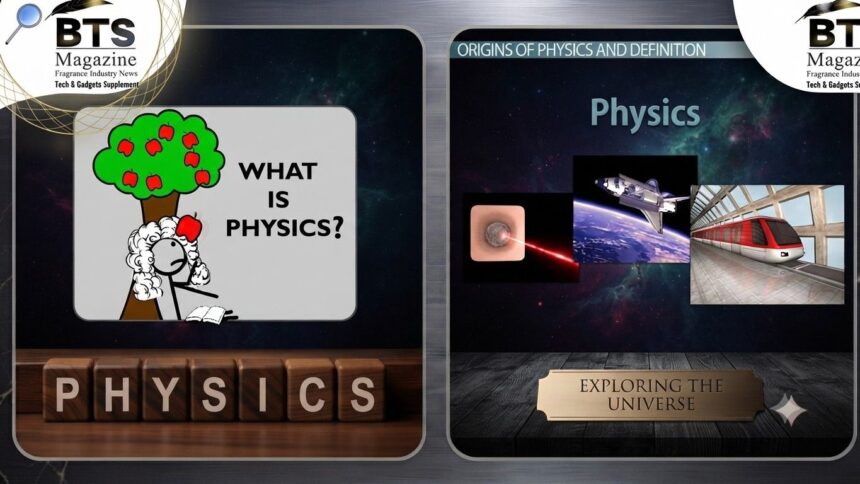
What is physics? In the simplest terms, physics is the scientific study of matter, energy, and how they interact. It’s the science that tries to explain why things fall, how light travels, and what holds the universe together. To be honest, it’s probably the most fundamental science there is.
Think about it. Every time you drop your phone, ride a bike, or heat up dinner, physics is quietly at work. It’s everywhere, whether you notice it or not.
Physics in Plain Words
Physics comes from the Greek word physis, which means “nature.” So at its heart, it’s the science of nature. It looks at the physical world and tries to figure out the rules behind it.
Here’s the thing. Physics isn’t just formulas on a chalkboard. It’s a way of understanding how everything around us actually works.
The Story Behind Physics
People have been asking “what is physics” long before the word even existed. Ancient thinkers like Aristotle tried to explain motion and the stars using logic and observation.
Then came the game-changers. Isaac Newton described gravity and the laws of motion in the 1600s. Later, folks like Einstein flipped our understanding of space and time on its head.
From Ancient Ideas to Modern Science
Early physics was mostly guesswork mixed with careful watching. Over centuries, it grew into a serious scientific study built on experiments and math.
What’s interesting is how each generation of scientists built on the last. That’s how we went from watching apples fall to launching rockets into space.
Key Concepts You Should Know
Before we go deeper, let’s cover the basics. A few core ideas show up again and again in physics.
Matter
Matter is anything that has mass and takes up space. Your desk, the air, even stars are made of matter. The study of matter and energy is one of the biggest reasons physics exists.
Energy
Energy is the ability to do work. It comes in many forms, like heat, light, sound, and motion. Energy can change from one form to another, but it never just disappears.
Force
A force is a push or a pull. Gravity pulls you toward the ground. A magnet pulls metal toward it. Forces cause things to speed up, slow down, or change direction.
Motion
Motion is simply movement from one place to another. Physics studies how fast things move, in what direction, and why they keep going or stop.
The Main Branches of Physics
Physics is a huge subject, so it’s split into different branches. Each one focuses on a specific part of the physical world.
Classical Mechanics
This is the oldest branch. It deals with the motion of objects you can see, like cars, balls, and planets. Newton’s laws live here.
If you’ve ever calculated how far a ball will fly, that’s classical mechanics doing its thing.
Thermodynamics
Thermodynamics is all about heat and energy. It explains why your coffee cools down and how engines turn fuel into movement.
It also gives us rules about energy transfer that apply everywhere, from your kitchen to power plants.
Electromagnetism
This branch studies electricity and magnetism, which turn out to be two sides of the same coin. It explains how your phone charges and how radio signals travel.
Honestly, without electromagnetism, modern life would grind to a halt.
Optics
Optics is the study of light. How it bends, reflects, and forms images. Glasses, cameras, and microscopes all rely on it.
Quantum Mechanics
Now things get weird. Quantum mechanics looks at the tiniest particles, like atoms and electrons. At this scale, particles behave in ways that seem strange and unpredictable.
What’s fascinating is that quantum physics powers modern tech like computers and lasers.
Relativity
Einstein’s relativity changed how we see space and time. It showed that time can slow down and space can bend, depending on speed and gravity.
It sounds like science fiction, but GPS satellites actually rely on it to stay accurate.
Nuclear Physics
Nuclear physics studies the core of the atom. It explains where the sun’s energy comes from and how nuclear power works.
Physics in Everyday Life
You might think physics only matters in labs. Not even close. It’s woven into your daily routine.
Your microwave uses electromagnetic waves. Your car brakes thanks to friction. Even walking involves balance, force, and motion.
Around the House
Refrigerators use thermodynamics. Light bulbs use electricity and optics. Your Wi-Fi signal? That’s electromagnetism traveling through the air.
In Sports
When a swimmer glides through water or a basketball arcs toward the hoop, physics decides the outcome. Understanding these natural phenomena can even make athletes better.
Why Physics Matters
So why should you care about any of this? Because the laws of physics shape everything we build and use.
Medical scanners, clean energy, smartphones, space travel. None of it exists without physics. It’s the backbone of technology and progress.
Physics also teaches you to think clearly. It trains your brain to question, test, and solve problems step by step.
Careers in Physics
If you enjoy asking “what is physics” and wanting real answers, there are plenty of paths for you.
Research and Academia
Some physicists spend their lives exploring big questions. They study black holes, particles, and the origins of the universe.
Engineering and Tech
Physics grads often work in engineering, software, and electronics. Companies love the problem-solving skills a physics background gives you.
Medicine and Energy
Medical physicists work with imaging and radiation therapy. Others focus on renewable energy, helping build a cleaner future.
To be honest, a physics degree opens more doors than most people expect.
Fun Facts About Physics
Let’s lighten things up with a few cool facts.
- Light travels at about 186,000 miles per second. Nothing we know moves faster.
- A single teaspoon of a neutron star would weigh billions of tons.
- Hot water can sometimes freeze faster than cold water. Scientists still debate exactly why.
- The universe is made mostly of stuff we can’t even see, called dark matter and dark energy.
What’s interesting is that physics still has huge mysteries left to solve. We haven’t figured everything out yet.
How Physics Connects to Other Sciences
Physics doesn’t work alone. It links up with chemistry, biology, and astronomy.
Chemistry relies on how atoms bond. Biology uses physics to explain how muscles move. Astronomy leans on physics to understand stars and galaxies.
In a way, physics is the foundation the other sciences stand on.
Tips for Learning Physics
Struggling with physics? You’re not alone. Here are a few simple tips.
Start with the basics like force, energy, and motion. Practice real problems instead of just reading. And connect concepts to everyday examples you already understand.
Don’t rush it. Physics rewards patience and curiosity more than raw memorization.
Final Thoughts
So, what is physics? It’s the scientific study of the physical world, from tiny particles to massive galaxies. It explains natural phenomena using logic, math, and careful testing.
Once you start seeing physics in daily life, you can’t unsee it. It’s genuinely everywhere. If you want to keep exploring the science of nature, this detailed overview on Wikipedia’s physics page is a great place to dig into the study of matter and energy even further.
Continue reading: Deerstalker, Pipe & Magnifying Glass: The Iconic Symbols Behind Sherlock Holmes