
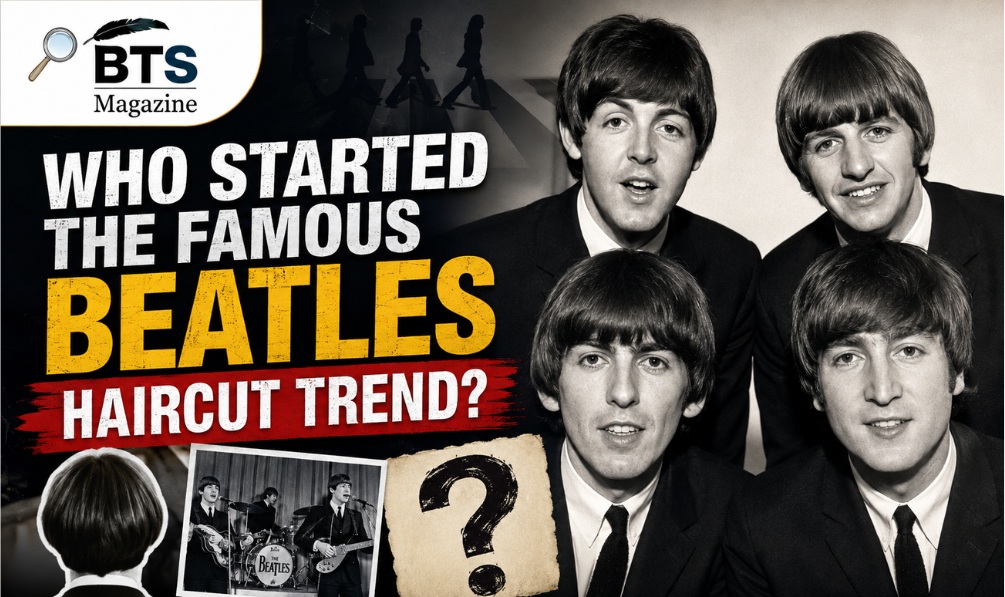
Picture this: it’s 1964, and four young men from Liverpool step off a plane in New York. Screaming fans line the streets. But it’s not just their music turning heads—it’s their hair! That shaggy, fringe-forward look sparked one of the biggest style crazes of the century.
So who actually started the famous Beatles haircut? In this article, you’ll learn where the iconic mop top hairstyle came from, why it mattered so much, and how you can rock it today. Let’s dive in!
For more music, celebrity, and culture stories, explore BTS Magazine.
What Is the Beatles Haircut?
The Beatles haircut, often called the “mop top,” is a collar-length style with a straight fringe that sweeps across the forehead. It’s brushed forward and down, with no part and no slicked-back styling.
Quick answer: The Beatles haircut is a rounded, medium-length hairstyle featuring bangs combed forward over the forehead and hair covering the ears and neck. It became world-famous during Beatlemania in the early 1960s and defined a generation of 1960s hairstyle trends.
At the time, most men wore short, greased hair. The Beatles flipped the script completely!
Why Is the Beatles Haircut Important?
The mop top wasn’t just a hairstyle—it was a cultural earthquake. Here’s why it still matters today.
- It challenged old rules. Short back-and-sides was the norm. The Beatles said goodbye to all that.
- It fueled Beatlemania. Fans copied the look everywhere, from London to Los Angeles.
- It shaped fashion history. The cut inspired designers, barbers, and musicians for decades.
- It symbolized youth and rebellion. Wearing longer hair became a statement of freedom.
So what? The Beatles proved that a single style choice could unite millions of young people around one bold idea: be yourself.
Barbershops in the 1960s reportedly saw parents dragging teens in for “corrections.” That’s how powerful this trend became!
Who Actually Started the Beatles Haircut?
Here’s the surprising twist. The band didn’t invent the mop top by themselves!
The story points to two German friends: Astrid Kirchherr and Jürgen Vollmer. When the Beatles played clubs in Hamburg, Germany, in the early 1960s, these young artists sported a similar brushed-forward style.
- Astrid Kirchherr, a photographer, is often credited with giving Stuart Sutcliffe (the band’s early bassist) the first mop top trim.
- Jürgen Vollmer wore the look too, and later cut Paul McCartney hair and John Lennon’s hair in Paris in 1961.
By 1962, John, Paul, and George had fully embraced the style. Ringo Starr joined the band and adopted it as well. The rest is history!
In short: European art students planted the seed, but the Beatles turned it into a global phenomenon.
Key Features of the Beatles Haircut
Want to spot a true mop top? Look for these signature traits.
- Forward-swept fringe: Bangs fall across the forehead, not to the side.
- No visible part: The hair flows in one smooth direction.
- Rounded shape: Think of an upside-down bowl outline.
- Collar-length back: Hair covers the neck slightly.
- Ear coverage: The sides drape over or near the ears.
- Natural texture: No heavy gel or grease—just soft, moveable hair.
The John Lennon haircut and Paul’s version were nearly identical, giving the band a unified, unforgettable image.
How to Get the Beatles Haircut (Step-by-Step)
Ready to channel your inner rock star? Here’s a simple guide to achieving the classic mop top.
- Grow it out first. You’ll need about 3–5 inches of length on top and around the sides. Patience pays off!
- Find a skilled barber. Ask for a “mop top” or bring a photo of the Beatles circa 1964.
- Request a rounded cut. The barber should shape your hair into a soft, bowl-like outline.
- Keep the fringe blunt. Ask for straight-across bangs that hit near your eyebrows.
- Skip the part. Have all the hair brushed forward and down.
- Style with light product. Use a small amount of matte cream for natural hold—never heavy grease.
- Maintain regularly. Trim every 4–6 weeks to keep that clean, rounded shape.
Pro tip: Air-dry your hair and brush it forward while damp for the most authentic 1960s finish.
Common Mistakes to Avoid
Even the best styles can go wrong. Steer clear of these slip-ups!
- Cutting it too short. The mop top needs length to fall properly. Don’t rush the growing stage.
- Using too much product. Grease flattens the look. Keep it soft and natural.
- Adding a side part. This breaks the signature forward flow instantly.
- Choosing an inexperienced barber. The rounded shape takes real skill. Show reference photos!
- Ignoring your face shape. The full fringe suits many faces, but ask your stylist for small tweaks if needed.
- Skipping maintenance. Grown-out mop tops lose their crisp shape fast.
Avoid these, and you’ll nail the look every time.
Expert Tips
Take your Beatles haircut to the next level with these stylist-approved pointers.
- Match the era you love. The 1963 cut was tighter; the 1965 version was longer and shaggier. Pick your favorite!
- Work with your hair type. Straight hair mimics the original best, but wavy hair adds charming volume.
- Communicate clearly. Use words like “rounded,” “forward fringe,” and “no part” with your barber.
- Invest in a good brush. A soft-bristle brush helps train hair to sweep forward.
- Embrace the grow-out phase. Awkward stages are temporary. The payoff is worth it!
Remember: Confidence is the real secret ingredient to pulling off any iconic style.
For additional historical background on The Beatles, their music, and their cultural impact, visit The Beatles’ official website.
FAQs
Who invented the Beatles haircut?
The mop top was inspired by German art students Astrid Kirchherr and Jürgen Vollmer in the early 1960s. Vollmer cut John Lennon’s and Paul McCartney’s hair in Paris in 1961. The Beatles then popularized the style worldwide during Beatlemania.
What is the Beatles haircut called?
The Beatles haircut is commonly called the “mop top.” It features a forward-swept fringe, rounded shape, and collar-length hair. This 1960s hairstyle became a defining symbol of the band and youth culture during the decade’s music revolution.
Did all four Beatles have the same haircut?
Yes! John, Paul, George, and Ringo all wore matching mop tops. This unified look created a strong, recognizable brand image. Their identical hairstyles helped fans instantly identify the band and fueled the massive Beatlemania trend across the globe.
Is the Beatles haircut still popular today?
Absolutely! The mop top remains a beloved retro style. Many people request it for a vintage or indie look. It also influences modern fringe cuts, proving the Beatles haircut’s lasting impact on hair fashion decades later.
How long does it take to grow a Beatles haircut?
Growing a proper mop top usually takes 3–6 months, depending on your starting length and hair growth rate. You’ll need about 3–5 inches on top and sides. Regular trims during the process keep the shape neat and even.
What face shape suits the Beatles haircut best?
The mop top flatters oval and long face shapes especially well, since the full fringe adds balance. However, a skilled stylist can adjust the cut for round or square faces by tweaking the fringe length and volume.
Conclusion
What a journey! The famous Beatles haircut started with a few creative German friends, then exploded into a worldwide sensation thanks to four talented lads from Liverpool. From the forward fringe to the rounded shape, the mop top hairstyle changed 1960s hairstyle trends forever and still turns heads today.
We covered where it came from, why it mattered, and exactly how to get the look yourself. Whether you love the John Lennon haircut or Paul McCartney’s version, this timeless style is easier to achieve than you think!
Ready to try it? Save a Beatles reference photo, book an appointment with a skilled barber, and step into a piece of music history. Your mop top adventure starts now—have fun with it!
For more historical details about The Beatles and their career, you can also explore The Beatles on Wikipedia.