
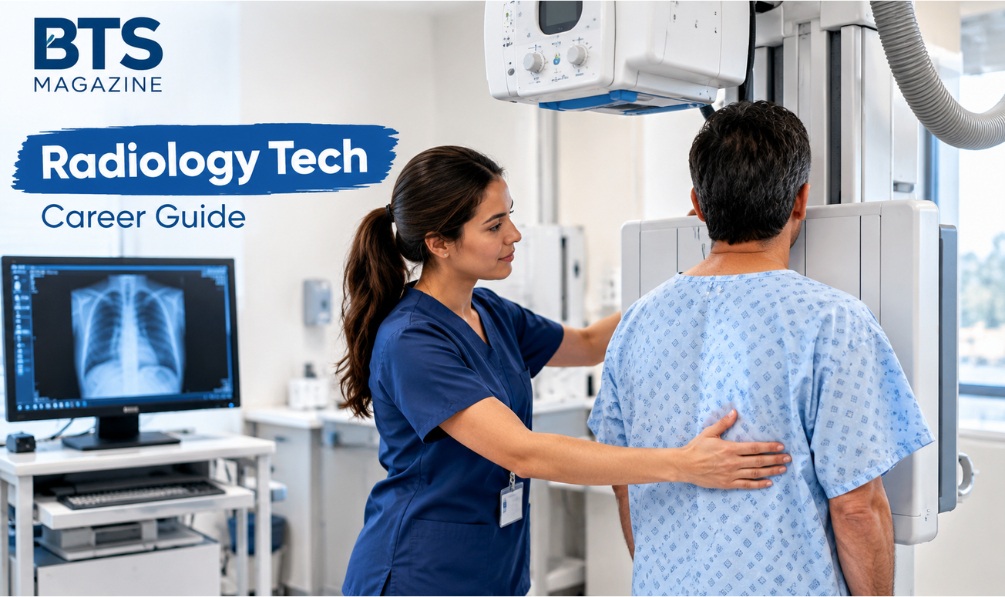
A radiology tech plays an important role in modern healthcare by producing medical images that help doctors identify injuries, diagnose diseases, and plan treatment. From taking routine X-rays to operating advanced imaging equipment, these professionals combine technical knowledge with patient care to support medical decisions.
If you are considering a healthcare career, understanding the radiology tech profession can help you decide whether it matches your interests, education goals, and long-term plans. You may also want to know how much radiology techs earn, what qualifications they need, where they work, and which specializations offer opportunities for professional growth.
This guide explains the profession, including its daily responsibilities, education requirements, certification process, salary information, and career outlook in the United States.
What Is a Radiology Tech?
A radiology tech, also called a radiologic technologist or radiographer in many settings, is a healthcare professional who operates medical imaging equipment to create pictures of the inside of the human body.
These images help physicians investigate conditions such as broken bones, chest infections, joint problems, and certain internal injuries. Depending on their training and specialty, imaging professionals may work with X-ray machines, computed tomography (CT) scanners, magnetic resonance imaging (MRI) systems, or other diagnostic technologies.
Radiology techs do not usually make the final diagnosis from the images they produce. That responsibility generally belongs to a radiologist or another qualified healthcare provider. Instead, the technologist focuses on obtaining accurate images, positioning patients correctly, following safety procedures, and documenting the examination.
According to the American Society of Radiologic Technologists, the profession includes several specialties, each requiring knowledge of imaging procedures, patient care, equipment operation, and safety.
What Does a Radiology Tech Do?
A radiology tech’s daily duties depend on the workplace, imaging equipment, and patients being examined. The role involves much more than pressing a button on a machine.
1. Prepare Patients for Imaging
Before an examination, the technologist verifies the patient’s identity and checks the requested procedure. They explain what will happen, answer basic questions, and help patients understand any preparation instructions.
Some examinations require patients to remove jewelry, change into a medical gown, or follow specific instructions. When necessary, the technologist also checks relevant safety information before proceeding.
2. Operate Medical Imaging Equipment
Radiology techs operate equipment according to the examination being performed. A general radiographer may take images of bones, joints, the chest, or other body areas. A CT technologist uses a scanner that combines multiple X-ray measurements to produce cross-sectional images.
MRI technologists work with magnetic fields and radio waves rather than ionizing X-ray radiation. Each type of equipment requires specific training and safety procedures.
3. Position Patients Correctly
Correct positioning helps produce useful images while reducing the need for repeat examinations. Technologists adjust the patient’s position, select appropriate imaging views, and follow the examination protocol.
This task can be challenging when patients are injured, elderly, anxious, or unable to move comfortably. Clear communication and careful handling are essential.
4. Follow Radiation Safety Procedures
Radiography and CT examinations use ionizing radiation. Technologists follow established safety procedures, use appropriate exposure settings, and apply radiation protection principles to minimize unnecessary exposure.
They also follow department protocols, equipment quality checks, and applicable regulations. MRI has different safety considerations because its strong magnetic field can interact with certain metal objects and medical devices.
5. Review Image Quality and Document Examinations
After obtaining images, the technologist checks whether they meet the required technical standards. If an image is incomplete or unsuitable, another image may be necessary under the applicable protocol.
The technologist records relevant examination details and makes the images available for interpretation by the appropriate healthcare professional. They may also assist with certain procedures under the direction of qualified clinicians.
How to Become a Radiology Tech in the United States
The exact pathway depends on your intended specialty, state regulations, and the credential required by an employer. For someone entering diagnostic radiography, the following steps provide a practical starting point.
Step 1: Complete High School or an Equivalent Qualification
A high school diploma or equivalent qualification is a common starting requirement for radiologic technology programs.
Courses in biology, anatomy, chemistry, mathematics, and physics can help you prepare for the scientific and technical subjects covered during training. Some colleges also require prerequisite courses or entrance assessments.
Step 2: Choose an Appropriate Educational Program
Many entry-level radiologic technologists complete an associate degree in radiologic technology or radiography. Programs generally combine classroom instruction, laboratory practice, and supervised clinical experience.
Students study subjects such as human anatomy, imaging procedures, patient care, radiation physics, image evaluation, and radiation protection.
Before enrolling, check whether the program meets the requirements of the certification body and licensing authority relevant to your intended career. The American Registry of Radiologic Technologists (ARRT) education requirements explain the educational requirements for its primary certification pathway.
Step 3: Complete Clinical Training
Clinical education allows students to apply classroom knowledge in healthcare settings under supervision. Depending on the program, students may rotate through different imaging departments and learn how to work with patients and equipment.
Clinical training helps develop practical skills in patient positioning, examination preparation, communication, infection prevention, and imaging safety.
Step 4: Meet Certification Requirements
For people pursuing initial ARRT certification through the primary pathway, the requirements include education, ethics, and examination. Applicants must complete the applicable educational requirements, satisfy the ethics requirements, and pass the relevant examination.
The exact eligibility rules depend on the credential and pathway. Review the official ARRT primary eligibility requirements before choosing a program or planning your examination.
Step 5: Check State Licensing Rules
Certification and state licensure are not the same thing. Many states regulate radiologic technologists, and their licensing requirements may differ.
Before applying for jobs, check the rules of the state where you intend to work. Employers may also require additional qualifications, current CPR or basic life support training, or specific experience.
Step 6: Apply for Entry-Level Positions
After meeting the relevant education, certification, and licensing requirements, you can apply for positions in hospitals, outpatient imaging centers, medical practices, and diagnostic facilities.
Entry-level roles commonly focus on general radiography. With experience and additional training, you may qualify for other imaging specialties or supervisory opportunities.
Radiology Tech Salary: How Much Can You Earn?
Salary is an important consideration when choosing a healthcare career, but earnings depend on specialty, location, experience, employer, and working hours.
According to the US Bureau of Labor Statistics (BLS), the median annual wage for radiologic technologists and technicians was $80,110 in May 2025. The median is the midpoint of the wage distribution: half of workers earned more and half earned less.
For comparison, the BLS reported a median annual wage of $95,480 for MRI technologists in May 2025. These figures describe different occupational groups and should not be treated as guaranteed starting salaries.
You can review the official BLS radiologic and MRI technologist salary data for wage ranges, employment statistics, and information about different industries.
What Affects a Radiology Tech’s Salary?
Several factors can influence how much a radiology tech earns:
- Specialization: CT and MRI roles may have different wage patterns from general radiography positions.
- Experience: Experienced technologists may qualify for senior, supervisory, or specialized roles.
- Location: Pay varies with regional labor markets and local demand.
- Employer: Hospitals, outpatient centers, medical offices, and diagnostic laboratories may offer different compensation packages.
- Work schedule: Certain evening, overnight, weekend, or on-call shifts may include additional compensation, depending on the employer.
When comparing jobs, consider benefits, shift requirements, commuting costs, training opportunities, and advancement potential rather than salary alone.
Types of Radiology Tech Specializations
Radiology tech is a broad career area with several possible directions. The right specialty depends on your interests, the additional education you are willing to complete, and local employment opportunities.
X-Ray or General Radiography
General radiographers use X-ray equipment to produce images of bones and other body structures. They commonly work in hospitals, clinics, urgent care facilities, and imaging centers.
This can be a starting point for people interested in diagnostic imaging.
Computed Tomography (CT)
CT technologists operate scanners that create detailed cross-sectional images. CT examinations are commonly used to investigate trauma, internal injuries, and a range of medical conditions.
Moving into CT may require additional training, clinical experience, and a recognized credential, depending on the employer and applicable requirements.
Magnetic Resonance Imaging (MRI)
MRI technologists operate scanners that use magnetic fields and radio waves to create detailed images. MRI is used in the evaluation of many soft tissues, joints, the brain, and the spine.
Because MRI involves strong magnetic fields, technologists must follow specific screening and equipment safety procedures.
Mammography
Mammography technologists perform specialized breast imaging examinations. Their work requires technical precision, patient communication, and attention to privacy and comfort.
The role may require additional education, competency requirements, and specialty credentials.
Interventional Radiography
Interventional radiography technologists assist with image-guided procedures that help clinicians diagnose or treat certain conditions. They may work in specialized hospital departments and procedure rooms.
This area can involve close teamwork, careful equipment preparation, and strict sterile and safety practices.
Additional specialties may include nuclear medicine, bone densitometry, and radiation therapy. These are distinct professional pathways, so check the relevant education and credentialing requirements before assuming that one qualification covers every specialty.
Where Do Radiology Techs Work?
Radiology techs work in several healthcare environments, including:
- Hospitals: Imaging departments, emergency services, operating rooms, and specialized units.
- Outpatient imaging centers: Facilities that provide scheduled diagnostic examinations.
- Physician offices and clinics: Practices that offer imaging as part of patient care.
- Diagnostic laboratories and medical centers: Organizations that perform imaging services.
- Specialty departments: Areas such as mammography, CT, MRI, and interventional radiology.
The work environment affects the pace of the job. Hospital-based technologists may encounter emergency cases, while outpatient centers may focus more heavily on scheduled examinations. Some positions require evenings, weekends, overnight shifts, or on-call availability.
Skills Every Successful Radiology Tech Needs
Technical training is essential, but patient care and communication are equally important.
Attention to detail: Accurate positioning and correct examination settings help produce useful images.
Communication: Patients may feel nervous or be in pain. Clear explanations can make examinations easier to complete.
Technical ability: Technologists must understand how to operate imaging systems and follow examination protocols.
Physical stamina: The job may involve standing for long periods and helping patients move safely.
Problem-solving: Equipment issues, patient limitations, and unexpected situations require careful judgment within the technologist’s scope of practice.
Safety awareness: Technologists must follow radiation protection measures or, for MRI, magnetic-field safety procedures appropriate to their specialty.
Radiology Tech Job Outlook
The BLS projects that employment of radiologic and MRI technologists combined will grow by 5% from 2025 to 2035, faster than the average projected growth for all occupations. It also projects approximately 15,300 openings per year on average across the combined occupational group.
These openings include opportunities created when workers leave their jobs or retire, as well as positions associated with employment growth. The figures cover both radiologic and MRI technologists, so they should not be interpreted as the outlook for general radiography alone.
Healthcare facilities need qualified professionals to produce diagnostic images for medical evaluation and treatment planning. However, opportunities vary by location, employer, specialty, and qualifications. Reviewing local job postings is a useful way to understand current hiring requirements.
Is Becoming a Radiology Tech Worth It?
A radiology tech career may suit people who enjoy science, technology, patient interaction, and practical problem-solving. It offers a defined educational pathway and opportunities to develop specialized imaging skills.
However, it also comes with responsibilities. Technologists must follow safety procedures, communicate with patients who may be uncomfortable, maintain accurate records, and work efficiently in busy healthcare environments. Some roles involve physically demanding tasks or irregular shifts.
Before enrolling in a program, compare tuition, clinical placement arrangements, graduation outcomes, certification eligibility, state licensing rules, and employment opportunities in your area. If you are exploring other healthcare-related topics, BTS Magazine’s guide to PRP under-eye treatment costs in the USA offers another example of how medical procedures and patient care can intersect, although it describes a different field.
Frequently Asked Questions
How long does it take to become a radiology tech?
Many entry-level radiography pathways involve an associate degree and clinical training, often taking around two years of full-time study after prerequisites. The actual timeline depends on the program, previous coursework, and certification requirements.
Is a radiology tech the same as a radiologist?
No. A radiologic technologist operates imaging equipment and produces diagnostic images. A radiologist is a physician who specializes in interpreting medical images and may also perform image-guided procedures.
Do radiology techs need a degree?
For initial ARRT certification through its primary pathway, candidates must earn an associate degree or higher and complete an eligible educational program. State rules and requirements for other pathways or roles may differ.
Can radiology techs specialize in MRI or CT?
Yes. Qualified professionals may pursue additional imaging credentials or training. Eligibility depends on the specialty, the certification pathway, and the applicable education and experience requirements.
Is radiology tech a good career for the future?
It can be a promising option for people interested in healthcare technology. The BLS projects 5% employment growth for radiologic and MRI technologists combined between 2025 and 2035, although actual opportunities depend on location and specialty.
Do radiology techs diagnose diseases?
Their primary role is to perform imaging examinations and produce technically suitable images. A radiologist or another qualified clinician generally interprets the findings and makes diagnostic decisions.
Conclusion
A radiology tech helps connect medical technology with patient care by producing images that support diagnosis and treatment. The profession offers several career directions, including general radiography, CT, MRI, mammography, and interventional imaging.
To enter the field, research accredited or otherwise appropriately recognized educational programs, complete the required clinical training, and verify certification and state licensing requirements. Compare salary data with local job listings, and consider both the responsibilities and the opportunities for specialization.
With suitable training, attention to safety, and strong patient-care skills, radiologic technology can be a practical career path for people who want to contribute to modern healthcare.