

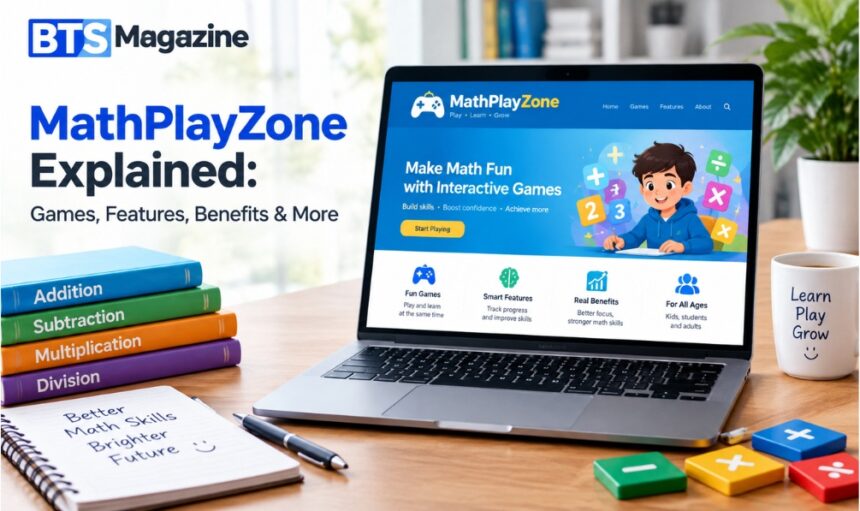
Learning math can sometimes feel difficult, especially when children see it as a long list of rules, formulas, and worksheets. MathPlayZone takes a different approach by making math practice more interactive and game-based.
- What Is MathPlayZone?
- Why Is MathPlayZone Important?
- Key Features of MathPlayZone
- 1. Interactive Math Games
- 2. Different Math Topics
- 3. Problem-Solving Practice
- 4. Instant Practice
- 5. Fun Learning Environment
- Benefits of MathPlayZone
- Makes Math More Engaging
- Builds Confidence
- Encourages Repetition
- Supports Mental Math
- Develops Problem-Solving Skills
- Helps Parents Find Extra Practice
- How to Use MathPlayZone Effectively
- Step 1: Identify the Skill
- Step 2: Start With the Right Difficulty
- Step 3: Keep Sessions Short
- Step 4: Review Mistakes
- Step 5: Connect Games With Real Learning
- MathPlayZone vs. Traditional Math Practice
- Tips for Parents and Teachers
- Frequently Asked Questions
- What is MathPlayZone?
- Is MathPlayZone suitable for children?
- What math skills can be practiced through games?
- Can math games improve calculation speed?
- Is game-based math better than worksheets?
- How long should children use math games?
- Can MathPlayZone replace a math teacher?
- Conclusion
Instead of simply solving problems on paper, learners can use games and activities to practice skills such as addition, subtraction, multiplication, logic, and number recognition. This can make practice feel less like homework and more like a challenge.
Whether you are a student, parent, teacher, or someone looking for online math activities, understanding what MathPlayZone offers can help you decide how it may fit into a learning routine.
What Is MathPlayZone?
MathPlayZone is a math-focused learning concept that uses games and interactive activities to help learners practice mathematical skills. Its main idea is simple: combine education with play so children can work on math concepts in a more engaging environment.
MathPlayZone can be viewed as a bridge between traditional math practice and digital learning. Rather than focusing only on written exercises, math games can encourage learners to solve problems, recognize patterns, make decisions, and improve their speed.
The approach also connects with the broader idea of game-based learning, where educational goals are supported through challenges, rewards, interaction, and problem-solving.
Why Is MathPlayZone Important?
Math skills develop through regular practice. However, children may lose interest when every practice session looks the same.
A game-based approach can give learners a different reason to keep trying. For example, a child who struggles with multiplication might be more willing to answer repeated multiplication questions when they are presented as part of a timed challenge.
MathPlayZone-style activities can help make practice:
- More interactive
- Easier to repeat regularly
- More enjoyable for children
- Focused on specific math skills
- Suitable for short learning sessions
It is important to remember that games should support learning rather than completely replace teaching. Children still benefit from explanations, examples, feedback, and guidance from parents or teachers.
Key Features of MathPlayZone
The exact activities available can vary depending on the platform or learning environment. However, a math game zone generally focuses on several useful features.
1. Interactive Math Games
Games can turn ordinary questions into small challenges. Instead of completing a worksheet, learners may need to choose an answer, solve a puzzle, or complete a task within a set time.
This interactive format can encourage active participation.
2. Different Math Topics
A useful math learning platform can cover several areas, including:
- Addition and subtraction
- Multiplication and division
- Fractions
- Decimals
- Geometry
- Number patterns
- Measurement
- Basic algebra
- Logical reasoning
Having different topics allows learners to practice skills at different stages of their education.
3. Problem-Solving Practice
Math is not only about remembering formulas. Students also need to understand how to approach a problem.
Games can introduce situations where learners must compare numbers, identify patterns, select strategies, or work through a sequence of steps.
4. Instant Practice
Digital activities can make it easier to practice whenever there is free time. A learner might complete a short activity after school, during a study break, or as part of a home-learning routine.
Short sessions can be useful because they do not require a child to sit through a long lesson.
5. Fun Learning Environment
One of the biggest attractions of math games is the combination of learning and entertainment.
When children enjoy an activity, they may be more willing to repeat it. Repetition is valuable because many foundational math skills improve through consistent practice.
Benefits of MathPlayZone
Makes Math More Engaging
A common challenge with math is keeping learners interested. Games introduce movement, challenges, goals, and immediate tasks that can make practice feel more active.
Builds Confidence
A child who finds traditional math exercises difficult may feel more comfortable starting with simple game-based challenges.
Successfully completing smaller tasks can provide a sense of progress and encourage the learner to attempt harder questions.
Encourages Repetition
Math requires practice. A student cannot usually master multiplication tables, fractions, or basic calculations after seeing them once.
Games can make repetition less boring, giving children another reason to practice the same skill.
Supports Mental Math
Some activities require learners to make quick calculations. With regular practice, this may help improve calculation speed and number familiarity.
Develops Problem-Solving Skills
Good math games often require more than finding an answer. Players may need to identify patterns, make choices, test solutions, and correct mistakes.
These habits are useful beyond mathematics.
Helps Parents Find Extra Practice
Parents looking for additional learning activities can use math games as a supplement to schoolwork.
For example, a parent could allow a child to spend 15–20 minutes practicing multiplication games after completing regular homework.
How to Use MathPlayZone Effectively
Simply playing a math game does not guarantee strong learning results. The activity works best when it is connected to a clear learning goal.
Step 1: Identify the Skill
First, decide what the learner needs to practice.
For example:
Goal: Improve multiplication skills.
Choose activities that focus on multiplication rather than random math topics.
Step 2: Start With the Right Difficulty
The activity should be challenging without becoming frustrating.
If a child is getting nearly every question wrong, move to an easier level. If the child answers everything instantly, gradually introduce more difficult problems.
Step 3: Keep Sessions Short
Children do not always need long sessions to benefit from practice.
A short, focused session can be more productive than forcing a learner to continue after losing interest.
Step 4: Review Mistakes
Mistakes are useful learning opportunities.
Ask the child why an answer was incorrect and work through the problem together. This helps turn game results into actual understanding.
Step 5: Connect Games With Real Learning
Use the game as one part of a broader routine.
For example:
- Explain the math concept.
- Solve a few examples.
- Practice with a math game.
- Review mistakes.
- Try a few real-world problems.
This approach combines explanation, practice, and application.
MathPlayZone vs. Traditional Math Practice
Traditional worksheets and math games can serve different purposes.
| Math Games | Traditional Practice |
|---|---|
| More interactive | More structured |
| Often feels like play | Usually feels like schoolwork |
| Useful for repeated practice | Useful for written problem-solving |
| Can provide quick feedback | Can show detailed working |
| Often encourages engagement | Good for formal assessment |
The two approaches do not have to compete. Using both can give learners a more balanced math-learning experience.
Tips for Parents and Teachers
Adults can make math games more useful by connecting them with real-life examples.
For example, while shopping, ask a child to calculate the total cost of two items. While cooking, discuss measurements and fractions. During travel, ask questions about distance, time, or speed.
Parents and teachers can also:
- Set a clear learning goal.
- Limit unnecessary screen time.
- Encourage children to explain their answers.
- Celebrate improvement instead of only perfect scores.
- Increase difficulty gradually.
- Use games alongside normal lessons.
For additional background on mathematical learning and related concepts, resources such as Mathematics and the Wikipedia mathematics overview can provide broader educational context.
Frequently Asked Questions
What is MathPlayZone?
MathPlayZone refers to a math-learning environment centered around games and interactive activities. Its purpose is to make math practice more engaging while helping learners work on skills such as calculations, patterns, reasoning, and problem-solving.
Is MathPlayZone suitable for children?
Math game platforms can be useful for children when the activities match their age and ability. Parents and teachers should select suitable difficulty levels and use games as a supplement to broader math instruction.
What math skills can be practiced through games?
Depending on the available activities, learners may practice addition, subtraction, multiplication, division, fractions, geometry, number patterns, measurement, logic, and other foundational math skills.
Can math games improve calculation speed?
Regular practice can help learners become more familiar with numbers and common calculations. However, results depend on the learner, the type of activity, and how consistently the skill is practiced.
Is game-based math better than worksheets?
Neither approach is automatically better for every learner. Games can improve engagement and provide repeated practice, while worksheets can help learners show their working and complete structured exercises. Combining both can be useful.
How long should children use math games?
There is no single ideal duration for every child. Short, focused sessions can work well, particularly when the activity has a clear learning goal. Parents should also balance educational screen activities with other forms of learning and play.
Can MathPlayZone replace a math teacher?
No. Math games are best treated as a learning supplement. Teachers and parents provide explanations, feedback, context, and support that a game alone may not provide.
Conclusion
MathPlayZone highlights how math practice can become more engaging when learning and play are combined. Interactive math games can give children opportunities to practice calculations, improve problem-solving, recognize patterns, and build confidence.
The biggest benefit is not simply that math becomes more entertaining. Well-designed activities can encourage learners to practice regularly and learn from mistakes.
For the best results, use MathPlayZone-style games alongside lessons, worksheets, real-world examples, and guidance from parents or teachers. A balanced approach can help children develop both mathematical knowledge and the confidence to use it.
Read also: Homoper.com Guide to Your Dream Home and Gardening: Complete 2026 Review