
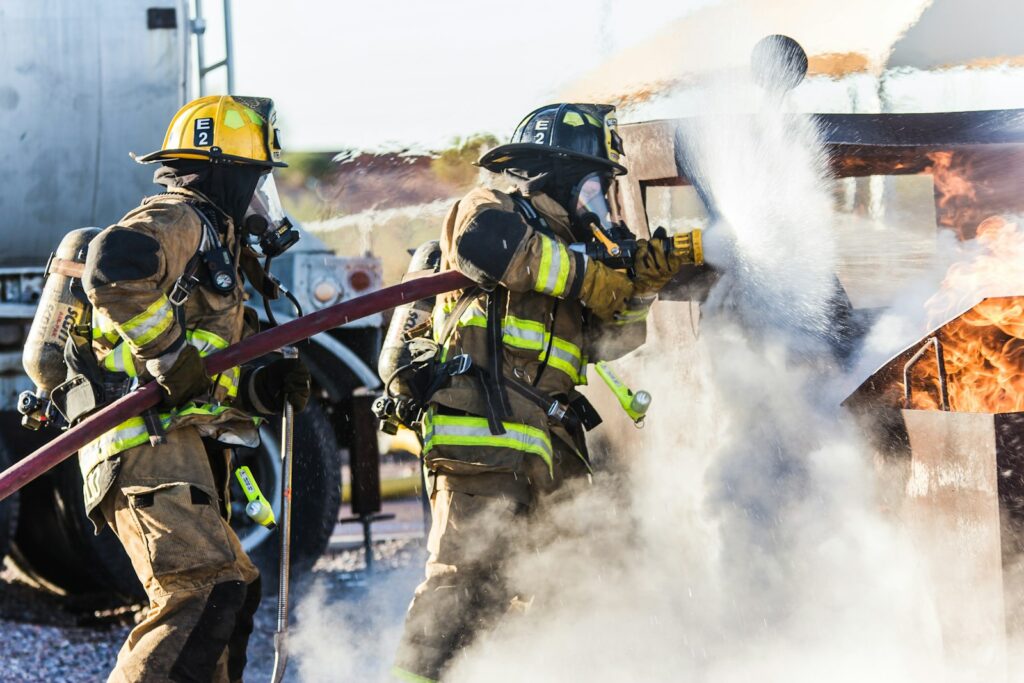
A step-by-step guide to becoming a firefighter: basic requirements, EMT and fire certifications, the physical and written tests, academy training, pay and career growth.
Quick answer: To become a firefighter in the US, you usually need to be at least 18 (often 21), have a high school diploma or GED and a driver’s licence, earn EMT certification, pass a written exam and a physical ability test such as the CPAT, complete interviews and background checks, and graduate from a fire academy before a probation period. Firefighters earned a median of $59,280 in May 2025, according to the BLS.
Firefighters do far more than fight fires. Most calls are medical emergencies, car accidents, rescues and hazardous materials incidents. It is physically and mentally demanding work, but also one of the most respected careers in any community.
This guide explains exactly how to become a firefighter: the minimum requirements, certifications, testing process, academy training, pay, job outlook and tips to stand out in a competitive hiring process.
Requirements differ by state, city and department, so always check the specific rules of the departments you want to join.
In this article
- What does a firefighter do?
- What skills and qualities do firefighters need?
- What are the basic requirements to become a firefighter?
- How to become a firefighter step by step
- How much do firefighters earn?
- Which certifications help firefighters?
- What types of firefighters are there?
- Can you start as a volunteer firefighter?
- What is the career path for a firefighter?
- Tips to pass the firefighter hiring process
- Frequently Asked Questions
- Final Thoughts
What does a firefighter do?
- Emergency response: fires, medical calls, vehicle crashes and rescues
- Emergency medical care: many firefighters are EMTs or paramedics
- Fire prevention: inspections, safety education and community outreach
- Equipment care: maintaining trucks, hoses, breathing apparatus and tools
- Training: constant drills to stay ready
- Wildland firefighting: some firefighters specialise in forest and grass fires
Shifts are often 24 hours on duty followed by 48 hours off, though schedules vary by department.
What skills and qualities do firefighters need?
- Physical strength and stamina: carrying people and heavy equipment in heat and smoke
- Calm under pressure: making quick, safe decisions in emergencies
- Teamwork: every task depends on trust within the crew
- Compassion: supporting patients and families in distress
- Problem-solving: adapting to unpredictable situations
- Mechanical aptitude: using pumps, saws, ladders and rescue tools
- Commitment to learning: training never stops in the fire service
What are the basic requirements to become a firefighter?
| Requirement | Typical standard |
|---|---|
| Age | 18 to 21 minimum, depending on the department |
| Education | High school diploma or GED; college fire science courses help |
| Licence | Valid driver’s licence, clean driving record |
| Medical certification | EMT-Basic often required or strongly preferred |
| Fitness | Pass a physical ability test such as the CPAT |
| Background | Criminal background check, drug screening |
| Health | Medical exam, vision and hearing standards |
How to become a firefighter step by step
1. Finish high school or get a GED
Focus on fitness, science and teamwork activities.
2. Earn EMT certification
An EMT course usually takes a few months and is required by many departments. Paramedic training takes longer but makes you more competitive.
3. Consider fire science education
A certificate or associate degree in fire science can improve your chances and help promotion later.
4. Get physically fit
Train for strength, endurance and carrying heavy equipment while wearing gear.
5. Pass the written exam
Tests cover reading comprehension, maths, mechanical reasoning and judgement.
6. Pass the physical ability test
The Candidate Physical Ability Test (CPAT) includes stair climbing, hose drag, equipment carry, ladder raise, forcible entry, search, rescue and ceiling breach.
7. Complete interviews and checks
Oral board interviews, background checks, medical and psychological evaluations.
8. Graduate from the fire academy
Academies typically last a few months and cover firefighting skills, hazardous materials and emergency medical care.
9. Complete probation
Most new firefighters serve a probation period while continuing training on the job.
How much do firefighters earn?
According to the US Bureau of Labor Statistics, firefighters earned a median of $59,280 per year in May 2025. There were about 355,300 firefighter jobs, with employment projected to grow 4% from 2025 to 2035 and about 26,800 openings each year, mostly to replace people who leave.
- Overtime: often adds significantly to pay
- Benefits: many departments offer strong pensions and health cover
- Location: large cities usually pay more
- Promotion: engineer, lieutenant, captain and chief roles pay more
Which certifications help firefighters?
- Firefighter I and II: core certifications based on NFPA professional qualification standards
- EMT-Basic and Paramedic: medical certifications that most departments value highly
- Hazardous materials: awareness and operations levels
- Driver/operator: for driving and pumping fire apparatus
- Fire inspector or investigator: for prevention and investigation roles
The National Fire Protection Association (NFPA) publishes the standards many of these certifications are based on.
Two candidates pass the written test. One is also a certified paramedic who volunteered at a local fire company for two years. The panel ranks that candidate higher because they can treat patients from day one and already know station life.
What types of firefighters are there?
| Type | Where they work |
|---|---|
| Municipal (structural) firefighter | City and county fire departments |
| Wildland firefighter | Forests and rural areas, often with federal or state agencies |
| Airport firefighter (ARFF) | Airports, handling aircraft emergencies |
| Industrial firefighter | Refineries, plants and large facilities |
| Military firefighter | Armed forces bases |
| Volunteer or on-call firefighter | Smaller communities |
Wildland firefighters may train through apprenticeships, which the BLS notes can last up to four years.
Can you start as a volunteer firefighter?
Yes. Many communities rely on volunteer or on-call firefighters. Volunteering gives you real experience, training and references, and it is a common route into paid departments.
Marcus joins his town’s volunteer fire company at 18, earns EMT and Firefighter I certifications through the company, and applies to a city department at 21. His experience helps him pass the academy near the top of his class.
What is the career path for a firefighter?
- Probationary firefighter: learning on the job under supervision.
- Firefighter: full member of a crew.
- Driver/engineer: drives and operates the fire engine.
- Lieutenant and captain: lead crews and stations.
- Battalion chief and fire chief: manage operations and whole departments.
Many firefighters also specialise as paramedics, inspectors, investigators or trainers.
Tips to pass the firefighter hiring process
- Start fitness training months before the physical test.
- Practise CPAT-style events while wearing a weighted vest.
- Take practice written exams.
- Prepare interview answers about teamwork, stress and community service.
- Keep a clean record online and offline.
- Apply to several departments to increase your chances.
Building a strong application is like any job search; see our guide to hobbies for a resume for showing teamwork and fitness.
Visit local fire stations and ask firefighters about their hiring process. Most are happy to share advice, and it shows departments you are genuinely interested.
Look up the hiring requirements for two fire departments near you and check the next written test and physical test dates. Then build a 12-week fitness plan to be ready.
Frequently Asked Questions
How long does it take to become a firefighter?
Often one to two years, including EMT training, testing, the hiring process and academy.
Do you need a degree to be a firefighter?
No. A high school diploma or GED is usually enough, though fire science courses help.
Do firefighters need to be EMTs?
Many departments require EMT certification, and most strongly prefer it.
What is the CPAT test?
The Candidate Physical Ability Test, a timed series of eight firefighting tasks used by many departments.
How much do firefighters make?
The BLS reports a median of $59,280 per year in May 2025, with more possible through overtime and promotion.
What is the age limit to become a firefighter?
Minimum ages range from 18 to 21; some departments have maximum entry ages too.
Final Thoughts
- Firefighters respond to fires, medical emergencies and rescues.
- Most need a diploma, driver’s licence, EMT certification and fitness.
- Expect written and physical tests, interviews, academy and probation.
- Volunteering and paramedic training can make you more competitive.