
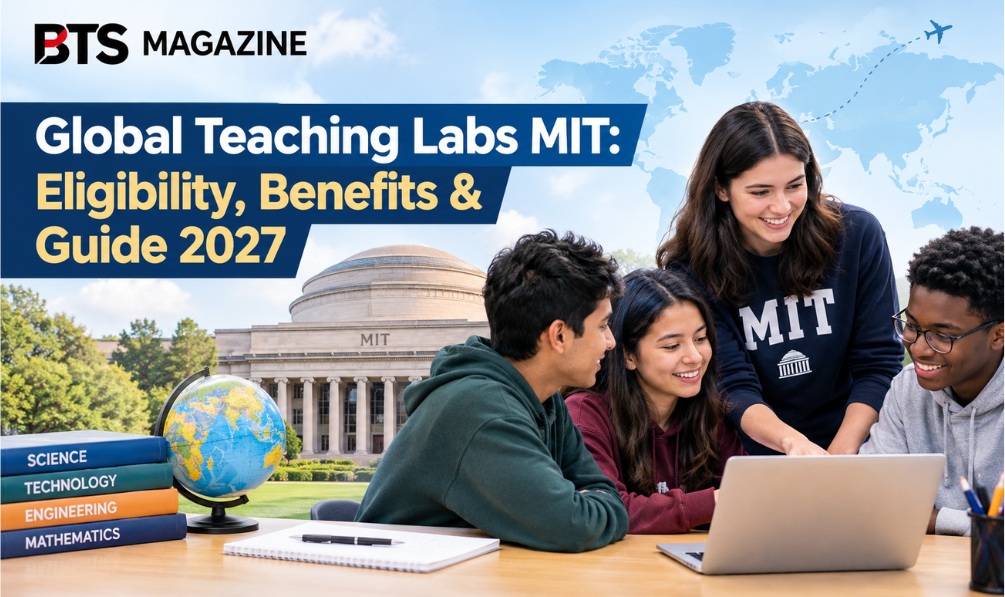
MIT Global Teaching Labs (GTL) is an international teaching program that gives selected Massachusetts Institute of Technology students the opportunity to share their knowledge with high school and university students in other countries. Organized through MIT International Science and Technology Initiatives (MISTI), the program combines practical teaching experience with cultural learning and international collaboration.
Most GTL placements take place over three to four weeks in January. Participants teach subjects such as science, technology, engineering, mathematics, computer science, artificial intelligence, robotics, and entrepreneurship, depending on the host country and available placement. Before travelling, selected students receive preparation and training to help them adapt to local classrooms and educational environments.
The program has specific academic requirements, a competitive selection process, and country-dependent language expectations. MIT also states that essential expenses, including airfare and housing, are covered through program funding arrangements, with a small stipend provided for meals and transportation.
In this guide, you will learn how MIT Global Teaching Labs works, who can apply, what students may teach, how funding works, and how to prepare for the application process. The information reflects the official MISTI guidance available for the 2027 program cycle.
What Is Global Teaching Labs?
Global Teaching Labs is an international teaching initiative associated with MIT International Science and Technology Initiatives (MISTI).
The basic concept behind the program is simple: teaching can be an effective way to deepen one’s own understanding. MIT students take subjects they already know and transform them into educational experiences for learners in another country.
Depending on the placement, participants may prepare classroom lessons, conduct experiments, organize workshops, support student projects or provide mentoring. At the same time, they develop practical skills in communication, collaboration, leadership and cross-cultural interaction.
This makes GTL more than an overseas teaching assignment. It combines education, international exposure and experiential learning in one program.
Global Teaching Labs at a Glance
| Detail | Information |
| Program | Global Teaching Labs (GTL) |
| Organization | MIT MISTI |
| Primary purpose | International teaching and experiential learning |
| Core subjects | STEM and related disciplines |
| Additional areas | Entrepreneurship, debate and other subjects |
| Typical period | January |
| Typical duration | About 3–4 weeks |
| Participants | Selected MIT students |
| Teaching environments | Schools and universities |
| Program costs | Essential expenses are generally funded |
MIT describes GTL as an opportunity for students to spend several weeks abroad teaching STEM-related courses. Depending on the destination, the curriculum can also extend into areas such as entrepreneurship and debate.
How Does Global Teaching Labs Work?
The GTL experience usually begins well before the participant boards a flight.
Students apply through MISTI and may go through an interview and selection process. Those who are chosen generally take part in preparation activities before leaving the United States.
Preparation can involve topics such as:
- Teaching and lesson-planning techniques
- Communication strategies
- Cultural awareness
- Understanding the host education system
- Health and safety
- Practical information about the destination
Once students reach their host country, their responsibilities can vary depending on the school and local partner.
A GTL participant may:
- Teach classroom lessons
- Lead STEM workshops
- Demonstrate scientific experiments
- Assist with student projects
- Provide tutoring or mentoring
- Collaborate with local teachers
- Develop hands-on educational activities
The exact format isn’t identical in every destination. Some students work as part of a teaching team, while others may have more independent classroom responsibilities.
What Subjects Do GTL Participants Teach?
STEM education is at the heart of Global Teaching Labs.
Depending on the specific placement, students may teach or develop activities around subjects such as:
- Mathematics
- Computer science
- Physics
- Engineering
- Robotics
- Artificial intelligence
- Machine learning
- Programming and coding
- Chemistry
- Biology
- Renewable energy
- Climate and sustainability
Some destinations also expand beyond traditional STEM subjects. Programs may include areas such as entrepreneurship, business, design, leadership, communication or debate.
The available subjects can change from one year to another because individual programs are designed around the requirements of participating schools, countries and local educational partners.
Where Is Global Teaching Labs Available?
GTL has operated in multiple regions around the world.
For the IAP 2026 cycle, MIT listed opportunities in regions including Africa, Asia, Europe, the Middle East and North Africa, and Latin America.
The listed destinations included countries such as:
- Angola
- Ghana
- Rwanda
- India
- Nepal
- South Korea
- Armenia
- Cyprus
- Kazakhstan
- Germany
- Italy
- Spain
- United Kingdom
- Chile
- Peru
- Uruguay
- Mexico
This list should not be treated as permanent. GTL destinations can change between application cycles as partnerships and program requirements evolve.
Students interested in a future cycle should therefore check the latest MISTI information instead of assuming that every previous destination will remain available.
Global Teaching Labs in the United Kingdom
The United Kingdom has been an important destination for GTL activities.
MISTI has described opportunities across England, Scotland and Wales.
In England, MIT participants have worked with schools in areas including London and the Southeast, with teaching activities covering subjects such as mathematics, physics, computer science and sustainability.
In Scotland, MISTI UK has partnered with Robert Gordon’s College in Aberdeen.
Wales has also developed a broader collaboration involving MISTI UK, the Welsh Government and Equal Education Partners.
Global Teaching Labs in Wales
The Welsh program focuses on bringing MIT student-teachers into schools and colleges to strengthen STEM education.
According to information cited in the original material, the 2025 program involved 12 MIT students, 34 schools and colleges, and more than 3,500 learners across Wales.
The activities can include:
- STEM workshops
- Interdisciplinary projects
- Tutoring
- Masterclasses
- Teacher collaboration
- Practical learning activities
One of the key ideas is to move beyond conventional classroom instruction. Students can be introduced to project-based activities that connect academic concepts with real-world challenges.
Who Is Eligible to Apply?
MIT Global Teaching Labs is primarily designed for eligible MIT students, rather than being a general international teaching program open to students from every university.
The requirements listed for the most recently referenced cycle included academic standing, an application, an interview and participation in preparation sessions.
Selection may consider several qualities, including:
- Knowledge of the relevant subject
- Ability to explain complicated concepts clearly
- Interest in hands-on teaching
- Classroom leadership
- Adaptability
- Teamwork
- Interest in the selected destination
- Cross-cultural communication skills
- Language ability when required
Individual destinations may have additional academic, language or class-year requirements.
Because eligibility criteria can change, prospective applicants should always review the requirements for the specific GTL placement they are considering.
Do You Need to Know Another Language?
Not necessarily.
Language requirements depend on the destination and individual program.
Some placements may require a certain level of proficiency, while others may simply prefer applicants who understand the local language.
For example, the requirements referenced for IAP 2026 included conversational or intermediate Spanish for Spain and Andorra and French for Ivory Coast. Other destinations listed language ability as a preference rather than an absolute requirement.
Because these rules can change, applicants should check the language requirements associated with their chosen destination during the relevant application cycle.
Is Global Teaching Labs Fully Funded?
For participating MIT students, MISTI describes its programs as designed to be cost-neutral.
Essential expenses such as airfare and housing can be covered through program funding, which may come from donors, host schools or a combination of sources. Participants may also receive a modest allowance to help with meals and transportation.
This funding structure helps make an international teaching experience accessible without requiring students to personally finance the main costs of the program.
However, applicants should always review the funding information for their particular GTL placement because financial arrangements can vary.
Why Does MIT Use Teaching as a Learning Method?
One of the most interesting aspects of GTL is that the teacher can also become the learner.
Understanding a subject academically is different from explaining it to someone who has never encountered the concept before. Teaching requires participants to organize their knowledge, communicate clearly and respond to unexpected questions.
A student may understand how to solve a complex physics or mathematics problem, for example, but explaining the same concept to younger students requires another level of understanding.
GTL encourages MIT participants to adapt their teaching to different academic levels, cultural environments and classroom expectations.
As a result, both sides can benefit: local students receive new educational experiences, while MIT participants strengthen their communication, leadership, teaching and problem-solving abilities.
Is Global Teaching Labs an Online Learning Platform?
No.
The phrase Global Teaching Labs could potentially make some people think of an online education website, tutoring platform or digital learning service. However, the MIT version of GTL is primarily an international experiential teaching program.
Participants generally travel to host countries and work directly with schools, universities and educational organizations.
Therefore, it is better understood as an international teaching and learning initiative rather than a conventional online course platform.
Is MIT Global Teaching Labs Legitimate?
Yes.
The MIT version of Global Teaching Labs is a documented program operated through MISTI, MIT’s international education and experiential learning initiative.
Information about program destinations, eligibility, preparation, funding and applications is provided through MIT-related resources. Individual GTL placements can also involve local schools, universities, government organizations and educational partners.
Anyone researching the program should still make sure they are looking at information associated with MIT MISTI, especially because the phrase “Global Teaching Labs” can refer to other initiatives as well.
Does “Global Teaching Labs” Always Mean MIT?
Not necessarily.
Although MIT’s GTL is one of the best-known programs using this name, another initiative exists at Ulm University in Germany.
Ulm University’s Global Teaching Labs program focuses on supporting international teaching projects and provides assistance and funding to teaching staff developing international or digitally connected educational projects.
The university has indicated that its initiative is offered across the 2026, 2027 and 2028 period.
This distinction is important for people searching online. If a webpage simply uses the phrase “Global Teaching Labs,” readers should check which university or organization is behind the program before assuming that it refers to MIT.
Benefits of the MIT Global Teaching Labs Experience
GTL can provide valuable experiences for both participating MIT students and students in host countries.
Benefits for MIT Students
Participants can develop:
- Teaching and presentation skills
- Greater confidence in public speaking
- Leadership abilities
- Teamwork experience
- International exposure
- Cultural awareness
- Problem-solving skills
- Communication skills
- Experience working in unfamiliar environments
Teaching abroad can also give participants a different perspective on their own academic knowledge.
Benefits for Host Schools
Host institutions can gain access to additional STEM activities, practical projects and educational experiences led by MIT students.
Students may interact with university-level instructors who bring different approaches to subjects such as science, engineering, mathematics and technology.
The result can be a classroom experience that emphasizes experimentation, creativity and real-world applications.
How to Apply for Global Teaching Labs
Eligible MIT students generally apply through the MISTI application system.
Applicants may identify preferred destinations, after which selection can consider factors such as:
- Academic background
- Subject expertise
- Teaching ability
- Communication skills
- Cultural adaptability
- Interest in the destination
- Needs of the specific program
Application deadlines aren’t necessarily the same every year.
The source material indicates that, as of August 11, 2026, details for the IAP 2027 GTL application—including the opening date, information session and deadline—were listed as TBD, with the MIT page indicating that updated information was expected.
For that reason, anyone planning to apply should rely on the latest MISTI announcement rather than an old application schedule.
Frequently Asked Questions (FAQs)
1. What is MIT Global Teaching Labs?
MIT Global Teaching Labs is an international educational program run through MIT MISTI. It sends selected MIT students abroad to teach and mentor high school and university students, mainly in STEM subjects. Depending on the location, placements may also include entrepreneurship, debate, and other specialized topics.
2. Who is eligible for MIT Global Teaching Labs?
Applicants must generally be MIT students in good academic standing, with a minimum GPA of 4.0 under the program’s stated requirements. They must submit a MISTI application, complete an interview, and attend required training sessions. Selection also considers subject knowledge, communication skills, adaptability, teaching ability, and interest in the host country.
3. Can first-year MIT students apply for GTL?
Yes, first-year students can apply, but their eligibility is restricted to specific countries and subjects. The available options depend on the current program guidelines. Applicants should review the official MISTI page carefully before choosing their preferred destinations.
4. Does MIT Global Teaching Labs cover travel expenses?
MIT MISTI describes its programs as designed to be cost-neutral. Funding arrangements cover essential expenses, including airfare and housing, and participants receive a small stipend for meals and transportation. Students should confirm the specific arrangements for their selected placement before travelling.
5. Which countries participate in Global Teaching Labs?
The 2027 program information lists opportunities across Africa, Asia, Europe, and Latin America. Locations include India, South Korea, Mexico, Peru, Uruguay, Germany, Italy, Spain, Portugal, and several other countries. The exact destinations, subjects, and available placements can vary by program cycle.
6. What subjects do students teach during GTL?
Teaching subjects vary by location. Common options include computer science, artificial intelligence, machine learning, robotics, mathematics, physics, chemistry, and other STEM disciplines. Some placements also cover entrepreneurship, business-related topics, data communication, or debate.
7. Is teaching experience required to join MIT Global Teaching Labs?
Teaching experience is not listed as a universal requirement for every placement. However, some country-specific opportunities require or prefer previous experience. Applicants should also demonstrate that they can explain complex ideas clearly, guide learners, manage classroom activities, and work effectively with others.
8. When is the MIT Global Teaching Labs application deadline for 2027?
According to MIT MISTI’s published 2027 timeline, the priority deadline was September 21, 2026, and the final deadline was September 23, 2026. As of October 16, 2026, both dates have passed. Applicants should contact MISTI or monitor the official website for any updates and information about future application cycles.
9. Do applicants need to speak the local language?
Language requirements depend on the host country and placement. Some programs prefer applicants who speak the local language, while others have no general language requirement. Certain placements may specifically seek speakers of languages such as Spanish, Portuguese, Korean, or Mandarin.
10. How can students apply for MIT Global Teaching Labs?
Eligible MIT students should review the official GTL program details, compare country-specific requirements, and submit their application through the MISTI Portal when applications are open. The application allows students to select first- and second-choice countries. Selected applicants may be invited to an interview before final decisions are made.
Conclusion
MIT Global Teaching Labs offers selected MIT students a valuable opportunity to apply their academic knowledge in international classrooms while developing communication, leadership, and cross-cultural skills. Through short-term teaching placements, participants can support students abroad, explore different education systems, and gain practical experience beyond the traditional classroom.
However, joining the program requires careful preparation. Applicants should meet the academic requirements, understand the subject and language expectations of their preferred country, and demonstrate a genuine interest in teaching and international collaboration. Although essential travel and accommodation expenses are covered through the program’s funding arrangements, students should verify the details of their individual placement.
For the 2027 cycle, MIT MISTI listed September 23, 2026, as the final application deadline, which has now passed. Students interested in future opportunities should check the official Global Teaching Labs website for updated dates, participating locations, and application instructions.
Ultimately, GTL is more than an overseas teaching experience. It is an opportunity to share knowledge, learn from different communities, and build skills that can support future academic and professional goals.
Read also: Spend Mark Zuckerberg Money NealFun.org: How to Play the Game