

Introduction
FRA-BOC, sometimes written online as “Fraboc,” was an Australian clinical tool known as Familial Risk Assessment – Breast and Ovarian Cancer. It was created to help healthcare professionals evaluate a woman’s likelihood of developing breast or ovarian cancer by looking closely at her family cancer history.
- Introduction
- What Does FRA-BOC Stand For?
- What Was FRA-BOC Used For?
- Who Was FRA-BOC Intended For?
- Why Was Family History Important?
- What Information Could Be Considered?
- How Does Family History Affect Risk?
- FRA-BOC Was Not a Cancer Test
- What Was the Difference Between Familial Risk and Genetic Risk?
- Why Was FRA-BOC Retired?
- What Replaced FRA-BOC?
- How Is iPrevent Different From FRA-BOC?
- What Risk Categories Does iPrevent Use?
- What Information Does Modern Risk Assessment Consider?
- Why Accurate Family Information Matters
- Common Misunderstandings About FRA-BOC
- Was FRA-BOC a Genetic Test?
- Was FRA-BOC Used to Diagnose Cancer?
- Does Family History Automatically Mean High Risk?
- Does Family History Prove an Inherited Mutation?
- Why Do People Still Search for FRA-BOC?
- How Should an Old FRA-BOC Reference Be Interpreted?
- What Can FRA-BOC Teach Us Today?
- Quick Facts About FRA-BOC
- Frequently Asked Questions
- What is FRA-BOC?
- Is FRA-BOC still available?
- What replaced FRA-BOC?
- Was FRA-BOC a cancer diagnosis?
- Was FRA-BOC a genetic test?
- Does having breast cancer in the family mean I have a hereditary mutation?
- What is iPrevent?
- Why might FRA-BOC appear in an old medical record?
- What Are the Main Takeaways?
- Sources & Further Reading
FRA-BOC was not a cancer diagnosis, genetic test, medication, or screening procedure. Instead, it was a risk-assessment resource that helped clinicians understand whether a patient’s family history appeared consistent with average, moderately increased, or higher familial cancer risk.
The tool is now historical. Cancer Australia no longer provides the original FRA-BOC tool on its website, and Australian healthcare resources have moved toward newer approaches for assessing breast cancer risk.
Understanding FRA-BOC can still be useful when reading older Australian medical documents, referral notes, or online resources that mention the acronym.
What Does FRA-BOC Stand For?
FRA-BOC stands for Familial Risk Assessment – Breast and Ovarian Cancer.
The name describes exactly what the tool was designed to do:
- FRA = Familial Risk Assessment
- BOC = Breast and Ovarian Cancer
The word “familial” is important. FRA-BOC focused on patterns within a person’s family rather than directly testing their DNA.
A family history can sometimes indicate an increased chance of cancer, but it does not automatically prove that a person carries an inherited cancer-related mutation.
What Was FRA-BOC Used For?
FRA-BOC was developed to give healthcare professionals a structured way to examine family histories involving breast and ovarian cancer.
Family histories can contain many details. For example, a person may have:
- One or more close relatives with breast cancer
- Relatives diagnosed at relatively young ages
- Ovarian cancer on one side of the family
- Breast cancer affecting several relatives
- Breast cancer in a male relative
- Cancer occurring in both breasts
- Different cancer patterns among relatives
Looking at these details together can provide more useful information than simply asking whether someone has “cancer in the family.”
The historical approach behind FRA-BOC therefore helped clinicians organize family-history information and determine whether additional assessment might be appropriate.
Who Was FRA-BOC Intended For?
FRA-BOC was primarily designed for health professionals, rather than for people to use as a self-diagnosis calculator.
Doctors, nurses, and other appropriate healthcare professionals could use family-history information to support discussions about:
- Further risk assessment
- Breast cancer screening
- Specialist referral
- Genetic assessment
- Possible prevention strategies
The tool was therefore part of a clinical decision-making process rather than a standalone diagnosis.
Why Was Family History Important?
Family history remains an important factor in assessing cancer risk.
If several close blood relatives have experienced breast or ovarian cancer, particularly when diagnoses occurred at younger ages, a healthcare professional may consider whether the pattern suggests increased familial risk.
However, family history has limitations.
Families share more than genes. They may also share lifestyle habits, environmental exposures, and other factors. As a result, cancer appearing in several relatives does not necessarily mean that the family carries a hereditary cancer mutation.
Peter MacCallum Cancer Centre also distinguishes between familial cancer, where cancer appears to run in a family without a known genetic explanation, and genetic cancer, where a specific inherited gene change is responsible for increased risk.
What Information Could Be Considered?
A meaningful family-history assessment can include several types of information.
Important details may include:
- Which relatives had cancer
- The relationship between the person and each affected relative
- Whether the relatives were on the mother’s or father’s side
- The type of cancer diagnosed
- Approximate age at diagnosis
- Whether multiple relatives were affected
- Whether breast and ovarian cancer occurred within the same family
- Whether a relative had a known hereditary cancer mutation
- Whether a person had previous breast disease
The relationship between relatives can matter because a cancer diagnosis in a close first-degree relative may have different implications from a diagnosis in a more distant relative.
How Does Family History Affect Risk?
Risk assessment generally depends on the overall pattern rather than one isolated family member.
For example, having one relative with breast cancer does not automatically place someone in a high-risk category. The number of affected relatives, their ages at diagnosis, the types of cancer involved, and the biological relationship between relatives can all influence the assessment.
This is why structured risk assessment can be more informative than relying on a single family-history detail.
At the same time, risk estimates are population-based calculations and should not be interpreted as a personal diagnosis.
FRA-BOC Was Not a Cancer Test
One of the most important points about FRA-BOC is that it was a risk-assessment tool, not a diagnostic test.
A risk assessment asks a question such as:
What is this person’s likelihood of developing cancer based on known risk factors?
A diagnostic investigation asks a different question:
Is cancer currently present?
Those are not the same thing.
Consequently, seeing FRA-BOC mentioned in an old medical document should not automatically be interpreted as evidence that the person had breast or ovarian cancer.
The surrounding clinical information is needed to understand why the assessment was performed.
What Was the Difference Between Familial Risk and Genetic Risk?
Familial and genetic risk are related, but they are not identical.
A person may have several relatives with cancer without having an identifiable inherited cancer-predisposing mutation. Conversely, someone can carry an inherited mutation even when their known family history appears limited.
Certain inherited genes, including BRCA1 and BRCA2, are associated with increased risks of breast and ovarian cancers.
For general background on breast cancer, readers can also consult Wikipedia’s breast cancer overview.
Genetic testing, however, is a separate clinical process from a family-history risk assessment. A healthcare professional may decide that genetic counseling or testing is appropriate based on the individual’s family pattern and other circumstances.
Why Was FRA-BOC Retired?
FRA-BOC is no longer available as the current Cancer Australia online tool.
Medical risk assessment changes over time as research, clinical models, and technology develop. Newer systems can incorporate a broader selection of personal and family risk factors than older family-history-focused approaches.
The retirement of FRA-BOC does not mean that family history has become unimportant. Instead, family history is now considered alongside a wider collection of relevant risk factors.
What Replaced FRA-BOC?
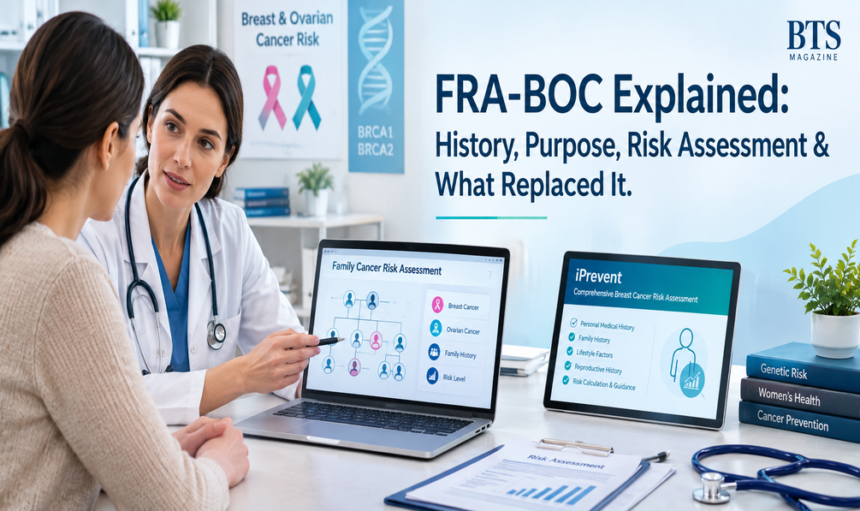
For contemporary breast cancer risk assessment in Australia, iPrevent is one of the tools used in current clinical practice and prevention discussions.
iPrevent was developed to provide a broader assessment of breast cancer risk. Depending on the information entered, it can consider factors such as:
- Personal medical history
- Family history
- Reproductive factors
- Lifestyle factors
- Previous breast disease
- Breast, ovarian, pancreatic, and prostate cancers among relatives
Peter MacCallum Cancer Centre states that iPrevent uses validated risk algorithms, including IBIS and BOADICEA/CanRisk, depending on the information provided.
How Is iPrevent Different From FRA-BOC?
Although both tools relate to cancer-risk assessment, they should not be treated as identical systems.
FRA-BOC
FRA-BOC was an older Australian tool focused strongly on familial risk involving breast and ovarian cancer.
Its main purpose was to help health professionals organize and interpret family-history information.
iPrevent
iPrevent is a newer breast cancer risk-assessment and management tool that incorporates family history together with personal, reproductive, lifestyle, and previous breast-disease factors.
It can estimate breast cancer risk over different time periods and provide information that can support conversations about screening and prevention.
This broader approach reflects the fact that breast cancer risk is influenced by multiple factors rather than family history alone.
What Risk Categories Does iPrevent Use?
According to Peter MacCallum Cancer Centre’s information for health professionals, iPrevent uses risk categories based on the estimated risk relative to population risk.
The categories are:
- Average risk: less than 1.5 times population risk
- Moderate risk: 1.5 to 3 times population risk
- High risk: more than 3 times population risk
These categories are intended to support clinical risk-management discussions. They should not be confused with a cancer diagnosis.
Risk calculations can also change when important personal or family information changes, which is why risk assessment may need to be revisited over time.
What Information Does Modern Risk Assessment Consider?
Modern tools can evaluate a wider range of information than a family-history-only approach.
For example, iPrevent asks about personal medical history and previous breast biopsies, as well as family cancer history. Family information can include relatives such as parents, grandparents, siblings, aunts, uncles, nieces, and nephews.
The tool also asks about the approximate ages at which relatives were diagnosed with breast, ovarian, pancreatic, or prostate cancer.
According to Peter MacCallum Cancer Centre, having more complete family information can make the assessment more accurate, although the tool can still be used when some details are unknown.
Why Accurate Family Information Matters
When discussing cancer risk with a healthcare professional, accurate family information can be helpful.
If possible, it may be useful to find out:
- Which relatives were diagnosed with cancer.
- What type of cancer they had.
- Approximately how old they were when diagnosed.
- Whether the cancer occurred on the maternal or paternal side.
- Whether several relatives were affected.
- Whether anyone in the family has undergone genetic testing.
- Whether a known hereditary mutation was identified.
Even approximate information can sometimes be useful, but confirmed details can provide a stronger basis for assessment.
Common Misunderstandings About FRA-BOC
Was FRA-BOC a Genetic Test?
No.
FRA-BOC was a familial risk-assessment tool. It used information about family history rather than directly analyzing someone’s DNA.
Genetic testing is a separate medical process.
Was FRA-BOC Used to Diagnose Cancer?
No.
Its purpose was to estimate risk rather than identify an existing tumor.
A person could undergo a risk assessment without having cancer.
Does Family History Automatically Mean High Risk?
No.
Having a relative with breast or ovarian cancer does not automatically place someone in a high-risk category.
The overall family pattern matters, including the number of affected relatives, their ages, cancer types, and biological relationships.
Does Family History Prove an Inherited Mutation?
No.
A family history can sometimes raise suspicion of hereditary cancer risk, but it cannot by itself establish that a person carries a particular mutation.
Genetic counseling or testing may be considered in appropriate circumstances.
Why Do People Still Search for FRA-BOC?
Although the tool is no longer current, the acronym can still appear in older Australian healthcare information.
People may encounter FRA-BOC when reviewing:
- Older medical records
- Previous referral letters
- Archived health websites
- Historical clinical guidance
- Older cancer-risk documentation
Someone who finds the term today may naturally wonder whether FRA-BOC is still available or whether it represents a medical diagnosis.
The important distinction is that FRA-BOC has historical significance, while newer risk-assessment approaches are used for current clinical purposes.
How Should an Old FRA-BOC Reference Be Interpreted?
An old reference to FRA-BOC should be interpreted within the context of the document in which it appears.
It may indicate that a healthcare professional was evaluating family-related breast or ovarian cancer risk at that time.
It does not, on its own, establish:
- That the person had cancer
- That cancer was detected
- That the person carried a BRCA mutation
- That the person required genetic testing
- That the person was considered high risk
Those conclusions require the surrounding medical information and, where appropriate, professional interpretation.
What Can FRA-BOC Teach Us Today?
The history of FRA-BOC demonstrates why family cancer history can be an important part of preventive healthcare.
It also highlights several important distinctions:
Risk is not diagnosis.
A higher estimated risk does not mean cancer is present.
Family history is not the same as genetic testing.
A family pattern can raise questions about hereditary risk, but it cannot establish a mutation by itself.
Risk assessment changes over time.
Newer tools can combine family history with personal and lifestyle information.
Historical tools should not be confused with current tools.
An old medical resource may describe a system that is no longer available.
Quick Facts About FRA-BOC
| Fact | Details |
|---|---|
| Full name | Familial Risk Assessment – Breast and Ovarian Cancer |
| Country | Australia |
| Main purpose | Familial breast and ovarian cancer risk assessment |
| Primary users | Health professionals |
| Format | Online clinical assessment tool |
| Current status | Former/discontinued tool |
| Main information used | Family cancer history |
| Diagnostic test? | No |
| Genetic test? | No |
| Modern breast-risk assessment | Tools such as iPrevent |
Frequently Asked Questions
What is FRA-BOC?
FRA-BOC was an Australian online clinical tool called Familial Risk Assessment – Breast and Ovarian Cancer. It helped health professionals evaluate familial risk of breast and ovarian cancer using family-history information.
Is FRA-BOC still available?
No. FRA-BOC is a former tool and is no longer available through Cancer Australia’s website.
What replaced FRA-BOC?
Modern Australian breast cancer risk assessment can use newer validated approaches, including iPrevent. iPrevent incorporates family history along with several personal and other risk factors.
Was FRA-BOC a cancer diagnosis?
No. FRA-BOC assessed the likelihood of developing breast or ovarian cancer based on risk information. It was not designed to diagnose existing cancer.
Was FRA-BOC a genetic test?
No. The tool assessed familial risk. Genetic testing is a separate process that can determine whether a person carries specific inherited genetic variants.
Does having breast cancer in the family mean I have a hereditary mutation?
Not necessarily. Cancer can occur in families for genetic and non-genetic reasons. A healthcare professional can assess the overall family pattern and determine whether genetic counseling or testing may be appropriate.
What is iPrevent?
iPrevent is a breast cancer risk-assessment and risk-management decision-support tool developed in Australia. It can incorporate family history, personal medical information, reproductive factors, lifestyle factors, and previous breast disease.
Why might FRA-BOC appear in an old medical record?
It may indicate that a healthcare professional previously used or referred to the historical FRA-BOC risk-assessment approach. The reference should be interpreted alongside the rest of the medical record.
What Are the Main Takeaways?
FRA-BOC, or Familial Risk Assessment – Breast and Ovarian Cancer, was an Australian clinical tool designed to help healthcare professionals assess familial risk involving breast and ovarian cancer.
Its role was to organize family-history information and support clinical decisions. It was not a cancer diagnostic test and not a genetic test.
FRA-BOC is now a historical tool rather than a current Cancer Australia online resource. Modern breast cancer risk assessment can use newer validated approaches such as iPrevent, which considers family history alongside personal, reproductive, lifestyle, and previous breast-disease information.
The most important point is that family history, genetic risk, risk assessment, screening, and cancer diagnosis are different concepts. A reference to FRA-BOC in an older document should therefore be understood in its historical clinical context rather than interpreted as proof of cancer or an inherited mutation.
For current concerns about breast or ovarian cancer risk, people should use up-to-date medical guidance and discuss their individual circumstances with an appropriately qualified healthcare professional.
Sources & Further Reading
- Cancer Australia — information on breast cancer risk assessment and familial risk
- Peter MacCallum Cancer Centre — iPrevent and family cancer resources
- Australian cancer-care guidance on current breast cancer risk assessment tools
Read also: HQPotner Explained: Meaning, Uses, Features, Benefits & What It Really Means