

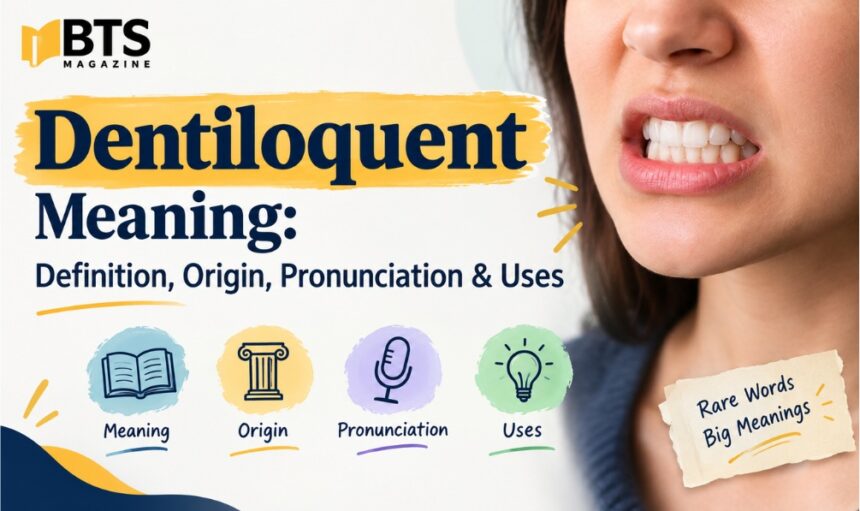
Dentiloquent is an uncommon English adjective used to describe speech made while the teeth are held close together or the jaw remains tightly positioned. In everyday language, the same idea is usually expressed by saying that someone is “speaking through clenched teeth.”
- What Does Dentiloquent Mean?
- Dentiloquent Meaning in Simple English
- Dentiloquent Origin and Etymology
- How Do You Pronounce Dentiloquent?
- Is Dentiloquent a Real English Word?
- Why Is Dentiloquent So Uncommon?
- What Does Dentiloquent Speech Sound Like?
- Why Would Someone Speak Through Their Teeth?
- Dentiloquent vs. Mumbling
- Dentiloquent vs. Muttering
- Dentiloquent vs. Whispering
- Dentiloquent vs. Ventriloquism
- How Is Dentiloquent Used Grammatically?
- Dentiloquent Example Sentences
- Using Dentiloquent in Creative Writing
- Other Rare Words Connected With Speech
- When Should You Use Dentiloquent?
- Why Is Dentiloquent Worth Learning?
- Final Thoughts
- Frequently Asked Questions
The term is rarely heard in normal conversation, but it can be useful in discussions about unusual English words, etymology, descriptive writing, and language. It focuses mainly on how speech is physically produced, rather than automatically describing the speaker’s emotions or intentions.
Understanding the word becomes easier when its definition, pronunciation, roots, grammatical use, and examples are considered together.
What Does Dentiloquent Mean?
Dentiloquent describes a person speaking through or between the teeth, particularly when the teeth are close together and normal jaw movement is restricted.
This position can change the quality of someone’s speech. The voice may sound tight, controlled, narrow, strained, or slightly muffled. However, Dentiloquent does not necessarily mean that the speaker is difficult to understand. A person can speak with limited mouth movement while still producing clear words.
The word describes the physical manner of speaking, not necessarily the reason behind it.
For example, someone might speak this way because they are angry, nervous, uncomfortable, acting, or deliberately trying to control their expression. Those meanings depend on the surrounding situation.
Dentiloquent Meaning in Simple English
In simple terms, Dentiloquent means talking through your teeth.
Picture someone keeping their jaw fairly tight while speaking. Their teeth remain close together, and their mouth does not open as widely as it normally would during relaxed conversation. That is the basic idea behind Dentiloquent.
The familiar expression “speaking through clenched teeth” communicates almost the same concept and is much easier for most readers to understand.
For instance, imagine someone involved in a tense argument who is trying not to lose control. Instead of opening their mouth normally, they keep their jaw tight and continue talking. Their speech could be described as Dentiloquent.
The word describes the speech pattern, while the situation explains the person’s emotions.
Dentiloquent Origin and Etymology
The meaning of Dentiloquent becomes clearer when its word parts are examined.
The first part is related to teeth. It connects with the Latin dens, meaning “tooth,” and the related dent- form found in many English words. Familiar examples include dental, dentist, dentition, and dentistry.
The second part relates to speaking. It is associated with the Latin verb loqui, meaning “to speak.” This root appears in several English words connected with speech and language, including eloquent, loquacious, colloquy, and soliloquy.
You can learn more about the Latin language and its influence on English through Wikipedia’s Latin language overview.
When the two ideas are considered together, Dentiloquent becomes easier to remember: the word combines the concept of teeth with the concept of speaking.
How Do You Pronounce Dentiloquent?
Dentiloquent may look challenging because it is not a word most English speakers encounter regularly.
A useful approximate pronunciation is:
den-TIL-uh-kwunt
Breaking it into smaller parts can make the word easier to say. The “den” beginning can be associated with dental words, while the middle and ending follow the sound pattern of the broader -loquent family.
Because the word is rare, pronunciation guides may vary slightly between sources. The easiest approach is to say the word slowly by its individual sound sections and then combine them into one word.
It is also important to remember that Dentiloquent describes a style of speaking. You do not need to pronounce the word itself through clenched teeth.
Is Dentiloquent a Real English Word?
Dentiloquent is used as a rare English vocabulary term, but it is far less common than ordinary words such as speaking, whispering, or mumbling.
Its rarity is important when deciding how to use it. A word can appear in vocabulary collections or language discussions without becoming part of everyday English. Dentiloquent belongs to this less-common category.
For many readers, the phrase “speaking through clenched teeth” will be immediately understandable, while Dentiloquent may require context or a definition.
That does not make the word useless. English contains many rare, literary, historical, and specialist terms. Dentiloquent can be useful when a writer specifically wants a concise word for this particular physical manner of speaking.
Why Is Dentiloquent So Uncommon?
The main reason is simple: English already has a familiar phrase that expresses the same basic idea.
Instead of saying:
“He was Dentiloquent.”
A person would normally say:
“He was speaking through clenched teeth.”
The second version requires no special vocabulary knowledge, so there is little reason for people to replace it with a rare adjective in everyday conversation.
Still, uncommon words can have value. They may be interesting to language learners, writers, crossword enthusiasts, etymology fans, and people who enjoy discovering unusual vocabulary.
Dentiloquent is a good example of a word that is specific but not widely used.
What Does Dentiloquent Speech Sound Like?
There is no single sound that every Dentiloquent speaker produces.
When the jaw is restricted and the teeth remain close together, normal articulation can change. Depending on the person and how tightly the mouth is held, the resulting speech might sound:
- Tight
- Restrained
- Pressed
- Narrow
- Tense
- Slightly muffled
- Controlled
The degree of clarity can also vary.
Someone may speak through nearly clenched teeth while remaining perfectly understandable. Another person may become harder to understand because their jaw and mouth movement are more restricted.
Therefore, Dentiloquent should be understood as a description of speech production, rather than a specific type of sound.
Why Would Someone Speak Through Their Teeth?
There are many possible reasons.
Anger or Frustration
Anger is probably the situation most people associate with clenched teeth. Someone trying to remain calm may tighten their jaw while continuing to speak.
Stress or Tension
A person under pressure may naturally hold their jaw tightly. Their speech can become more restricted as a result.
Fear or Discomfort
Physical or emotional discomfort may also affect the way someone holds their mouth while speaking.
Deliberate Performance
Actors can intentionally restrict their jaw movement to create a particular character or emotional effect. In this case, the manner of speech is part of the performance rather than an involuntary reaction.
Self-Control
Someone may consciously keep their voice and facial movements controlled during a difficult conversation. Speaking through nearly closed teeth can become part of that restrained presentation.
The important point is that Dentiloquent does not itself mean angry. The word describes the physical delivery. Context is needed to determine the emotion.
Dentiloquent vs. Mumbling
Dentiloquent and mumbling can sometimes sound similar, but they describe different things.
Mumbling generally refers to speech that is quiet, indistinct, poorly articulated, or difficult to hear clearly. A person can mumble without clenching their teeth.
Dentiloquent, on the other hand, focuses specifically on the relationship between speech and the position of the teeth or jaw.
For example:
- A student gives a low, unclear answer while looking at the floor → this may be mumbling.
- A character keeps their jaw tight and speaks through nearly closed teeth → this is closer to Dentiloquent speech.
The distinction is mainly about what the description emphasizes.
Dentiloquent vs. Muttering
Muttering usually means speaking in a low voice, often in a way that is difficult for others to hear or understand.
A person can mutter with a relaxed mouth, so clenched teeth are not a necessary part of muttering.
Dentiloquent is more physically specific because the position of the teeth or restricted jaw movement is central to the description.
The two behaviors can overlap, but they are not exact synonyms.
Dentiloquent vs. Whispering
Whispering is another separate concept.
A whisper involves producing speech in a quiet, breathy manner. It does not require the speaker to keep their teeth together.
Someone could potentially whisper while holding their teeth close together, but the two terms describe different features of speech:
- Dentiloquent → focuses on teeth and jaw position.
- Whispering → focuses on a quiet, breathy method of speaking.
Understanding this difference helps prevent the words from being treated as interchangeable.
Dentiloquent vs. Ventriloquism
Dentiloquent should not be confused with ventriloquism.
Ventriloquism is a performance technique in which a person controls visible mouth movements while creating the impression that the voice is coming from another source, traditionally a puppet or object.
Dentiloquent does not involve an illusion about where a voice originates. It simply describes speech produced with the teeth held close or the jaw restricted.
The two concepts therefore involve very different aspects of speech.
How Is Dentiloquent Used Grammatically?
Dentiloquent functions as an adjective.
It can describe nouns related to speech, such as:
- Dentiloquent voice
- Dentiloquent speech
- Dentiloquent reply
- Dentiloquent warning
- Dentiloquent delivery
- Dentiloquent response
Because the term is unfamiliar to many readers, context is especially useful.
For example:
“He gave a Dentiloquent reply, keeping his jaw tight and his teeth barely apart.”
The second part of the sentence gives readers enough information to understand the rare adjective without needing to stop and search for its definition.
The adjective describes the manner of delivery, not the actual message.
Dentiloquent Example Sentences
Here are some examples showing how the word can work in context:
- She gave a Dentiloquent answer while keeping her jaw tightly closed.
- His Dentiloquent warning was clear despite the limited movement of his mouth.
- The actor used a Dentiloquent delivery to portray a character struggling to control his anger.
- Her Dentiloquent speech made the tense conversation feel even more restrained.
- The unusual character spoke in a Dentiloquent manner throughout the scene.
- Although his voice sounded tight, his Dentiloquent response was still easy to understand.
These examples show why context matters when using an uncommon word.
Using Dentiloquent in Creative Writing
Dentiloquent can be particularly useful in fiction and descriptive writing.
Writers often need to communicate emotions through physical behavior rather than simply telling readers how a character feels. A tightly controlled jaw, restricted mouth movement, and tense speech can reveal conflict beneath apparently calm dialogue.
For example, a character may say something polite while speaking through clenched teeth. The contrast between the polite words and the physical delivery can create tension.
The word may also be useful when describing:
- Character performances
- Dramatic scenes
- Dialogue
- Acting techniques
- Unusual speaking styles
- Character studies
However, writers should consider their audience. Because Dentiloquent is rare, using the familiar phrase “through clenched teeth” may sometimes be more effective.
Good writing is not about choosing the most unusual word. It is about choosing the word that communicates the idea clearly.
Other Rare Words Connected With Speech
Dentiloquent is part of an interesting group of words that contain elements associated with speaking.
Grandiloquent
Grandiloquent describes language that is overly elaborate, impressive, pompous, or lofty.
Unlike Dentiloquent, it is concerned with the style of language, not the position of the teeth.
Loquacious
Loquacious describes someone who talks a lot or is very talkative.
Somniloquent
Somniloquent refers to speaking while asleep.
Melliloquent
Melliloquent is a rare term associated with pleasant or sweet-sounding speech.
Recognizing the speech-related roots in these words can make unusual vocabulary easier to understand and remember.
When Should You Use Dentiloquent?
Dentiloquent is most appropriate when you specifically need to describe speech produced through close or clenched teeth.
It may fit well in:
- Creative writing
- Vocabulary articles
- Language discussions
- Literary analysis
- Character descriptions
- Scripts
- Discussions of unusual English words
For everyday communication, however, “speaking through clenched teeth” is usually clearer.
In business writing, beginner-level educational content, instructions, or casual conversation, an unfamiliar word can create unnecessary confusion. In those situations, plain language is often the better choice.
The right choice depends on your audience and purpose.
Why Is Dentiloquent Worth Learning?
Dentiloquent may not become part of your daily vocabulary, but it offers an interesting example of how English can express a very specific physical action with a single adjective.
It also demonstrates how word roots can help readers understand unfamiliar terms.
The dent- element points toward teeth, while the -loquent element connects with speaking. Once these connections are understood, the word becomes much easier to remember.
More importantly, learning a rare word does not mean you need to use it everywhere. Knowing both Dentiloquent and the familiar phrase “speaking through clenched teeth” gives you more choices as a writer.
The best vocabulary choice is the one that communicates the intended idea to the intended audience.
Final Thoughts
Dentiloquent is a rare English adjective describing speech produced while the teeth are held close together or the jaw is tightly positioned. It focuses on the physical manner of speaking, rather than automatically indicating anger, fear, frustration, or another emotion.
The word can be distinguished from related concepts such as mumbling, muttering, whispering, and ventriloquism because each describes a different feature of speech.
For everyday readers, “speaking through clenched teeth” will usually be the clearer expression. Dentiloquent is more useful in vocabulary discussions and descriptive writing where a precise and unusual adjective is appropriate.
Its real value comes from its specificity: it gives a concise name to a recognizable but uncommon way of speaking.
Frequently Asked Questions
What does Dentiloquent mean?
Dentiloquent means speaking through or between the teeth, generally while the teeth are held close together and the jaw has limited movement. It describes the physical manner of speech rather than the speaker’s emotions.
Is Dentiloquent a real English word?
Yes, Dentiloquent is used as a rare English vocabulary term associated with speaking through one’s teeth. It is uncommon in everyday speech, which is why the phrase “speaking through clenched teeth” is more familiar.
How do you pronounce Dentiloquent?
Dentiloquent can be pronounced approximately as den-TIL-uh-kwunt. Saying the word in smaller sound groups can make it easier to pronounce.
Does Dentiloquent mean speaking angrily?
No. Dentiloquent describes how the speech is produced, not why someone is speaking that way. Anger is one possible context, but tension, discomfort, stress, self-control, or acting can also produce similar speech.
What is the difference between Dentiloquent and mumbling?
Dentiloquent focuses on speech produced through close or clenched teeth, while mumbling generally refers to speech that is quiet, indistinct, or poorly articulated. A Dentiloquent speaker can still be understandable.
Is Dentiloquent commonly used?
No. Dentiloquent is a rare vocabulary term. Most English speakers are more likely to use the phrase “speaking through clenched teeth” because it is immediately familiar.
Can Dentiloquent be used in creative writing?
Yes. It can be useful when describing a character’s physical manner of speaking, especially during tense or controlled scenes. Because the word is uncommon, writers should provide enough context for readers to understand it.
Read also: HQPotner Explained: Meaning, Uses, Features, Benefits & What It Really Means