

Bass Clef Explained is one of those things that looks confusing at first, but once it clicks, it stays with you. If you play piano, cello, trombone, or sing low notes, you’ll bump into it all the time. So let’s break it down in plain language.
- What Is the Bass Clef?
- A Quick Look at the History
- What the Bass Clef Symbol Means
- Understanding the Staff and Lines
- How to Read Bass Clef Notes
- What Are Ledger Lines?
- Instruments That Use the Bass Clef
- Bass Clef vs Treble Clef
- Tips for Beginners Learning the Bass Clef
- Common Mistakes to Avoid
- Why Learning the Bass Clef Matters
- Final Thoughts
Here’s the thing: reading music isn’t magic. It’s a system. And the bass clef is a big part of that system, especially when you’re dealing with lower sounds.
What Is the Bass Clef?
The bass clef is a symbol placed at the start of a music staff. It tells you that the notes written there are lower in pitch. Think of it as a signpost for your eyes.
You’ll often hear it called the F-clef. That’s because it wraps around the line that stands for the note F. More on that in a bit.
A Quick Look at the History
Music notation didn’t always look the way it does now. Centuries ago, musicians used all sorts of marks to show pitch. Over time, these settled into the clefs we use today.
What’s interesting is that the bass clef started as a fancy letter “F.” Slowly, scribes changed how they drew it. Eventually it became the curly symbol with two dots that we recognize now.
To be honest, a lot of music theory has roots like this. Old letters that morphed into shapes we barely question today.
What the Bass Clef Symbol Means
Take a good look at the bass clef symbol. You’ll notice a curved shape with two little dots on the right side.
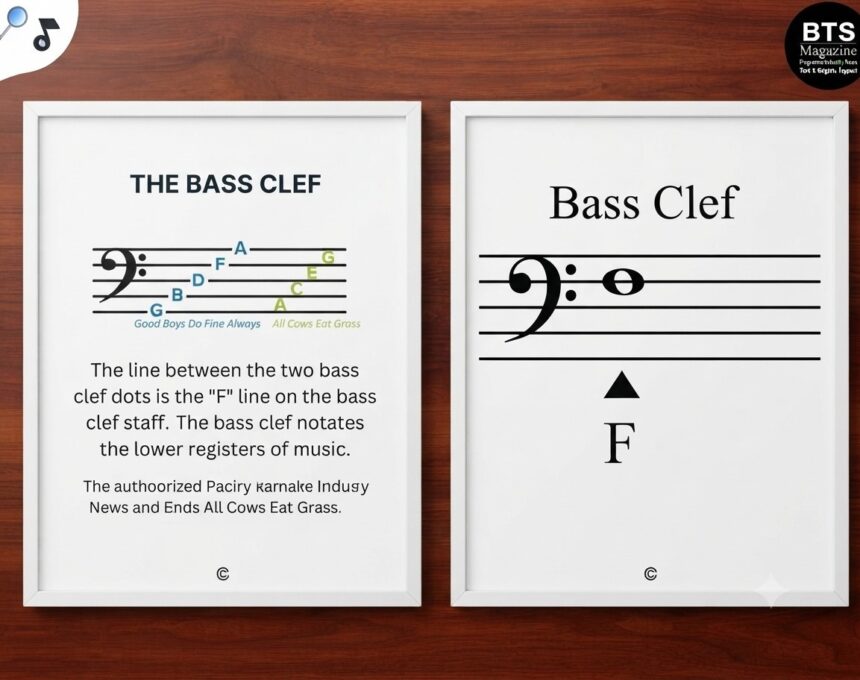
Those two dots aren’t just decoration. They sit above and below a specific staff line. That line is the F line, which is why it’s called the F-clef.
So the symbol itself is basically pointing at F for you. Handy, right?
Understanding the Staff and Lines
Music sits on a staff, which is a set of five lines with four spaces between them. In music notation, the bass clef tells you which notes belong on those staff lines.
Each line and space stands for a different note. The clef sets the reference point, and everything else follows from there.
Once you know where F sits, the rest of the notes fall into place around it.
How to Read Bass Clef Notes
Reading bass clef notes gets easier with a couple of memory tricks. Musicians have used these for ages, and they work.
The Lines from Bottom to Top
The five lines, reading from bottom to top, spell out: G, B, D, F, A.
A classic phrase to remember them is “Good Boys Do Fine Always.” Silly, sure. But it sticks.
The Spaces from Bottom to Top
The four spaces, from bottom to top, spell: A, C, E, G.
People often remember this with “All Cows Eat Grass.” Once you say it a few times, you won’t forget.
Putting It Together
When you see a note on the staff, just figure out if it’s on a line or in a space. Then match it to your memory phrase. That’s the whole trick.
Practice a little each day and your brain starts to read the bass clef without effort. It becomes automatic.
What Are Ledger Lines?
Sometimes notes go higher or lower than the five staff lines allow. That’s where ledger lines come in.
Ledger lines are short lines added above or below the staff. They let you write notes that don’t fit on the normal staff. You’ll see them a lot when music dips into very low notes.
Don’t panic when you spot them. They follow the same pattern as the regular lines and spaces.
Instruments That Use the Bass Clef
The bass clef is the go-to choice for instruments that play in the lower range. If it makes deep sounds, chances are it reads bass clef.
Common examples include:
- Cello and double bass
- Trombone, tuba, and bassoon
- The left hand part on piano
- Bass guitar (often written in bass clef)
Singers with lower voices, like baritones and basses, also read from the bass clef.
Bass Clef vs Treble Clef
People mix these two up all the time when they’re starting out. So here’s a simple way to keep them straight.
The treble clef handles higher notes. The bass clef handles lower notes. On the piano, your right hand usually reads treble, and your left hand reads bass.
What’s interesting is that they overlap in the middle. Middle C sits right between them, which is why piano music uses both clefs at once.
Why Piano Uses Both
A piano covers a huge range of pitch. One clef alone can’t handle all those notes without a ton of ledger lines.
Using both the treble clef and the bass clef keeps the music readable. Your eyes don’t have to strain over endless extra lines.
Tips for Beginners Learning the Bass Clef
Learning any new part of music theory takes patience. But a few smart habits speed things up.
Start Slow and Steady
Don’t try to memorize everything in one sitting. Learn a handful of notes, then add more as you go.
Use Flashcards
Write a note on one side and its name on the other. Quiz yourself for a few minutes a day. This old-school method really works.
Play What You Read
Sit at a piano or pick up your instrument and play the notes as you name them. Connecting sound to symbol locks it in your memory faster.
Don’t Skip the Boring Stuff
Scales and simple exercises feel dull, I know. But they build the muscle memory that makes bass clef note reading second nature.
Common Mistakes to Avoid
A few slip-ups trip up almost everyone. Knowing them ahead of time helps you dodge them.
One big one is confusing bass clef lines with treble clef lines. They use different notes, so keep your memory phrases separate.
Another is ignoring ledger lines until they show up in a piece. Learn a couple early so they don’t surprise you.
Why Learning the Bass Clef Matters
You might wonder if it’s worth the effort. Honestly, yes. Reading the bass clef opens up a whole world of music.
It helps you understand harmony, follow along with sheet music, and play in groups. Plus, once you know both clefs, you can read almost any piece of music notation you meet.
Final Thoughts
Getting comfortable with the bass clef is a big step in your music journey. It might feel awkward at first, but with steady practice, those low notes will start to make sense.
Keep your memory tricks close, play the notes out loud, and don’t rush. Before long, the clef symbol and its staff lines will feel like second nature. If you want to dig deeper into the history and technical side of how these symbols developed, the Wikipedia article on Clef is a solid place to keep reading.
Continue reading: Chondromalacia: What It Really Is, Why It Happens, and How to Deal With It