

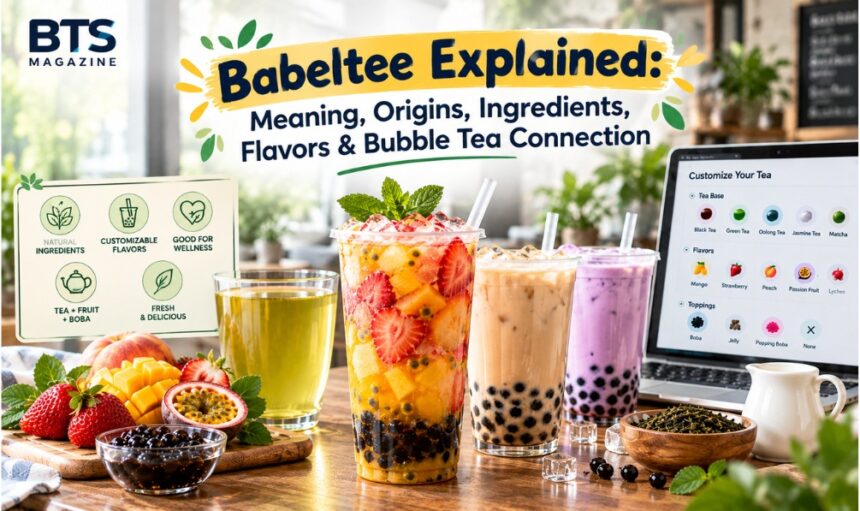
If you have come across the term Babeltee online, you may be curious about what it actually refers to. Is it a new tea brand, a variation of bubble tea, a fruit-based drink, or simply a modern name for a customizable beverage?
- What Does Babeltee Mean?
- Is Babeltee a Real Type of Tea?
- Where Did the Name Babeltee Come From?
- Babeltee vs. Bubble Tea
- A Brief History of Bubble Tea
- What Ingredients Can Be Used in Babeltee?
- Popular Babeltee Flavor Combinations
- Why Are People Interested in Babeltee?
- How to Create a Babeltee-Style Drink
- Can You Make Babeltee at Home?
- Does Babeltee Have a Lot of Sugar?
- How to Choose a Babeltee Drink
- Check the Tea Base
- Understand the Sweetness
- Look at the Toppings
- Consider the Main Flavor
- Ask About Ingredients
- Babeltee and Modern Tea Culture
- Babeltee vs. Traditional Tea
- Is Babeltee an Official Brand?
- Is Babeltee a Traditional Ancient Drink?
- What Makes Babeltee Different?
- What Should You Check Before Ordering?
- Final Thoughts
- FAQs About Babeltee
- What is Babeltee?
- Is Babeltee the same as bubble tea?
- Does Babeltee contain boba?
- Where did bubble tea originate?
- What flavors can Babeltee have?
- Can you make Babeltee at home?
- Is Babeltee healthier than bubble tea?
- Is Babeltee an official beverage brand?
- Does Babeltee have an ancient origin?
- Why is Babeltee attracting attention?
The answer is not completely clear.
Unlike bubble tea, which has a recognizable identity and a documented connection to Taiwan, Babeltee does not currently appear to have one universally accepted definition, recipe, or established origin story. Different descriptions may associate the term with tea, fruit, milk, herbs, spices, sweeteners, ice, and boba-style toppings.
Because of this, Babeltee is better understood as an emerging and flexible tea-related concept rather than a traditional beverage with one fixed formula.
What Does Babeltee Mean?
Babeltee can be described as a broad term associated with creative and customizable tea-based drinks. Depending on the preparation, a drink described as Babeltee may contain brewed tea, fruit, milk, herbs, spices, sweeteners, ice, or toppings.
There is no single ingredient that appears to define every version.
For example, one preparation could combine green tea with peach, while another might use black tea, milk, honey, and tapioca pearls. This flexibility makes the term different from established beverages that are normally associated with more recognizable recipes.
A simple definition would be:
Babeltee is an emerging beverage concept centered around customizable tea drinks and creative flavor combinations.
It is also important not to confuse online descriptions with confirmed history. Claims about a specific inventor, original shop, ancient tradition, or exact creation date should be treated cautiously unless supported by reliable evidence.
Is Babeltee a Real Type of Tea?
Babeltee should not necessarily be understood as a particular tea plant or traditional tea variety.
Instead, the name appears to describe a style or concept of preparing tea-based beverages. The underlying tea could be black tea, green tea, jasmine tea, oolong, matcha, or another suitable base.
This distinction is useful because the word “tea” can describe both the actual tea ingredient and a much broader category of modern drinks.
In a Babeltee-style beverage, tea may serve as the foundation while other ingredients create the final flavor, texture, and appearance.
Where Did the Name Babeltee Come From?
The exact origin of the name Babeltee is not clearly established.
The word “Babel” could be interpreted as suggesting a mixture of cultures, ingredients, or ideas. That interpretation fits the concept of combining different tea traditions and modern beverage ingredients, but it should not be presented as a confirmed explanation for the name.
There is currently insufficient reliable evidence to identify one universally accepted creator or naming story.
For that reason, it is more accurate to say that the background of the Babeltee name remains unclear.
Babeltee vs. Bubble Tea
Babeltee is sometimes associated with bubble tea, but the two terms should not automatically be treated as identical.
Bubble tea, also known as boba tea or pearl milk tea, is a well-established beverage category strongly associated with Taiwan. It commonly combines tea with milk or fruit flavors, sweeteners, and toppings such as tapioca pearls.
Babeltee is much less standardized.
| Feature | Babeltee | Bubble Tea |
|---|---|---|
| Definition | Flexible and emerging term | Established beverage category |
| Tea base | Can vary | Usually tea-based |
| Fruit | May be included | Common in many varieties |
| Milk | Optional | Common in milk-tea versions |
| Tapioca pearls | Optional | Widely associated with the drink |
| Recipe | No universally fixed formula | Recognizable established styles |
| Origin | Not clearly documented | Closely associated with Taiwan |
| Customization | Often central to the concept | Major part of modern boba culture |
The simplest distinction is that a Babeltee-style drink may contain boba, but boba is not what defines Babeltee.
A Brief History of Bubble Tea
Understanding bubble tea provides useful context for why the two concepts are sometimes connected.
Modern bubble tea emerged in Taiwan during the 1980s. The drink developed alongside Taiwan’s established tea culture and the popularity of cold and shaken beverages.
The history of its invention is not completely settled. Chun Shui Tang in Taichung and Hanlin Tea Room in Tainan have both been associated with competing claims regarding the development of pearl milk tea.
Over time, bubble tea expanded far beyond Taiwan. Cafés introduced fruit teas, milk teas, flavored pearls, popping boba, jellies, matcha drinks, and numerous other combinations.
The broader history of tea and its cultural development is extensive; readers interested in tea more generally can also explore the topic through Wikipedia’s Tea article.
This evolution helps explain how new beverage names and combinations can appear as consumers and businesses continue experimenting.
What Ingredients Can Be Used in Babeltee?
Since Babeltee has no universally standardized recipe, ingredients can differ considerably.
Tea Bases
Potential tea bases include:
- Black tea
- Green tea
- Jasmine tea
- Oolong tea
- Matcha
- Herbal infusions
Fruits
Fruit can provide sweetness, acidity, aroma, and color. Possible choices include:
- Mango
- Strawberry
- Peach
- Passion fruit
- Lychee
- Lemon
- Orange
Milk and Creamy Ingredients
Some preparations may use:
- Dairy milk
- Oat milk
- Almond milk
- Coconut milk
- Other plant-based alternatives
Sweeteners and Flavorings
Depending on the recipe, a drink may include:
- Honey
- Sugar
- Flavored syrups
- Vanilla
- Ginger
- Cinnamon
- Mint
Toppings
Some versions may also use:
- Tapioca pearls
- Popping boba
- Fruit jelly
- Other chewy toppings
These ingredients should not be assumed to be present in every Babeltee drink. The actual contents depend on the recipe or café offering it.
Popular Babeltee Flavor Combinations
The flexible nature of Babeltee makes experimentation one of its main attractions.
A fruit-focused version could combine green tea with peach, mango, strawberry, or passion fruit. Jasmine tea with lychee could create a floral and fruity profile, while lemon and green tea can produce a lighter, more refreshing combination.
For people who prefer creamy drinks, black tea with milk and vanilla can provide a richer experience. Matcha with milk is another familiar combination for people who enjoy smooth and creamy tea beverages.
For beginners, simpler combinations can be easier to appreciate. Starting with one tea base and one main flavor makes it easier to understand how each ingredient affects the final drink.
Why Are People Interested in Babeltee?
Part of the appeal comes from curiosity and customization.
An unfamiliar name can encourage people to search for its meaning, especially when it appears on websites, social media, food content, or beverage menus.
Modern drinks are also highly visual. Transparent cups, colorful fruit, ice, layered liquids, and toppings can make tea beverages particularly attractive in photographs and short videos.
Customization adds another dimension. Depending on the seller, customers may be able to choose:
- Tea type
- Sweetness
- Ice level
- Milk
- Fruit
- Syrups
- Toppings
This allows the final beverage to be adjusted according to individual taste.
How to Create a Babeltee-Style Drink
There does not need to be a complicated formula.
A simple approach is to choose:
1 tea base + 1 main flavor + 1 optional texture or aroma
For example, you could combine:
- Green tea + peach + mint
- Jasmine tea + lychee + ice
- Black tea + milk + honey
- Matcha + milk + vanilla
Starting with fewer ingredients can actually produce a more balanced drink. Adding too many syrups, fruits, spices, and toppings at once can make individual flavors difficult to identify.
The objective is to create a combination where the tea and main flavor complement each other.
Can You Make Babeltee at Home?
Yes. The flexible nature of the concept makes it suitable for home experimentation.
One simple method is to brew green tea and allow it to cool. Add a fruit such as peach or strawberry, adjust the sweetness, and serve the drink over ice. Fresh mint can be added for extra aroma.
For a creamy option, prepare black tea, let it cool slightly, and combine it with milk and a small amount of honey.
The important point is that there is no single official home recipe that must be followed. The basic idea is to experiment with tea, flavor, sweetness, and texture until you find a combination you enjoy.
Does Babeltee Have a Lot of Sugar?
That depends entirely on how the drink is prepared.
Tea itself does not automatically make a beverage high in sugar. However, syrups, sweeteners, flavored milk, tapioca pearls, popping boba, and other toppings can increase the amount of added sugar.
If you want greater control over sweetness, ask for less syrup or reduced sugar. You can also limit additional toppings.
The name “Babeltee” alone cannot tell you whether a particular drink is low or high in sugar. The ingredients and serving size matter more than the name.
People with allergies or dietary restrictions should also ask about ingredients rather than assuming that a fruit or tea drink is automatically dairy-free, gluten-free, or suitable for a particular diet.
How to Choose a Babeltee Drink
If you are trying a Babeltee-style beverage for the first time, start by checking the menu carefully.
Consider the following:
Check the Tea Base
Find out whether the drink uses black tea, green tea, jasmine, matcha, or another base.
Understand the Sweetness
Ask how much sugar or syrup is included and whether the sweetness can be adjusted.
Look at the Toppings
Tapioca pearls, fruit jelly, and popping boba can significantly change the texture and sweetness.
Consider the Main Flavor
If you prefer refreshing drinks, fruit and green tea may work well. If you like richer beverages, milk tea or matcha-based combinations may be more suitable.
Ask About Ingredients
If you have an allergy or dietary restriction, confirm the ingredients directly with the café or seller.
Babeltee and Modern Tea Culture
The concept of Babeltee fits into a wider transformation in how people consume tea.
Traditional tea culture often emphasizes the tea itself, including its origin, processing, aroma, brewing method, water temperature, and preparation technique.
Modern café culture adds other elements, including:
- Customization
- Sweetness
- Fruit
- Milk
- Ice
- Textures
- Visual presentation
- Social-media appeal
Bubble tea demonstrates how successfully tea can adapt to changing consumer preferences. What began as a modern Taiwanese beverage category developed into an international café phenomenon with countless variations.
Babeltee, if the term continues to develop, can be viewed within this larger environment of experimentation.
Babeltee vs. Traditional Tea
Traditional tea and modern customizable tea beverages represent different approaches to enjoying tea.
A traditional cup may focus primarily on the characteristics of the tea leaves and the brewing process. A modern fruit or milk-based drink may treat tea as one component of a larger flavor combination.
For example, someone who normally drinks plain green tea could experiment with peach, lemon, or mint. A person who enjoys boba could explore different tea bases or fruit combinations.
The difference is not necessarily about one approach replacing another. Instead, modern beverage culture creates additional ways for people to experience familiar ingredients.
Is Babeltee an Official Brand?
There is no clear evidence in the information available here that establishes Babeltee as one universally recognized global beverage brand.
The term may be used in different contexts to describe a drink, concept, or style rather than a single company or standardized commercial product.
Therefore, if you encounter a product or café using the name Babeltee, it is useful to check the specific business, menu, ingredients, and product description rather than assuming every use of the word refers to the same thing.
Is Babeltee a Traditional Ancient Drink?
There is currently no reliable basis for describing Babeltee as an ancient traditional beverage.
Its exact origin remains unclear, while the modern history of bubble tea is much better documented.
This distinction is important because an unfamiliar beverage name can sometimes become associated online with historical claims that are repeated without sufficient evidence.
A more accurate approach is to describe Babeltee as a modern or emerging beverage term with an uncertain background unless stronger historical documentation becomes available.
What Makes Babeltee Different?
The biggest difference is its apparent lack of a fixed formula.
A standardized drink normally has a recognizable set of ingredients and preparation methods. Babeltee, by comparison, can refer to different combinations depending on how the term is being used.
That flexibility makes it possible to create drinks around:
- Different tea varieties
- Fruit flavors
- Milk
- Herbs
- Spices
- Sweeteners
- Ice
- Boba-style toppings
In other words, the idea of customization is more important than one specific ingredient.
What Should You Check Before Ordering?
Because the term does not guarantee a particular recipe, check the details of the actual drink you are ordering.
Ask about:
- Tea type
- Fruit ingredients
- Milk or dairy alternatives
- Added sugar
- Syrups
- Toppings
- Serving size
- Potential allergens
This is especially important if you have dietary restrictions.
A drink that looks like a simple fruit tea could contain sweetened syrup or milk, while a beverage that appears to be plain tea could include additional flavorings.
Final Thoughts
So, what is Babeltee?
The most accurate description is that Babeltee is an emerging and loosely defined concept connected with customizable tea-based beverages.
Unlike bubble tea, it does not currently have one widely accepted recipe, creator, historical timeline, or universal definition. Different interpretations can include tea, fruit, milk, herbs, spices, sweeteners, ice, and boba-style toppings.
Its connection with bubble tea is understandable because both can involve creative combinations and customizable ingredients. However, they should not automatically be treated as identical.
For now, Babeltee is best approached as a modern beverage concept whose meaning may continue to develop as more cafés, consumers, and online sources use the term.
If you encounter Babeltee on a menu or online, the most useful step is to check what that specific version contains. The drink’s ingredients, preparation method, and flavor combination will tell you much more than the name alone.
FAQs About Babeltee
What is Babeltee?
Babeltee is an emerging term associated with customizable tea-based beverages. Depending on the preparation, it may include tea, fruit, milk, sweeteners, herbs, spices, ice, or boba-style toppings.
Is Babeltee the same as bubble tea?
No fixed equivalence has been established. Some Babeltee-style drinks may resemble bubble tea, but Babeltee does not have the same standardized identity as the established bubble tea category.
Does Babeltee contain boba?
It can, but boba is not necessarily required. Some versions may include tapioca pearls, popping boba, or fruit jelly, while others may focus mainly on tea and fruit.
Where did bubble tea originate?
Modern bubble tea is associated with Taiwan and emerged during the 1980s. Chun Shui Tang and Hanlin Tea Room are both connected with competing historical claims regarding its development.
What flavors can Babeltee have?
Potential combinations include mango, strawberry, peach, passion fruit, lychee, lemon, jasmine, green tea, black tea, matcha, milk, vanilla, ginger, and mint. The exact combination depends on the specific preparation.
Can you make Babeltee at home?
Yes. You can start with brewed tea, add one main fruit or flavor, adjust sweetness, and serve it hot or cold. Milk or toppings can be added according to preference.
Is Babeltee healthier than bubble tea?
Not automatically. The nutritional profile depends on ingredients such as sugar, syrups, milk, toppings, and serving size. The name of the beverage does not determine its nutritional value.
Is Babeltee an official beverage brand?
There is no clear evidence establishing the term as one universally recognized global beverage brand. It may instead be used as an emerging or flexible beverage concept.
Does Babeltee have an ancient origin?
There is no reliable evidence presented here establishing Babeltee as an ancient traditional drink. Its exact origin remains uncertain.
Why is Babeltee attracting attention?
Its unusual name, customizable nature, colorful presentation, connection with modern tea culture, and potential overlap with boba-style beverages can all contribute to online curiosity.
Read also: HQPotner Explained: Meaning, Uses, Features, Benefits & What It Really Means