

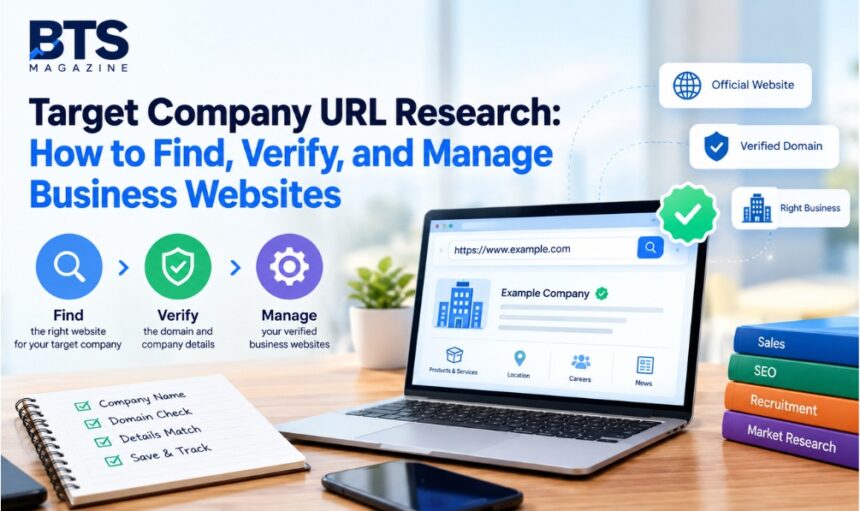
Target company URL research is the process of identifying a company’s official website and confirming that the website belongs to the correct business.
- What Is Target Company URL Research?
- Why Is Company URL Research Important?
- Who Uses Target Company URL Research?
- How Does Target Company URL Research Work?
- Manual Company URL Research
- Automated Company URL Research and Tools
- How to Verify a Company Website
- Match Scores and Verification Status
- Common Challenges in Company URL Research
- Similar or Identical Company Names
- Parent Companies, Subsidiaries, and Brands
- Regional and International Websites
- Rebrands, Acquisitions, and Old Domains
- Careers and Hosted Platforms
- Benefits of Target Company URL Research
- Limitations and Drawbacks
- Common Mistakes to Avoid
- How to Organize Company URL Research
- Measuring the Quality of Bulk URL Research
- Using AI for Company URL Research
- Privacy and Responsible Research
- Tips for More Accurate Company URL Research
- Bottom Line
- Frequently Asked Questions
- What is target company URL research?
- How can I find a company’s official website?
- What is the difference between a company URL and a domain?
- Can company URL research be automated?
- Are automated company URL results always accurate?
- What should I do if two companies have the same name?
- How often should company URLs be checked?
- Does finding an official website prove that a company is legitimate?
Simply finding a website with a matching company name is not enough. Several businesses can operate under similar names, while some companies use separate brands, regional websites, subsidiary domains, or older web addresses.
This type of research can support B2B sales, SEO, recruitment, marketing, business intelligence, and market research.
This guide explains what target company URL research means, how the process works, which tools can assist with it, how to verify websites, and what common problems researchers should watch for.
What Is Target Company URL Research?
Target company URL research involves locating the website or domain associated with a particular business and confirming that it represents the company you intend to research.
A target company can be any business you want to investigate. It might be a potential customer, employer, supplier, competitor, investment opportunity, or business partner.
For instance, suppose you have a spreadsheet containing 500 business names but no website information. URL research can help identify possible websites for those companies.
However, discovering a possible domain is only the beginning. You should compare information such as the business name, industry, location, products, services, and contact information before treating the URL as verified.
It is also important to understand the difference between a company, domain, and URL.
A company is the business being researched.
A domain is the primary web address, such as example.com.
A URL is a complete web address that can point to a particular page, such as example.com/careers/.
A single business can operate multiple websites. A parent company and subsidiary can also maintain separate domains, while an individual brand may have its own website.
The term “target company URL research” is a general business-research concept. It does not necessarily refer to research about the retailer Target Corporation.
Why Is Company URL Research Important?
A company website can provide valuable information about its products, services, locations, careers, leadership, partnerships, announcements, and contact details.
The problem is that this information only helps when the website actually belongs to the business being researched.
Two companies may have identical or very similar names. A business might also operate through multiple brands, regional domains, or a new website while its old domain continues appearing in search results.
Selecting the wrong website can affect everything that follows. A salesperson could investigate the wrong prospect, an SEO specialist could analyze the wrong competitor, or a recruiter could direct candidates toward another company.
This makes website verification an important part of the research process.
Accurate domains are also valuable for CRM platforms and business databases. A smaller collection of verified URLs is generally more useful than a large database filled with uncertain websites.
Who Uses Target Company URL Research?
Company URL research can support several types of professional work.
B2B Sales and Lead Generation
Sales professionals frequently work with lists of potential customers.
Finding the correct company website helps them understand what a business sells, where it operates, which markets it serves, and what type of customers it targets.
Once verified, the domain can be stored in a CRM and used for future research and outreach.
SEO and Digital Marketing
SEO professionals need to identify the correct competitor websites before analyzing search performance.
Once the correct domain has been established, researchers can examine keywords, backlinks, ranking pages, content, technical structure, and organic visibility.
Company URL research and SEO research are not the same thing.
URL research determines which website belongs to the target business. SEO research examines how that website performs in search engines.
Using an incorrect domain can therefore make the entire competitor analysis unreliable.
Recruitment
Recruiters can use company URL research to locate official employer websites and careers sections.
This becomes particularly useful when several businesses share similar names.
Some companies send applicants to third-party recruitment platforms. In such cases, a useful approach is to identify the official company website first and then follow its careers or employment links.
Market and Business Research
Business researchers can use verified websites to examine products, services, markets, locations, partnerships, customers, and company announcements.
Verified domains can also support competitor research, supplier research, business intelligence, and investment research.
However, a company website primarily represents information published by the business itself. Important claims should therefore be compared with independent and reliable sources when necessary.
For general background research, resources such as Wikipedia can also provide useful starting points, although important business facts should be checked against primary or authoritative sources.
How Does Target Company URL Research Work?
The process usually begins with a list of company names.
Additional information can make identification easier. Useful details may include:
- Country
- City
- Industry
- Brand name
- Parent company
- Social profile
- Existing website
- Product or service
- Previous company name
Keep the original company name in your database.
For searching purposes, you can also create a simplified version. For example, “ABC Technologies Limited” could be searched as “ABC Technologies.”
Legal endings such as “Ltd.,” “LLC,” or “GmbH” can sometimes be removed from the search query to produce broader results. However, retain the full legal name in your records because it may be useful during verification.
Next, search for potential websites manually or with an automated service.
After finding a possible domain, compare it with the information available about the company. Look at its name, industry, location, products, services, contact details, and legal information.
If several important details agree, the URL may be accepted.
If key information conflicts or cannot be confirmed, keep the result under review rather than making an unsupported assumption.
For large projects, record the evidence used for each decision. This makes the research easier to audit and update later.
Manual Company URL Research
Manual research works well for smaller lists and complicated company-identification cases.
Useful search patterns include:
- Company name + city + official website
- Company name + country + product
- Full company name + contact
- Company name + industry
- Company name + location
Adding a location or industry can make a major difference when a business has a common name.
Do not automatically select the first search result. Search engines may display directories, social profiles, news stories, marketplaces, review sites, or completely different businesses.
Business directories can help locate potential websites, but they should generally be treated as discovery sources rather than final proof.
One advantage of manual research is greater control. Researchers can investigate unusual cases and compare information across multiple sources.
The main disadvantage is time. Reviewing hundreds or thousands of companies individually can become extremely slow.
Automated Company URL Research and Tools
Automation can significantly reduce the time required for large company lists.
A company-domain finder or URL lookup service can take a business name and return a potential website.
Bulk lookup tools can process many companies together, while spreadsheet solutions can help organize and clean company lists in Excel or Google Sheets.
Data-enrichment platforms may also append website domains and other business information to existing records.
For larger systems, APIs can connect URL research with CRM platforms, lead-generation systems, data-cleaning workflows, and internal research tools.
AI can provide additional assistance. It can help standardize company names, identify potential duplicates, compare business information, organize supporting evidence, and highlight conflicting details.
Automation, however, does not automatically establish ownership.
A tool may return a website simply because its name resembles the target company. Important or uncertain matches should therefore receive human review.
How to Verify a Company Website
Website verification is the process of determining whether a potential domain genuinely represents the company being researched.
A matching name alone should not be considered sufficient evidence.
Check the Company Identity
Begin with the business name.
The name displayed on the website may not exactly match the company’s legal name because businesses often use shortened names, trading names, or consumer-facing brands.
Next, check the industry.
If your target is a software company but the website describes a construction business, the domain is probably unrelated.
Products and services should also correspond with the information you already have.
Location can provide another useful signal. Compare the company’s country, city, headquarters, offices, and operating markets.
A different address does not necessarily indicate an incorrect website because businesses can have multiple offices, warehouses, or branches.
Examine the Website
Start with the About page.
It may provide information about the company’s history, services, locations, founders, ownership, and business relationships.
The Contact page can provide addresses, telephone numbers, email details, and office locations.
Legal pages can be particularly useful. Review the privacy policy, terms and conditions, footer, and company-information pages.
These sections may identify the legal entity operating the website or provide registration information.
Check Independent Evidence
For important companies, verify the website using information outside the site itself.
Official business registers may provide legal names, registered addresses, previous names, and other company information.
A parent company’s official website or a corporate announcement can sometimes confirm the relationship between a business and a domain.
Official social media profiles may also link directly to the company website.
Domain-registration information can provide supporting clues, but it should not be treated as conclusive proof on its own.
The same caution applies to business directories. Several directories may simply reproduce information from the same underlying source.
The strongest verification usually comes from multiple independent details pointing toward the same business.
Match Scores and Verification Status
Some URL research platforms provide match or confidence scores.
These numbers can be useful for prioritizing results that need additional investigation.
However, a high score does not necessarily mean the website is correct. The score may simply represent how closely the company name resembles the domain or website.
For example, a score of 95 should not automatically be interpreted as a 95% probability that the website belongs to the company.
A simple verification system can make large projects easier to manage:
- Verified: Available evidence supports the website.
- Needs Review: The website looks plausible but requires additional checking.
- Rejected: Evidence indicates that the domain belongs to another business.
- Unresolved: There is not enough evidence to select a website.
It can also be useful to record the supporting evidence, verification date, and a short explanation for every decision.
Common Challenges in Company URL Research
Some companies are easy to identify, while others create problems because of similar names, multiple brands, regional domains, or outdated information.
Similar or Identical Company Names
Different businesses can operate under the same or nearly identical names.
Never rely on the company name alone.
Compare the country, location, industry, products, contact information, and legal details.
If the evidence still does not establish the correct business, classify the result as unresolved rather than guessing.
Parent Companies, Subsidiaries, and Brands
A company may belong to a larger corporate group.
The parent company may operate one website, while a subsidiary maintains another. A consumer brand owned by the group may also have its own domain.
All of these websites can be genuine, but they may represent different parts of the organization.
Select the website that fits the specific research objective.
Regional and International Websites
Large organizations frequently maintain separate websites for different countries or markets.
They may use a global .com domain, country-code domains, subdomains, country folders, or localized versions.
The global website may be appropriate for general corporate research.
A regional website may be more useful for local SEO, recruitment, sales research, or market analysis.
When necessary, store both the primary domain and the relevant regional URL.
Rebrands, Acquisitions, and Old Domains
Websites can change after mergers, acquisitions, rebrands, or technical migrations.
Older domains may continue appearing in business directories, historical articles, and cached information.
Sometimes an old website redirects to a new domain.
Before replacing an old URL, determine why the redirect exists. Keeping the previous URL in your records can also help preserve historical information.
Careers and Hosted Platforms
A company’s recruitment pages may not exist directly on its primary website.
Some businesses use external recruitment systems for applications. This is not necessarily a problem when the official company website links to the platform.
Smaller companies may also use hosted website services rather than a custom domain.
When relevant, save the complete business-page URL.
If no official website can be confirmed, classify the record as unresolved. This does not automatically mean the business itself does not exist.
Benefits of Target Company URL Research
The main benefit of company URL research is improved business identification.
A verified website gives researchers a reliable starting point for further investigation.
Sales teams can investigate the correct prospects. Recruiters can identify the appropriate employer. SEO professionals can analyze the right competitor.
Market researchers can use verified websites to examine products, services, locations, markets, partnerships, and company updates.
Verified domains can also improve the quality of CRM systems and business databases by reducing incorrect or outdated records.
Limitations and Drawbacks
Company URL research can require significant time and effort.
Manual verification becomes difficult when a project includes hundreds or thousands of businesses.
Automated systems are faster but can produce inaccurate matches.
Common business names, corporate structures, regional websites, old domains, acquisitions, and rebrands can all make identification more complicated.
Different data providers may also produce different results. One service may identify a website that another service misses.
AI can assist with the workflow, but its information may be outdated, incomplete, or incorrect.
Some companies may not have an official website that can be confidently verified.
When evidence is insufficient, leaving the record unresolved is usually better than entering a potentially incorrect URL.
Common Mistakes to Avoid
Several mistakes can reduce the quality of company URL research.
Do not select the first search result without checking it.
Do not accept a website simply because its name resembles the company name.
Consider location, industry, products, services, and legal information.
Do not treat match scores as final proof.
Be careful when dealing with brands, subsidiaries, and parent companies.
Old directories may contain outdated domains.
Always examine redirects because they may indicate a website migration, acquisition, or rebrand.
Avoid adding large numbers of unverified domains to a CRM. Incorrect records can create additional work later.
A website being temporarily unavailable also does not necessarily mean that the company has closed.
How to Organize Company URL Research
Good recordkeeping makes large-scale URL research easier to manage.
Assign each business a record ID and preserve its original company name.
Useful database fields can include:
- Original company name
- Search name
- Country
- Industry
- Candidate URL
- Accepted website
- Main domain
- Regional URL
- Parent or subsidiary
- Evidence URL
- Verification note
- Verification status
- Reviewer
- Verification date
- Previous URL
- Next review date
Whenever possible, save the exact evidence page that helped confirm the website.
For example, if a company’s legal-information page helped verify its identity, save that specific page rather than recording only the homepage.
A Last Verified field can show when a URL was most recently checked.
Do not hide unresolved records. An empty URL accompanied by a clear explanation is better than an incorrect website.
Measuring the Quality of Bulk URL Research
Finding a URL for every company does not necessarily mean the research is accurate.
Several basic measurements can help evaluate the process.
Coverage measures how many companies received a possible website.
Sample precision measures how many reviewed results were actually correct.
Usable yield measures how many companies ultimately received an accepted website.
Imagine a list containing 100 companies.
A tool identifies possible websites for 90 businesses. After verification, 72 are confirmed as correct.
The coverage is 90%, the checked-result precision is 80%, and the usable yield is 72%.
These measurements describe different aspects of the research process.
It is also useful to manually inspect a sample of results that appear correct, rather than reviewing only uncertain matches. This can reveal mistakes that automated confidence systems may miss.
Using AI for Company URL Research
AI can simplify several parts of company URL research.
It can standardize company names, identify possible duplicates, compare business details, organize evidence, and highlight information that conflicts.
For example, an AI system can compare a target company’s name, industry, and country against information found on a potential website.
It can then organize which details agree and which details require further investigation.
AI can also help researchers create short verification notes.
However, important information should still have supporting evidence.
If an AI system provides a company address or ownership relationship without a reliable source, the information should not automatically be treated as confirmed.
AI is best used as a research assistant rather than as the sole authority responsible for final verification.
Privacy and Responsible Research
Company URL research generally relies on publicly available business information.
Even so, researchers should collect only information that is necessary for their purpose.
Avoid gathering unnecessary personal information, particularly when building sales, recruitment, or marketing databases.
Organizations should also consider applicable privacy, data-protection, communication, and data-retention requirements.
The fact that information is publicly available does not automatically mean that it can be collected or used without restrictions.
Tips for More Accurate Company URL Research
The following practices can improve the reliability of company URL research:
- Keep the original company name.
- Use a simplified search name when useful.
- Add the city, country, industry, or product to difficult searches.
- Try local-language versions of company names when appropriate.
- Never rely on a matching name alone.
- Compare multiple company details.
- Manually verify important businesses.
- Use current information whenever possible.
- Save evidence supporting accepted websites.
- Avoid guessing when evidence is unclear.
- Recheck older company records.
- Examine redirects and domain changes.
- Look for rebrands and acquisitions.
- Keep previous URLs when they have historical value.
- Test automated tools on a small dataset before processing thousands of records.
Include difficult examples in your initial test set. This can show how well a tool handles common company names, small businesses, regional companies, and organizations with complicated corporate structures.
Bottom Line
Target company URL research helps connect the correct business with the correct website.
Finding a possible domain is only the first stage. A reliable process also checks the company name, industry, location, products, services, legal information, and other relevant evidence.
Manual research remains useful for unusual or difficult cases, while automated tools, APIs, spreadsheets, and AI can reduce the workload for large datasets.
A practical workflow can combine automation for discovering candidate websites with human review for important or uncertain results.
When there is not enough evidence to establish the correct website, leaving the record unresolved is safer than making an unsupported guess.
Frequently Asked Questions
What is target company URL research?
Target company URL research means finding a company’s website and checking whether it belongs to the correct business.
How can I find a company’s official website?
Search the company name together with its location, country, industry, or product. Then compare the information on the website with reliable company details before accepting the domain.
What is the difference between a company URL and a domain?
A domain is the primary web address, such as example.com. A URL can refer to the domain or to a specific page, such as example.com/careers/.
Can company URL research be automated?
Yes. Domain lookup services, spreadsheets, APIs, data-enrichment platforms, and AI tools can help identify potential company websites more efficiently.
Are automated company URL results always accurate?
No. Automated tools can produce incorrect matches, especially when companies have similar names. Important results should be reviewed before being treated as verified.
What should I do if two companies have the same name?
Compare their location, industry, products, services, contact information, and legal details. If the available evidence still does not identify the correct business, mark the result as unresolved.
How often should company URLs be checked?
URLs should be reviewed when a website stops working, a company changes its name, a domain changes, or the information in your database becomes outdated.
Does finding an official website prove that a company is legitimate?
No. Confirming a website only helps establish which web presence belongs to a business. It does not, by itself, prove that the company is safe, trustworthy, or legitimate.
Read also: Blessingtide.com USA Explained: Website, Content, and What Readers Should Know