

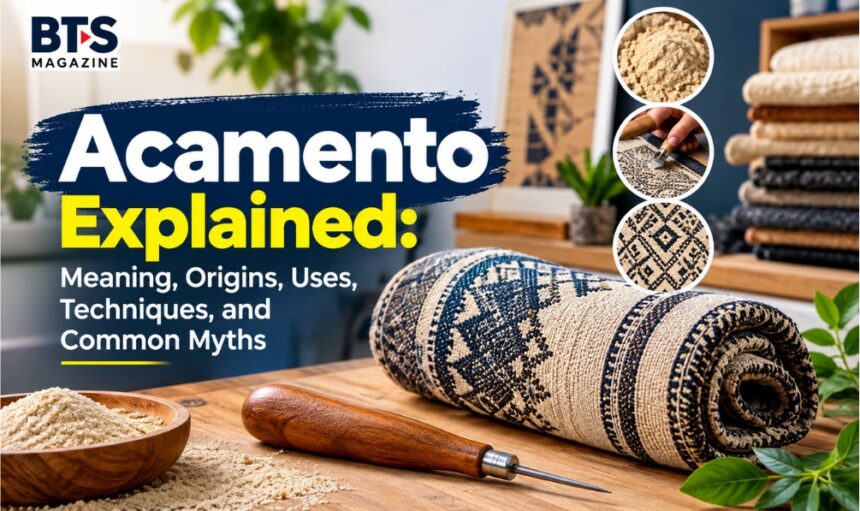
Acamento is a term that can be found online in several different contexts. Some references use it when discussing detailed finishing and refinement, while others associate it with craftsmanship, design, or an alleged digital productivity service.
- What Does Acamento Mean?
- Acamento Meaning and Possible Origin
- History and Background of Acamento
- Core Principles of Acamento
- Acamento in Craftsmanship
- Tools and Materials for Acamento-Style Work
- Basic Acamento Techniques for Beginners
- Advanced Finishing and Creative Techniques
- Acamento in Product and Industrial Design
- Acamento in Digital Design and UX
- Acamento in Business and Professional Work
- Benefits of Acamento Principles
- How to Evaluate the Finished Result
- Common Acamento Mistakes
- Is Acamento Actually an AI Productivity Platform?
- Common Misconceptions About Acamento
- Practical Tips for Better Acamento
- Final Thoughts
- FAQs
Because the word is not always explained consistently, people often search for Acamento to discover what it means, where it comes from, and how the concept can be applied. This guide explores its possible meaning, background, principles, practical applications, finishing methods, and the common misunderstandings linked to the term.
What Does Acamento Mean?
Acamento is generally used online to describe the careful completion and refinement of something rather than simply stopping once the primary work has been done. The idea involves reviewing details, correcting weaknesses, and making useful improvements before a final product, project, or service is delivered.
This concept can apply to physical and digital work. For example, a craft worker might smooth and polish a surface. A product designer could refine an object’s appearance and usability. A software team might correct navigation issues, improve accessibility, or resolve small interface problems before release.
There is no single universally accepted technical definition of Acamento. Different online sources use the term differently, making context particularly important.
A practical interpretation is to view Acamento as purposeful finishing and refinement. The objective is not to keep adding unnecessary details. Instead, the aim is to make a final result more complete, useful, reliable, attractive, consistent, or suitable for its intended purpose.
Acamento Meaning and Possible Origin
The most useful linguistic connection found in the available material is the Portuguese word acabamento. In Portuguese, acabamento refers to finishing, a finish, or the final treatment given to something.
The connection makes sense when Acamento is discussed in relation to craftsmanship and design. Finishing work can involve polishing a surface, checking dimensions, improving appearance, treating materials, or correcting minor defects before an item is considered complete.
For reference, the Portuguese Wikipedia entry on Acabamento describes finishing as a final stage applied in areas including construction, furniture, clothing, visual arts, and printing.
Other websites provide different explanations of the word Acamento. Some attempt to divide the term into parts associated with concepts such as action, accomplishment, or management. However, the supplied material does not provide convincing linguistic evidence for those interpretations.
Therefore, the connection with acabamento is a more useful explanation, while unsupported word-origin theories should be approached cautiously.
The basic idea is straightforward: completing the main task does not always mean the entire project is ready. Inspection, testing, correction, and presentation can all contribute to the quality of the final result.
History and Background of Acamento
There is no strong evidence in the available material showing that Acamento was historically recognized as the name of one particular traditional craft. However, the broader practice of carefully finishing work has existed for centuries.
Traditional crafts have long relied on finishing processes. Woodworkers sand, smooth, stain, polish, and protect wooden surfaces. Metalworkers remove sharp edges, smooth imperfections, and polish components. Textile workers trim threads, strengthen seams, press fabric, and improve the final presentation. Builders use coatings, paints, sealants, and other treatments during final construction stages.
These processes are not only decorative. They can improve durability, safety, comfort, performance, and ease of use.
The same principle later became important in areas beyond physical craftsmanship. Product designers refine objects before production. Companies review reports and client deliverables. Software teams test interfaces, fix errors, and improve usability before launching digital products.
This broader application helps explain why Acamento may appear in different industries today. The tools and materials change, but the underlying idea of purposeful completion remains similar.
It is still important to distinguish between the long history of finishing practices and evidence that “Acamento” itself was historically established as an independent craft tradition. The available material does not demonstrate that distinction.
Core Principles of Acamento
Acamento can be understood through several principles that help separate meaningful finishing from unnecessary decoration.
Intentionality
The finishing stage should have a clear purpose. Before beginning final improvements, it is useful to determine what a completed result should achieve.
A physical product might require smooth surfaces, secure connections, accurate dimensions, readable labels, and safe edges. A digital product may need fast performance, readable content, accessible controls, useful navigation, and functional links.
Defining the target makes the final review more organized.
Precision
Small details can have a major effect on the final outcome. Measurements should be verified, text should be proofread, surfaces should be inspected, and digital features should be tested.
Careful checking helps prevent minor errors from becoming noticeable defects or larger problems after completion.
Purpose
Every finishing step should have a reason.
A protective coating may extend the life of an object. Better spacing in an interface may improve readability. Clearer wording in a report can make instructions easier to follow.
If a proposed change does not improve function, safety, clarity, durability, usability, or another meaningful quality, it may not be worth making.
Consistency
Finishing should follow a dependable standard rather than being based entirely on chance.
Businesses and professionals often use checklists, quality procedures, templates, and review systems to maintain consistent results. These methods make final quality easier to predict across repeated projects.
Sustainability
Finishing decisions can influence long-term value as well.
Materials and methods should be considered in terms of maintenance, durability, waste, and replacement. A surface treatment that looks attractive but wears away quickly may not be the most practical choice.
The same principle applies to digital work. Systems should remain maintainable instead of becoming unnecessarily difficult to update after delivery.
Acamento in Craftsmanship
Craftsmanship is one of the easiest areas in which to understand the concept of Acamento-style finishing.
A handmade object can be structurally complete while still requiring attention to smaller details before it is ready. The final stage may determine how polished, comfortable, durable, or practical the finished item becomes.
In woodworking, finishing may include sanding uneven areas, improving joints, polishing surfaces, applying oil or varnish, and checking that edges are smooth.
Textile work may involve removing loose threads, reinforcing seams, pressing fabric, checking alignment, and creating clean decorative edges.
Metalworking can involve smoothing sharp sections, polishing surfaces, applying protective treatments, or verifying that joined components fit properly.
The appropriate method depends on the material, design, and purpose of the object.
Some websites describe Acamento as a distinct artistic craft involving textiles, wood, metal, knots, and mixed materials. That claim should be treated carefully because the available material does not clearly establish Acamento as one recognized traditional craft with a documented historical development.
A safer description is that the term may be used online when discussing careful finishing techniques across different craft disciplines.
Tools and Materials for Acamento-Style Work
Acamento does not have one universal set of tools because finishing requirements change from project to project.
Basic craft work may require precision scissors, rulers, measuring tapes, cutting mats, calipers, adhesives, files, or other appropriate cutting equipment.
Textile projects may use needles, thread, fabric scissors, measuring devices, and pressing equipment. Woodworking can require sandpaper, files, clamps, brushes, polishing products, and protective coatings.
Good lighting is also valuable. Uneven edges, scratches, gaps, alignment issues, and surface defects can be difficult to notice when the workspace is poorly illuminated.
An organized work area is equally helpful. A cluttered surface can make measuring, cutting, joining, and inspecting materials more difficult.
Expensive equipment is not always necessary. Choosing a suitable tool for the material and task is generally more important than simply purchasing advanced equipment.
For example, an appropriate sharp cutting tool can provide more control and accuracy than a damaged or unsuitable one.
Basic Acamento Techniques for Beginners
People learning finishing skills should first develop accuracy and control rather than immediately attempting complex techniques.
Start with measurement. Check dimensions before cutting, joining, drilling, stitching, gluing, or making another permanent change. Measuring carefully at the beginning can prevent much larger corrections later.
Material knowledge is also important. Wood, fabric, metal, paper, and synthetic materials respond differently to pressure, moisture, heat, adhesives, and cutting.
Testing a technique on leftover material is often a useful precaution. It can show how a finish or adhesive behaves before it is applied to the final piece.
Cutting should be controlled and deliberate. Edges should be inspected before assembly, and parts that need to align should be positioned carefully before using glue, stitches, screws, or another permanent connection.
Some craft-related sources mention simple knots such as square knots and bowlines. These can be useful when working with rope or cord, but they are not required for every type of finishing project.
Patience is especially important for beginners. Rushing the final stage can produce uneven edges, poor alignment, visible marks, or other avoidable defects.
It also helps to inspect the completed work from multiple directions. A project can appear correct from one angle while revealing gaps, rough sections, or alignment problems from another.
Advanced Finishing and Creative Techniques
After basic finishing skills become dependable, more advanced techniques can be introduced.
Layering is one approach. Different textures, materials, or surface treatments can be combined to create additional depth. This method is often useful in decorative and mixed-media work.
Color blending can also improve presentation when multiple shades need to transition smoothly. However, color should support the design rather than compensate for weak construction.
More advanced finishing can include detailed edge treatment, precision polishing, decorative joining, specialized surface preparation, or combining several materials within one project.
Mixed-media projects require additional planning because materials may respond differently to heat, moisture, movement, pressure, or adhesives. Testing compatibility before final assembly can prevent damage.
Advanced finishing should not simply mean adding more detail. A complicated finish is not automatically superior to a simple one.
Useful refinement is the kind that improves function, appearance, durability, consistency, usability, or another clearly defined quality.
Workshops and experienced makers can also help learners develop these abilities. Watching how skilled professionals solve finishing problems can improve both technical accuracy and creative thinking.
Acamento in Product and Industrial Design
In product and industrial design, Acamento-style thinking can be seen during the final development stages before a product reaches customers.
Designers may improve joints, surface treatments, dimensions, packaging, textures, or visual consistency. Small adjustments can influence how users understand, hold, operate, or maintain an object.
Tactile experience can be particularly important. A handle may need to feel comfortable, an edge may need rounding, and a button may require suitable resistance to prevent accidental activation.
Prototypes are useful during this stage. Designers can create trial versions, test them, identify weaknesses, and make changes before full-scale production.
User testing can uncover problems that the original designer may overlook. A product can appear attractive while still being difficult to open, hold, clean, read, or operate.
Good finishing therefore requires a balance between appearance, functionality, safety, durability, production costs, and user requirements.
The objective is not merely to make an object look polished. The final treatment should contribute to making the complete product more effective.
Acamento in Digital Design and UX
Although digital products do not have physical surfaces to sand or polish, the same finishing concept can be applied to websites, applications, and software.
Digital finishing often involves removing small problems that make a product confusing or difficult to use.
Navigation is one major area. Menus, buttons, and links should be understandable, while users should be able to recognize their current location and next step.
Visual hierarchy is equally important. Headings, paragraphs, controls, spacing, and other interface elements should organize information in a way that makes important content easier to locate.
Accessibility is another part of digital refinement. Text needs to remain readable, images may require useful alternative descriptions, and controls should work with different input methods where practical.
Microcopy can also affect usability. Button labels, form instructions, error messages, confirmations, and warnings should provide clear information instead of creating additional confusion.
Performance belongs to the final review as well. Slow pages, delayed interactions, broken layouts, and poor mobile behavior can make a technically functional product feel unfinished.
Development teams may therefore test multiple screen sizes, correct inconsistent styles, remove unnecessary delays, improve interactions, and fix small usability problems before launch.
This does not mean Acamento is automatically a software platform. The concept can be applied to digital products without proving that a specific Acamento productivity application exists.
Acamento in Business and Professional Work
The idea can also be applied to professional work where the final deliverable must be complete, understandable, and ready for someone else to use.
For reports, finishing may include proofreading, verifying figures, improving headings, removing unclear language, and making recommendations easier to locate. A document can contain valuable information while still being difficult to use if its important points are poorly organized.
In consulting, construction, event management, and related services, finishing may involve a formal handover. This could include final records, instructions, maintenance information, supporting documents, or follow-up details.
Customer service provides another example. Solving the main issue may not always be the final step. Customers may also need confirmation, instructions, or an explanation of what happens next.
Thoughtful completion can reduce confusion and unnecessary follow-up. It can also help organizations maintain similar quality standards across different projects.
Benefits of Acamento Principles
The primary benefit of careful finishing is improved final quality.
A detailed review can identify small defects before a product, service, document, or digital experience reaches the intended user. Finding problems earlier can reduce later corrections and improve reliability.
In physical products, finishing may contribute to longer use. Smooth edges, protective coatings, secure joins, and careful assembly can improve durability.
For digital products, final testing can improve usability. Clear navigation, readable content, responsive layouts, consistent design, and acceptable performance can make tasks easier to complete.
Finishing can also strengthen communication. Well-organized reports, instructions, and project handovers are generally easier for other people to understand.
Consistency is another potential benefit. When teams follow defined completion standards, different projects are more likely to meet similar expectations.
However, these benefits come from meaningful refinement. Simply adding more decoration, more steps, or more complexity does not automatically create a better result.
How to Evaluate the Finished Result
A final product should be checked before it is officially considered complete.
One effective approach is to establish acceptance criteria early. These criteria define what the finished result must accomplish.
A physical product may have requirements involving dimensions, strength, safety, appearance, and surface quality. A website may need working links, responsive layouts, readable content, and reasonable loading performance.
Checklists can help prevent small tasks from being forgotten. They are particularly useful when the same type of project is completed repeatedly.
Peer review can provide another perspective. Someone who was not involved in creating the work may identify errors or confusing areas that the original creator has stopped noticing.
User testing is valuable when a product is intended for customers or the general public. Even limited testing can uncover confusing instructions, difficult controls, or unexpected usability problems.
Some physical products may also require durability, safety, or compliance testing depending on their purpose and applicable standards.
Ultimately, the final review should return to the project’s original objective. A visually polished result is not genuinely successful if it fails to solve the problem it was created to address.
Common Acamento Mistakes
One frequent mistake is treating the final stage as something that should be completed as quickly as possible. Rushing can lead to alignment issues, rough surfaces, spelling mistakes, incomplete testing, and other small defects.
Incorrect measurement can cause even larger problems. Dimensions should be verified before permanent changes are made.
Tool selection is another concern. An unsuitable adhesive, damaged cutting tool, or incorrect surface treatment can lower quality and potentially damage materials.
The working environment can also affect results. Poor lighting can hide defects, while an untidy workspace can make accurate assembly and measurement more difficult.
Another mistake is prioritizing appearance over function. Something may look attractive while remaining weak, uncomfortable, difficult to operate, or unsafe.
Over-finishing can create problems too. Excessive refinement may waste materials, increase costs, consume unnecessary time, remove useful character, or introduce new defects.
A practical way to avoid these issues is to connect each final adjustment with a clear objective. If an alteration does not improve function, safety, durability, clarity, usability, or another meaningful quality, it may not be necessary.
Is Acamento Actually an AI Productivity Platform?
Some websites describe Acamento as an all-in-one digital productivity platform. According to those sources, the supposed service combines project management, communication, file sharing, analytics, and automation.
Reported capabilities include task management, team workspaces, real-time collaboration, cloud access, automated reminders, AI-generated reports, and customizable dashboards.
Some of the same online claims mention integrations with services such as Google Workspace, Google Drive, Dropbox, Slack, Zoom, Trello, Asana, Microsoft 365, and Salesforce.
Other descriptions refer to Android and iOS applications, free and paid subscription plans, end-to-end encryption, and compatibility with more than 50 external services.
However, the supplied material does not provide enough primary evidence to independently confirm these claims.
There is no clearly verified developer or company profile in the material provided. It also does not include confirmed pricing information, an official app-store listing, security documentation, product manuals, or authoritative technical documentation.
For that reason, readers should not assume that detailed software claims are confirmed simply because they appear in an online article.
Anyone researching a possible Acamento service should first look for an official website, identifiable company information, privacy documentation, terms of service, transparent pricing, and trustworthy application listings before creating an account or providing personal information.
Common Misconceptions About Acamento
A major misconception is that Acamento has one universally accepted definition. In practice, the term appears online in different contexts.
Another misconception is that Acamento is definitely an established software platform. Several websites make detailed product claims, but the available evidence does not independently verify all of those claims.
It is also sometimes presented as the formal name of a particular traditional craft. Although the available material discusses many finishing techniques, it does not clearly demonstrate that Acamento is the documented name of one established traditional craft.
Another misunderstanding is that finishing only concerns appearance. In reality, careful finishing can also affect durability, safety, accessibility, clarity, comfort, and usability.
More finishing is not necessarily better. Excessive polishing or unnecessary modifications can consume time and resources while making the result less practical.
There is also no universal Acamento toolkit. A textile worker, woodworker, metalworker, designer, and software team will naturally use different tools and processes.
Practical Tips for Better Acamento
A useful first step is to define what “finished” means before reaching the final stage.
Create a simple checklist based on the most important requirements. Prioritize function, safety, durability, and usability before focusing on minor visual improvements.
Allow enough time for final inspection. Finishing should not be treated as an optional activity that happens only when extra time remains.
Test important changes before making them permanent. This is especially useful with coatings, adhesives, interface changes, and materials that may respond unpredictably.
View the completed result from the user’s perspective. The person who created something may understand its operation automatically, while a first-time user may find certain parts confusing.
When possible, ask another person to review the work. A fresh perspective can reveal unclear wording, inconsistent details, or defects that the creator has overlooked.
For repeated projects, record useful measurements, materials, tolerances, and finishing methods. Keeping these details can make future work more consistent.
Most importantly, recognize when the project is finished. Once additional changes stop providing meaningful value, continuing to refine the result may simply waste time.
Final Thoughts
Acamento is most useful as a concept associated with careful finishing, refinement, and attention to final quality.
The idea can be applied to craftsmanship, industrial and product design, digital interfaces, business documents, professional services, and many other forms of work. The shared principle is to complete something thoughtfully rather than stopping immediately after the primary task is finished.
Some online sources present Acamento as a specific craft or as an AI productivity platform. Those descriptions should be approached with caution because the available evidence does not clearly establish either one as a universally recognized definition.
The most practical interpretation is simple: review the finished work, correct the details that matter, and ensure that the final result is genuinely ready for the person who will use it.
FAQs
What does Acamento mean?
Acamento is generally used online in connection with careful finishing and refinement. It is often associated with the Portuguese word acabamento, which refers to finishing or a final treatment.
Is Acamento a type of craft?
The term can appear in discussions about craft finishing, including sanding, polishing, stitching, joining, and surface treatment. However, the available material does not clearly establish Acamento as the official name of one specific traditional craft.
Where does Acamento come from?
Acamento is often connected online with the Portuguese word acabamento. The broader practice of finishing, however, has existed across many cultures, crafts, and industries for a long time.
What are the main principles of Acamento?
Key principles include intentionality, precision, purpose, consistency, and sustainability. Together, these ideas encourage useful refinement without unnecessary work.
What tools are used for Acamento?
There is no standard toolkit. Depending on the project, tools may include scissors, rulers, calipers, cutting mats, adhesives, sanding equipment, polishing products, measuring tools, or digital testing systems.
Can Acamento be used in digital design?
Yes. The finishing concept can be applied to websites, applications, and software through improved navigation, accessibility, responsive layouts, performance, microcopy, and interface consistency.
Is Acamento an AI productivity application?
Some online sources describe Acamento in this way, but the available material does not provide sufficient primary evidence to verify detailed claims about its features, applications, pricing, integrations, or security.
How can beginners improve their Acamento skills?
Beginners can start by learning accurate measurement, understanding materials, using suitable tools, working patiently, maintaining good lighting, testing techniques on spare materials, and inspecting the finished project carefully.
Read also: Musol Solvent vs Other Solvents: Key Differences Explained