

Introduction
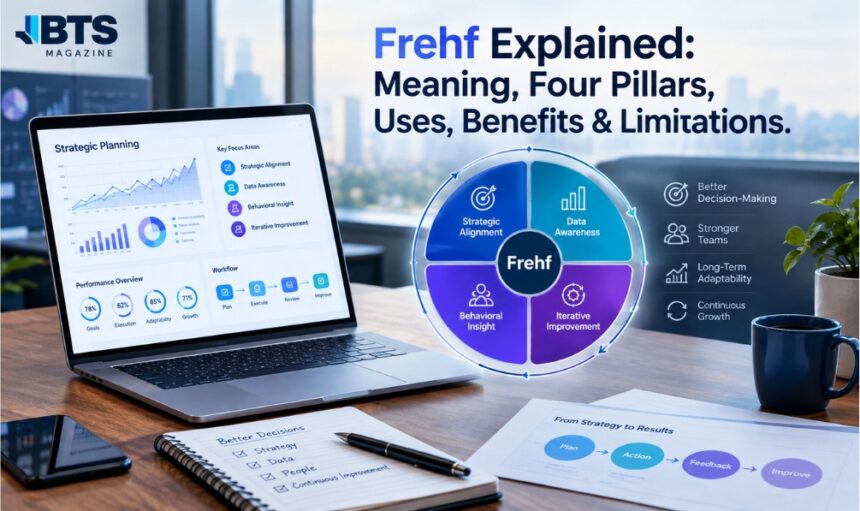
Frehf is described by Frehf.org as a structured framework intended to help individuals and organizations improve clarity, execution, performance, and their ability to adapt over time. Rather than focusing on a single business process, the framework brings together four connected areas: Strategic Alignment, Data Awareness, Behavioral Insight, and Iterative Improvement.
- Introduction
- What Is the Frehf Framework?
- What Does Frehf Mean?
- What Are the Four Pillars of Frehf?
- How Do the Four Pillars Work Together?
- Why Is Frehf Described Differently Online?
- What Evidence Supports the Frehf Definition?
- How Can Frehf Improve Decision-Making?
- How Does Strategic Alignment Connect Goals With Resources?
- Why Is Data Awareness Important?
- Why Does Human Behavior Matter?
- What Role Do Feedback Loops Play?
- What Is Decision Ownership?
- How Can Frehf Be Applied in Business?
- Can Individuals Use Frehf for Personal Productivity?
- How to Implement Frehf Step by Step
- Step 1: Define the Desired Outcome
- Step 2: Map Resources and Responsibilities
- Step 3: Select Useful Information
- Step 4: Examine Human Factors
- Step 5: Assign Decision Owners
- Step 6: Create a Review Schedule
- Step 7: Make Adjustments
- What Are the Potential Benefits of Frehf?
- How Can Frehf Support Accountability?
- How Does Iterative Improvement Support Adaptability?
- How Does Frehf Relate to Human-Centered AI?
- Can Human Judgment Work Alongside AI?
- How Is Frehf Different From Traditional Automation?
- When Is Continuous Adaptation Useful?
- Does Frehf Require Special Software?
- Can Templates Make Frehf Easier to Apply?
- How Does Frehf Compare With OKRs, Agile, and Scrum?
- Can Frehf Be Used With Other Frameworks?
- What Are the Main Limitations of Frehf?
- What Could Make Frehf Difficult to Implement?
- Why Should Frehf Performance Claims Be Evaluated Carefully?
- What About Privacy and Security?
- How Can Human Oversight Be Maintained?
- Frequently Asked Questions About Frehf
- What is Frehf?
- What are the four pillars of Frehf?
- Is Frehf a management standard?
- Is Frehf an AI governance framework?
- Does Frehf require special software?
- Can Frehf be used by individuals?
- Is Frehf the same as Agile?
- Is Frehf the same as OKRs?
- Is Frehf scientifically validated?
- Quick Knowledge Check: Frehf MCQs
- 1. How does Frehf.org describe Frehf?
- 2. How many primary pillars are included in the Frehf framework?
- 3. Which option is one of Frehf’s pillars?
- 4. What is the main focus of Data Awareness?
- 5. What does Behavioral Insight examine?
- 6. What does Iterative Improvement encourage?
- 7. Is Frehf established as a government AI standard?
- Final Thoughts
The basic idea is straightforward. Organizations need clear goals, useful information, an understanding of how people behave, and a willingness to adjust their approach when new evidence becomes available.
Frehf therefore treats improvement as an ongoing process rather than something that happens only during annual planning or major organizational changes.
Because Frehf is not a universally recognized management standard, it is important to separate the framework’s own description from claims about independent validation. The main evidence for the specific Frehf model comes from Frehf.org itself. As a result, its four-pillar structure should be understood primarily as the framework’s stated approach.
For general background on what a framework means in an organizational or conceptual context, readers can also explore Wikipedia’s overview of frameworks.
What Is the Frehf Framework?
The Frehf framework is a conceptual model that connects organizational goals with execution, information, human behavior, and continuous learning.
Its four pillars are:
- Strategic Alignment
- Data Awareness
- Behavioral Insight
- Iterative Improvement
Each pillar addresses a different part of the decision-making process.
Strategic Alignment asks whether everyday work is connected to larger objectives. Data Awareness focuses on identifying information that can actually support decisions. Behavioral Insight considers the way people, habits, motivation, cognitive biases, and friction affect outcomes. Iterative Improvement encourages organizations to learn from results and make repeated adjustments.
The four components are intended to work together rather than operate as separate management techniques.
What Does Frehf Mean?
The meaning of Frehf can be difficult to determine because the term is relatively unfamiliar and may appear in different contexts online.
For the purposes of this article, Frehf refers specifically to the framework described by Frehf.org.
That distinction matters because an unfamiliar name, acronym, or newly introduced concept can sometimes be used by unrelated websites or organizations. Assuming that every reference to “Frehf” describes the same thing could result in unrelated definitions being combined.
The most clearly documented interpretation available from the primary source is the four-pillar framework focused on alignment, information, behavior, and improvement.
What Are the Four Pillars of Frehf?
1. Strategic Alignment
Strategic Alignment is concerned with connecting organizational objectives to actual work.
An organization may have ambitious goals, but those goals are less useful if employees, departments, budgets, and daily activities are moving in different directions.
For example, if customer retention is an important company objective, individual teams should understand how their responsibilities contribute to that objective. Resources and measurements can then be reviewed to determine whether they support the larger goal.
Strategic Alignment therefore creates a connection between what an organization wants to accomplish and what it actually does.
2. Data Awareness
Data Awareness focuses on using meaningful information rather than collecting large quantities of data simply because it is available.
Modern organizations can easily become overwhelmed by dashboards, reports, analytics, surveys, and performance indicators. More information does not automatically result in better decisions.
The Frehf approach instead emphasizes identifying signals that are relevant to the decision being made.
The important question is not simply:
“What data do we have?”
It is:
“Which information can actually help us decide what to do next?”
3. Behavioral Insight
Behavioral Insight introduces the human element into the framework.
Processes and strategies ultimately involve people, meaning that employee behavior, customer reactions, motivation, habits, incentives, cognitive biases, and friction can all influence results.
A process might appear efficient on paper but perform poorly in practice because employees find it confusing or customers experience unnecessary obstacles.
Behavioral Insight encourages decision-makers to consider these human factors alongside numerical or operational information.
4. Iterative Improvement
Iterative Improvement is based on making adjustments over time instead of assuming that the original plan will remain effective forever.
A team can introduce a change, observe the outcome, review the evidence, and decide whether another adjustment is necessary.
This does not necessarily mean making large organizational changes every time something goes wrong. Smaller improvements can be tested first and evaluated based on their results.
The concept is therefore closely related to the broader idea of learning through repeated feedback, although Frehf should not be treated as simply another name for Agile.
How Do the Four Pillars Work Together?
The four pillars can be viewed as parts of one continuous cycle.
First, an organization establishes a desired outcome. Strategic Alignment then connects that objective to people, resources, and activities.
Once work begins, Data Awareness helps identify relevant signals. Behavioral Insight adds context by considering how people interact with the process.
Finally, Iterative Improvement uses the information gathered from actual results to determine what should change.
The cycle can be summarized as:
Goal → Action → Observation → Human Understanding → Review → Adjustment
The process can then repeat.
This approach means that planning is not treated as the final step. Instead, planning creates the direction for action, while evidence and experience help determine what happens next.
Why Is Frehf Described Differently Online?
One reason for the uncertainty surrounding Frehf is that the terminology does not appear to have a universally standardized meaning.
Emerging concepts can be interpreted differently by different websites, writers, or organizations. When the term is not associated with a widely established standards body, readers need to pay particular attention to the source behind a definition.
For this reason, information about Frehf should be checked against the source being discussed.
In the context of this article, the relevant definition is the model presented by Frehf.org rather than every unrelated use of the word.
What Evidence Supports the Frehf Definition?
The four-pillar description is supported most directly by Frehf.org, which presents Strategic Alignment, Data Awareness, Behavioral Insight, and Iterative Improvement as the main elements of its framework.
However, that does not automatically establish Frehf as an officially recognized management standard, academic discipline, government framework, or scientifically validated methodology.
The distinction is important.
A framework can provide a structured way of thinking without having the same status as an established professional standard or extensively independently researched methodology.
Therefore, claims about Frehf should remain within what the available evidence supports.
How Can Frehf Improve Decision-Making?
Frehf can be understood as a way of organizing several questions around a decision.
A team can ask:
- Does this decision support our main objective?
- What information is actually relevant?
- How might people respond to the decision?
- What happened after we implemented it?
- What should we change based on what we learned?
These questions correspond closely with the framework’s four pillars.
Strategic Alignment keeps the decision connected to the goal. Data Awareness identifies useful evidence. Behavioral Insight considers human reactions and influences. Iterative Improvement creates a mechanism for learning from the result.
How Does Strategic Alignment Connect Goals With Resources?
A strategic goal is more useful when people understand how their work contributes to it.
Teams can begin by identifying the desired outcome and then mapping the resources required to achieve it.
These resources may include:
- Employees
- Time
- Budget
- Technology
- Information
- Management support
- Operational processes
This exercise can reveal situations in which an organization has a large strategic ambition but insufficient operational capacity.
In such cases, the organization may need to prioritize the objective, provide additional resources, change responsibilities, or reconsider the expected outcome.
Why Is Data Awareness Important?
Data can support decision-making, but only when it is relevant and interpreted correctly.
Collecting every available metric can create unnecessary complexity. A smaller number of meaningful indicators may be more useful when they directly relate to the decision being evaluated.
For example, a customer-service team might monitor response time, customer satisfaction, and recurring complaints instead of tracking dozens of unrelated statistics.
Data Awareness therefore encourages attention to useful signals rather than information volume alone.
Why Does Human Behavior Matter?
Numbers can describe what happened, but they do not always explain why it happened.
Suppose a company introduces a new internal process and productivity declines. The available data may show the decline, but additional investigation could reveal that employees do not understand the new workflow.
Other factors might include:
- Lack of motivation
- Confusing instructions
- Poor incentives
- Established habits
- Customer friction
- Cognitive biases
- Unclear responsibilities
Behavioral Insight helps place those factors into the decision-making process.
What Role Do Feedback Loops Play?
A feedback loop connects an action with the result produced by that action.
Consider a customer-support team that changes its response process. After the change, the team can examine response times, customer feedback, resolution rates, and recurring issues.
If the results improve, the team may keep the change.
If the results are worse, the team can investigate what happened and make another adjustment.
The key point is that the result does not end the process. Instead, it becomes information for the next decision.
What Is Decision Ownership?
Decision ownership refers to clearly identifying who is responsible for evaluating information and taking action.
Even high-quality data may have little practical value if nobody knows who has authority to use it.
Clear ownership can answer several questions:
- Who reviews the evidence?
- Who makes the decision?
- Who implements the change?
- Who monitors the outcome?
- Who is accountable for the result?
This can reduce delays caused by uncertainty or overlapping responsibilities.
How Can Frehf Be Applied in Business?
Frehf’s principles can be applied conceptually to many areas of business operations.
For example, a company could use Strategic Alignment to connect corporate objectives with departmental activities.
Data Awareness could help determine which operational metrics deserve attention.
Behavioral Insight could be used to understand employee or customer friction.
Iterative Improvement could then provide a structure for testing process changes and reviewing their results.
This creates a repeatable way to examine business operations without suggesting that the framework guarantees a particular outcome.
Can Individuals Use Frehf for Personal Productivity?
The same principles can also be interpreted at an individual level.
Someone trying to improve productivity could begin by choosing a clear goal. They could then identify the resources and activities connected to that goal, track a small number of meaningful indicators, examine habits or distractions, and make adjustments over time.
For example, a person trying to establish a better work routine might measure completed tasks rather than tracking every minute of the day.
If the routine repeatedly fails because of distractions or unclear priorities, the individual can identify the problem and change one element at a time.
How to Implement Frehf Step by Step
Frehf.org presents the concept through its four pillars rather than as a mandatory software system or formal certification process.
A practical interpretation can therefore turn the four pillars into a repeatable workflow.
Step 1: Define the Desired Outcome
Start by identifying exactly what you want to accomplish.
A vague goal makes measurement and decision-making difficult. A clear outcome provides a reference point for later evaluation.
Step 2: Map Resources and Responsibilities
Identify the people, time, budget, technology, and activities connected to the objective.
This helps reveal gaps between the intended strategy and the organization’s actual ability to execute it.
Step 3: Select Useful Information
Choose measurements that can influence decisions.
Avoid collecting data simply for the sake of having more metrics.
Step 4: Examine Human Factors
Consider how employees, customers, managers, or other participants may interact with the process.
Look for motivation issues, confusing steps, habits, incentives, biases, or friction.
Step 5: Assign Decision Owners
Make it clear who is responsible for important decisions and who will review the evidence.
Step 6: Create a Review Schedule
Determine when the results will be examined.
The review could happen weekly, monthly, or at another interval appropriate to the project.
Step 7: Make Adjustments
Use the evidence from the review to determine what should happen next.
The adjustment may involve changing the process, improving resources, clarifying responsibilities, or reconsidering the original objective.
What Are the Potential Benefits of Frehf?
The potential advantages of Frehf follow from the structure of the framework rather than from a large independent body of performance research.
Its four pillars create a broad lens through which organizations can examine execution and adaptation.
Potential areas of usefulness include:
- Clearer connections between goals and daily work
- More focused use of information
- Greater attention to human behavior
- Clearer decision responsibilities
- Regular performance reviews
- Smaller, repeated improvements
- Greater awareness of changing conditions
These should be treated as potential benefits of applying the framework’s principles, not as guaranteed results.
How Can Frehf Support Accountability?
Accountability becomes easier when goals and responsibilities are clearly defined.
If employees understand the purpose behind a task and know who owns a decision, there may be less confusion about priorities.
Data can then be reviewed against the agreed objective, while feedback provides information about whether the chosen approach is working.
This creates a clearer relationship between:
Objective → Responsibility → Action → Result → Review
How Does Iterative Improvement Support Adaptability?
Conditions can change after a strategy has been introduced.
Customer expectations may shift, market conditions may change, employees may encounter unexpected problems, or a process may perform differently from initial expectations.
Iterative Improvement provides a way to respond to those changes.
Instead of treating the original plan as permanent, teams can review new information and decide whether an adjustment is necessary.
This principle resembles ideas found in established adaptive working methods, but Frehf presents it as one part of its broader four-pillar framework.
How Does Frehf Relate to Human-Centered AI?
Frehf is not presented by Frehf.org as an official artificial-intelligence governance standard.
However, its focus on human behavior and decision processes can be considered alongside established approaches to responsible technology and AI.
For example, the NIST AI Risk Management Framework addresses areas such as reliability, safety, security, accountability, transparency, explainability, privacy, and fairness.
These established AI governance concepts should not be interpreted as evidence that NIST formally endorses Frehf. Instead, they provide separate guidance that organizations may consider when technology or AI is involved.
Can Human Judgment Work Alongside AI?
Automated systems can provide recommendations, classifications, predictions, or other outputs, but organizations may still need human oversight when decisions have meaningful consequences.
Human review can help determine whether an automated recommendation makes sense in the relevant context.
A structured process might establish:
- When automated recommendations can be accepted
- When human review is required
- Who is responsible for challenging an output
- How exceptions are documented
- When an automated decision should be overridden
This type of oversight fits naturally with the Behavioral Insight and Iterative Improvement concepts, although it should not be confused with an official Frehf AI standard.
How Is Frehf Different From Traditional Automation?
Traditional automation generally aims to make a defined process happen automatically according to established rules.
Frehf has a broader focus.
Automation asks:
“How can this task or process be performed automatically?”
The Frehf approach asks broader questions such as:
“Does this process support the goal, what information tells us how it is performing, how are people interacting with it, and what should change?”
Automation can therefore be part of an organization’s operations without replacing the broader alignment, data, behavioral, and improvement considerations described by Frehf.
When Is Continuous Adaptation Useful?
A process can work well today and become less effective later.
Changing customer behavior, new technology, staffing changes, or external conditions can affect performance.
A feedback-based approach can help organizations recognize those changes earlier.
Instead of assuming that an existing process will remain correct indefinitely, teams can monitor outcomes and revise the process when evidence supports doing so.
Does Frehf Require Special Software?
There is no special software requirement established by the primary Frehf framework description.
The principles can be implemented using tools an organization already has, such as:
- Spreadsheets
- Planning documents
- Project-management platforms
- Dashboards
- Team meetings
- Reporting systems
- Internal documentation
The technology is secondary to the process.
An organization can use sophisticated software and still have unclear goals, poor ownership, irrelevant metrics, or weak feedback loops.
Can Templates Make Frehf Easier to Apply?
Templates and digital tools can make the framework’s principles easier to organize.
For example, a simple template could contain:
| Area | Question |
|---|---|
| Objective | What are we trying to achieve? |
| Alignment | How does current work support that objective? |
| Data | Which indicators matter? |
| Behavior | What human factors affect the result? |
| Ownership | Who makes the key decisions? |
| Feedback | When will the outcome be reviewed? |
| Improvement | What should change next? |
Such a structure can turn an abstract framework into a practical review process.
How Does Frehf Compare With OKRs, Agile, and Scrum?
Frehf overlaps with several established approaches, but the concepts are not interchangeable.
OKRs, or Objectives and Key Results, are primarily designed to structure goals and measurable outcomes.
Agile represents a broader set of principles and practices centered on adaptive work, collaboration, customer value, frequent delivery, and responding to change.
Scrum is a specific framework commonly used for complex work and is associated with the broader Agile movement.
Frehf, according to Frehf.org, combines Strategic Alignment, Data Awareness, Behavioral Insight, and Iterative Improvement into one conceptual framework.
The approaches can therefore share certain ideas while serving different purposes.
Can Frehf Be Used With Other Frameworks?
Conceptually, organizations could combine Frehf principles with existing management approaches.
For example, a company might use OKRs to establish measurable objectives, Agile practices to organize iterative work, and the Frehf pillars as a broader lens for examining strategy, data, behavior, and improvement.
Whether such a combination works effectively would depend on the organization’s circumstances.
The organization should evaluate the results rather than assuming that combining frameworks automatically improves performance.
What Are the Main Limitations of Frehf?
One of the most important limitations is the current lack of broad independent evidence establishing Frehf as a widely validated methodology.
Frehf.org describes its approach as research-informed and tested in real-world operations. However, those statements represent claims made by the framework’s own source.
The available material does not establish a large independent evidence base comparable to widely researched management or professional frameworks.
This does not necessarily mean the ideas are ineffective. It means readers should distinguish between:
- The framework’s own claims
- Independently verified evidence
- Established practices from other fields
- Practical interpretation by individual organizations
What Could Make Frehf Difficult to Implement?
Putting the principles into practice can still create challenges.
Organizations may struggle with:
- Unclear objectives
- Poor-quality information
- Too many competing priorities
- Unclear decision ownership
- Resistance to process changes
- Difficulty measuring human behavior
- Limited resources
- Weak review processes
Behavior is especially difficult to measure because people respond differently depending on circumstances.
A useful framework can provide structure, but implementation still depends on the quality of the decisions and the organization’s willingness to learn from results.
Why Should Frehf Performance Claims Be Evaluated Carefully?
A framework can provide a useful method without guaranteeing a specific result.
Organizations considering Frehf should therefore establish their own success measures.
For example, a company might define success using customer satisfaction, productivity, response times, error rates, employee experience, or another metric relevant to its objective.
The organization can then compare results before and after implementing changes.
This approach provides more useful evidence than assuming that a framework will automatically produce better performance.
What About Privacy and Security?
Privacy and security become particularly important when an organization collects information about employees, customers, users, behavior, or interactions with AI systems.
The Frehf four-pillar description does not establish a separate privacy or cybersecurity standard.
Organizations should therefore use appropriate established privacy, cybersecurity, and AI-governance practices when handling sensitive information.
Before collecting behavioral data, organizations should consider:
- What information is actually necessary?
- Who can access it?
- How long will it be retained?
- How will it be protected?
- What purpose will it serve?
- What rules or regulations apply?
The answers can help prevent a useful measurement system from becoming an unnecessary privacy risk.
How Can Human Oversight Be Maintained?
Organizations can create clear responsibility for important decisions and document how automated recommendations or data-driven conclusions are reviewed.
Where AI is involved, human oversight may be particularly important for high-impact decisions.
Teams can establish procedures for reviewing questionable outputs, documenting exceptions, and intervening when an automated recommendation appears unsuitable.
This complements the broader principles of accountability and continuous review without suggesting that Frehf itself is an AI governance framework.
Frequently Asked Questions About Frehf
What is Frehf?
Frehf is presented by Frehf.org as a structured framework focused on clarity, performance, execution, and adaptability. It is organized around Strategic Alignment, Data Awareness, Behavioral Insight, and Iterative Improvement.
What are the four pillars of Frehf?
The four pillars are Strategic Alignment, Data Awareness, Behavioral Insight, and Iterative Improvement.
Is Frehf a management standard?
The available evidence does not establish Frehf as a universally recognized management standard. Its four-pillar framework is primarily documented by Frehf.org.
Is Frehf an AI governance framework?
No official AI governance status is established in the primary description. Frehf’s behavioral and decision-making concepts can be considered alongside established AI governance practices, but it should not be presented as an official AI standard.
Does Frehf require special software?
No special software requirement is established by the primary framework description. The principles can be implemented using ordinary planning, reporting, spreadsheet, project-management, or documentation tools.
Can Frehf be used by individuals?
The principles can be interpreted for personal planning and productivity. An individual can define a goal, identify resources, monitor useful information, consider behavioral obstacles, and make adjustments over time.
Is Frehf the same as Agile?
No. Frehf and Agile can share ideas about adaptation and continuous improvement, but they are different approaches. Frehf combines four specific pillars, while Agile represents a broader set of principles and practices.
Is Frehf the same as OKRs?
No. OKRs primarily provide a framework for defining objectives and measurable key results. Frehf covers a wider combination of strategy, information, behavior, and iterative improvement.
Is Frehf scientifically validated?
The available material does not establish a broad independent evidence base proving Frehf as a scientifically validated methodology. Claims made by Frehf.org should therefore be distinguished from independently verified research.
Quick Knowledge Check: Frehf MCQs
1. How does Frehf.org describe Frehf?
A. A programming language
B. A structured framework for clarity, performance, and adaptability
C. A government regulation
D. A cybersecurity protocol
Answer: B
2. How many primary pillars are included in the Frehf framework?
A. Two
B. Three
C. Four
D. Six
Answer: C
3. Which option is one of Frehf’s pillars?
A. Strategic Alignment
B. Financial Auditing
C. Network Encryption
D. Software Compilation
Answer: A
4. What is the main focus of Data Awareness?
A. Ignoring measurements
B. Using meaningful information to support decisions
C. Removing human involvement
D. Automating every business process
Answer: B
5. What does Behavioral Insight examine?
A. Computer hardware
B. Human patterns, motivation, biases, and friction
C. Tax regulations
D. Software compilation
Answer: B
6. What does Iterative Improvement encourage?
A. Keeping the original plan unchanged
B. Making repeated adjustments based on learning
C. Avoiding feedback
D. Eliminating measurement
Answer: B
7. Is Frehf established as a government AI standard?
A. Yes
B. No
C. Only in the United States
D. Only in Europe
Answer: B
Final Thoughts
Frehf is presented by Frehf.org as a structured framework that brings together four ideas: Strategic Alignment, Data Awareness, Behavioral Insight, and Iterative Improvement.
Its central concept is to connect goals with real-world action while paying attention to useful information, human behavior, and lessons learned through experience.
The framework can be viewed as a continuous cycle. An organization defines an objective, connects resources and activities to that objective, observes meaningful signals, considers human factors, reviews the results, and then makes adjustments.
At the same time, Frehf should be discussed within the limits of the available evidence. It should not automatically be described as a government standard, established academic discipline, universally recognized management methodology, or independently validated system.
The strongest documented source for the specific Frehf framework is Frehf.org. Its ideas may overlap with established approaches such as OKRs, Agile, responsible AI, and continuous improvement, but those approaches should not be presented as formal endorsements of Frehf.
Ultimately, the most useful way to understand Frehf is as a four-part framework for connecting strategy, information, human behavior, and ongoing improvement.
Read also: Musol Solvent vs Other Solvents: Key Differences Explained