

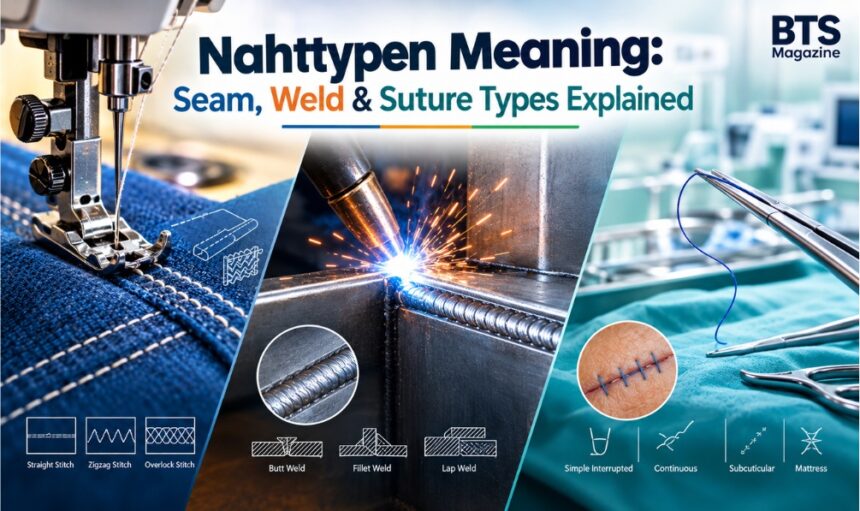
The German term Nahttypen can be confusing because its English meaning changes depending on the industry. It may refer to seam types, weld types, joint forms, or suture techniques.
- What Does Nahttypen Mean?
- Nahttypen in Sewing and Textiles
- Flat Felled Seams and French Seams
- Overlock and Flatlock Seams
- Why Seam Classification Matters
- Nahttypen in Welding and Metalworking
- Common Weld Forms
- Nahttypen in Medicine
- Common Surgical Suture Techniques
- How to Translate Nahttypen Correctly
- Why Context Changes the Meaning of Nahttypen
- Nahttypen in Technical Documents
- Frequently Asked Questions
- What does Nahttypen mean in English?
- What does Nahttypen mean in sewing?
- What does Nahttypen mean in welding?
- What does Nahttypen mean in medicine?
- Why does Nahttypen have different translations?
- Final Takeaway
The common idea behind all these meanings is simple: something is being joined together. In textiles, pieces of fabric are connected. In welding, metal components are joined. In medicine, sutures bring tissue or skin edges together.
Understanding the subject around the word is therefore essential. A sewing manual, welding document, and medical guide may all use the word Naht, but the appropriate English translation will be different in each case.
What Does Nahttypen Mean?
Nahttypen is a German plural expression. The word Naht can describe a seam, a weld seam, or a surgical suture, while Typen means types.
For that reason, translating Nahttypen simply as “seam types” is not always accurate. The correct translation depends on the context in which the term appears.
For example:
- In sewing, Nahttypen generally means seam types.
- In welding, it can describe weld types or joint configurations.
- In medicine, it usually relates to suture types or suturing techniques.
Looking at nearby words is often the easiest way to identify the intended meaning. Terms related to fabric and thread point toward textiles, while words such as groove, metal, and weld indicate engineering. References to skin, wounds, or surgery suggest a medical meaning.
Nahttypen in Sewing and Textiles
In the textile industry, Nahttypen normally refers to different ways of joining fabric. A seam does more than simply hold two pieces together. Its design can influence durability, flexibility, comfort, appearance, and how a garment behaves after washing.
The appropriate seam depends on the material and the purpose of the finished product. A lightweight blouse may require a neat and discreet seam, while workwear or denim may need a much stronger construction.
Common examples include plain seams, flat felled seams, French seams, overlock seams, and flatlock seams.
Plain Seams
The German term Einfache Naht is commonly associated with a plain seam. This is one of the most basic and widely used sewing constructions.
Two fabric pieces are positioned together and stitched along their edges. Because the construction is relatively straightforward, it is frequently used in clothing and general sewing projects.
A plain seam does not automatically protect the cut edges from fraying. Depending on the fabric, the seam allowance may therefore need additional finishing.
This type of seam is also useful for beginners because the basic technique is easy to understand and practice.
Flat Felled Seams and French Seams
A Kappnaht is commonly translated as a flat felled seam. This construction folds the fabric in a way that encloses the raw edges, producing a durable and tidy finish.
Flat felled seams are strongly associated with products such as jeans, shirts, uniforms, and workwear. Their enclosed construction can provide durability while giving the garment a clean appearance.
A Französische Naht, or French seam, also conceals the raw fabric edges. It is particularly useful for delicate, lightweight, or sheer materials where a clean inside finish is important.
Although both techniques hide raw edges, they are constructed differently and are selected for different sewing situations.
Overlock and Flatlock Seams
An overlock seam is produced by stitching around the edge of fabric. The thread wraps around the edge, helping secure the material and reduce fraying.
Overlock construction is widely used in clothing manufacturing because it can combine edge finishing and seam construction in one operation.
A flatlock seam, on the other hand, creates a flatter connection between fabric layers. Because there is less raised material at the seam, it can help reduce bulk and rubbing.
Flatlock seams are therefore frequently associated with sportswear, stretch garments, underwear, and other clothing where flexibility and comfort matter.
Why Seam Classification Matters
Using consistent terminology is important in textile design and manufacturing. Designers, pattern makers, factories, and quality-control teams need to understand exactly how a garment should be constructed.
International classification systems can make this communication easier. ISO 4916, for example, provides a standardized approach to classifying stitches and seams used in textile work.
Standardized terminology becomes particularly useful when a product is designed in one country and manufactured in another. Clear descriptions reduce the chance of misunderstandings during production.
Nahttypen in Welding and Metalworking
In welding and metal fabrication, Nahttypen can refer to different weld forms or joint configurations.
The exact English translation depends on what the document is describing. Sometimes the focus is the weld itself; in other situations, the important feature is the way two metal components are positioned before welding.
Metal parts can meet edge-to-edge, overlap, or form an angle. Each arrangement can require a different preparation method and welding approach.
Technical drawings often use welding symbols alongside short descriptions. As a result, translating German welding terminology requires attention to the surrounding technical information.
Common Weld Forms
An I-Naht can refer to a square or I-shaped groove configuration in which the edges are prepared without a pronounced V-shaped bevel.
A V-Naht describes a V-shaped groove arrangement. The edges are prepared at an angle, creating a V profile that can accommodate weld material.
A Kehlnaht is generally known in English as a fillet weld. It is commonly used when two metal components meet at an angle, such as in a T-joint.
Other welding terms describe different groove preparations and joint arrangements. The correct interpretation should always be checked against the relevant technical drawing, welding standard, or process specification.
Lap Joints and Overlapping Metal
An Überlappnaht is associated with a lap joint, where one piece of metal overlaps another before the connection is made.
Lap joints are frequently encountered in sheet-metal work and fabrication. Depending on the application, overlapping the materials can simplify positioning and reduce the need for certain types of edge preparation.
However, the specific weld design still depends on factors such as material thickness, loading requirements, welding process, and applicable standards.
Nahttypen in Medicine
In a medical setting, Nahttypen generally refers to suture types or suturing techniques.
Sutures are used to bring tissue or wound edges together after an injury or surgical procedure. Medical professionals select a closure technique according to factors such as tissue type, wound location, tension, and the desired healing process.
Medical terminology is especially context-sensitive. A general word such as “stitch” may describe the idea broadly, but a professional medical text may require a much more specific term.
Common Surgical Suture Techniques
An Einzelknopfnaht is generally known as an interrupted suture. Individual stitches are placed separately and tied independently.
One practical feature of interrupted sutures is that each stitch can be managed separately. If one stitch needs to be removed or becomes compromised, the remaining stitches are not necessarily affected in the same way.
A Fortlaufende Naht is a continuous suture. Instead of tying each stitch individually, one continuous strand is used across the closure.
A Matratzennaht, or mattress suture, is designed with a particular stitch path that can provide useful wound-edge support. Mattress sutures may be horizontal or vertical.
The Donati technique is associated with the vertical mattress suture pattern.
An Intrakutannaht is commonly described as a subcuticular or intradermal suture. The suture runs within the skin layers rather than creating a series of visible external knots. The technique may be selected when the appearance of the healed incision is an important consideration.
How to Translate Nahttypen Correctly
The most reliable way to translate Nahttypen is to identify the subject before choosing an English equivalent.
Start by asking what the document is about.
If the surrounding text contains words such as:
- Fabric
- Thread
- Denim
- Garment
- Sewing machine
- Overlock
then seam types is likely the appropriate translation.
If the document mentions:
- Metal
- Groove
- Welding
- Joint
- Plate
- Fabrication
then weld types, weld forms, or joint types may be more suitable.
For medical material, terms such as:
- Wound
- Skin
- Tissue
- Surgery
- Incision
- Suturing
usually indicate that suture types or suture techniques is the intended meaning.
This context-first approach is more reliable than depending on a single dictionary translation.
Why Context Changes the Meaning of Nahttypen
The different meanings of Nahttypen come from the fact that the underlying concept—joining two things—is shared by several professional fields.
In textiles, a seam connects pieces of material and can influence the appearance, strength, and comfort of a garment.
In welding, a weld creates a connection between metal components, and the joint configuration affects preparation and construction.
In medicine, suturing brings tissue or skin edges together as part of wound closure.
The basic idea is similar, but the technical vocabulary is not interchangeable.
This is why translators and students should consider the complete sentence instead of translating the word in isolation. The words surrounding Nahttypen often provide enough information to determine the correct English expression.
Nahttypen in Technical Documents
People working with German technical documents may encounter Nahttypen in manuals, specifications, diagrams, educational materials, or industry standards.
A dictionary can provide a general definition, but technical documents often require industry-specific terminology. A word that means “seam” in everyday language may have a specialized meaning in an engineering or medical document.
When accuracy matters, it is useful to compare the term with the relevant industry standard or glossary. This is particularly important when translating instructions that affect manufacturing, construction, or clinical procedures.
Frequently Asked Questions
What does Nahttypen mean in English?
Nahttypen can mean “seam types,” “weld types,” “joint types,” or “suture types.” The correct translation depends on the industry and the surrounding text.
What does Nahttypen mean in sewing?
In sewing and textile production, Nahttypen generally means seam types. It can include constructions such as plain seams, French seams, flat felled seams, overlock seams, and flatlock seams.
What does Nahttypen mean in welding?
In welding, Nahttypen may refer to different weld forms or joint configurations. Terms such as I-groove, V-groove, fillet weld, and lap joint describe different ways materials can be prepared or connected.
What does Nahttypen mean in medicine?
In medicine, Nahttypen generally refers to suture types or suturing techniques, including interrupted, continuous, mattress, and subcuticular sutures.
Why does Nahttypen have different translations?
The German word Naht has a broad joining-related meaning. Different industries use specialized terminology for their own joining methods, so the correct English translation changes with the context.
Final Takeaway
Nahttypen is a context-dependent German technical term. Depending on where it appears, it can describe seam types in sewing, weld or joint forms in metalworking, or suture techniques in medicine.
In textiles, common examples include plain, French, flat felled, overlock, and flatlock seams. In welding, the term can relate to groove preparations, fillet welds, and lap joints. In medicine, it can describe interrupted, continuous, mattress, and subcuticular sutures.
The key is not to rely on one fixed English translation. Instead, identify the field, examine the surrounding terminology, and then select the English technical term that matches that specific context.
Read also: Atadevolper Official Website Homepage Explained: Services, Features, Benefits & Key Facts