

When software projects become more complex, simply collecting a list of requirements is rarely enough. Teams also need to understand the business context, identify stakeholders, define what the system should do, and connect those expectations to a realistic technical solution.
- What Is AMDiRE?
- Why Was AMDiRE Developed?
- The Three Main AMDiRE Layers
- What Are AMDiRE Artefacts?
- How Does the AMDiRE Process Work?
- How Artefacts Connect Across the Layers
- What Makes AMDiRE Different From a Traditional RE Process?
- What Are the Benefits of Using AMDiRE?
- Better Traceability
- Clearer Responsibilities
- Domain Independence
- Greater Consistency
- Process Flexibility
- Is AMDiRE Still Relevant Today?
- Frequently Asked Questions
- What does AMDiRE stand for?
- What are the three layers of AMDiRE?
- What are the main AMDiRE artefacts?
- Who is responsible for the AMDiRE artefacts?
- Is AMDiRE a software development methodology?
- Final Takeaway
AMDiRE addresses this challenge through an artefact-based approach to Requirements Engineering (RE). The name stands for Artefact Model for Domain-independent Requirements Engineering. Rather than focusing primarily on a fixed sequence of activities, AMDiRE organizes the important results of requirements work into connected artefacts and provides models for their structure, roles, and process integration.
The approach was developed from research and industrial experience and is intended to provide a domain-independent reference that organizations can adapt to their own development environments.
What Is AMDiRE?
AMDiRE is an artefact-based Requirements Engineering approach that helps teams organize information needed to understand, specify, and design a software-intensive system.
Requirements Engineering (RE) is the process of identifying, analyzing, documenting, validating, and managing what a software or system is expected to do. For a broader overview of the field, see Requirements Engineering on Wikipedia.
Its central idea is straightforward: instead of defining only what activities people should perform, AMDiRE puts strong emphasis on what artefacts should exist and how those artefacts relate to one another.
This distinction matters because software projects can use different development processes, tools, and techniques. An organization may use Agile practices, a traditional lifecycle, or a customized internal process. AMDiRE can be tailored and integrated into different organizational environments rather than requiring one universal workflow.
In simple terms:
AMDiRE provides a structured blueprint for the information that Requirements Engineering should produce, how that information is connected, who is responsible for it, and where it fits into the development process.
Why Was AMDiRE Developed?
Requirements Engineering is difficult partly because software projects operate in different domains and involve different stakeholders, constraints, technologies, and organizational practices.
A generic process can therefore become either too rigid or too vague.
AMDiRE was developed to address this problem by consolidating experience from several artefact-based RE approaches. Its authors describe the approach as the result of years of research and industrial collaborations aimed at creating detailed yet adaptable requirements artefacts.
The approach also separates the content of requirements work from the specific methods used to create that content. For example, a project can use natural-language descriptions, UML-based models, interviews, workshops, or other techniques while still organizing the resulting information according to the AMDiRE model.
The Three Main AMDiRE Layers
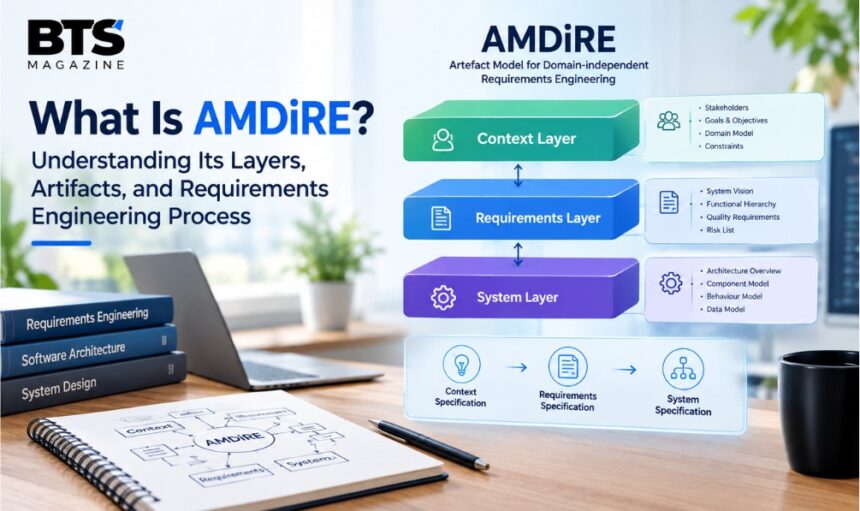
One of the easiest ways to understand AMDiRE is to look at its three major layers:
- Context Layer
- Requirements Layer
- System Layer
Together, these layers move from understanding the problem and environment toward defining requirements and eventually describing the system solution.
1. Context Layer
The Context Layer establishes the environment in which the system will exist.
It answers questions such as:
- What problem are we trying to solve?
- What is inside or outside the project scope?
- Who are the stakeholders?
- What goals matter?
- What constraints or rules exist?
- What does the surrounding domain look like?
Typical content includes the Project Scope, Stakeholder Model, Objectives and Goals, Domain Model, Constraints and Rules, Business Case, and Glossary.
This layer is important because requirements should not be interpreted in isolation. A requirement makes more sense when its business, organizational, or operational context is understood.
2. Requirements Layer
The Requirements Layer focuses on what the system is expected to provide from an external or user-oriented perspective.
This is essentially the problem space: the team defines what is needed without prematurely deciding exactly how the internal system will implement it.
Its content can include:
- System Vision
- Usage Model
- Service Model
- Functional Hierarchy
- Data Model
- Quality Requirements
- Deployment Requirements
- System Constraints
- Process Requirements
- Risk List
For example, a requirement might state that users need to receive notifications when an important event occurs. The requirement describes the expected capability without immediately prescribing the software architecture, database structure, or programming technology.
3. System Layer
The System Layer moves toward the solution space.
Here, the team describes how the required behavior can be realized internally. The model includes elements such as an Architecture Overview, Function Model, Component Model, Behaviour Model, and Data Model.
This creates an important connection between Requirements Engineering and system design.
In simplified terms:
Context = Why and where?
Requirements = What is needed?
System = How can it be realized?
This progression is one of the most useful ways to explain AMDiRE to someone encountering it for the first time.
What Are AMDiRE Artefacts?
An artefact is a significant result or deliverable produced or maintained during a development effort.
AMDiRE groups its content into three major artefact types:
Context Specification
The Context Specification captures the environment surrounding the system. It covers areas such as project scope, stakeholders, goals, constraints, business considerations, and the domain model.
Requirements Specification
The Requirements Specification describes the requirements from the system’s external perspective. It includes elements such as the system vision, usage model, functional hierarchy, quality requirements, deployment requirements, and risks.
System Specification
The System Specification describes the internal realization of the system, including architecture, functions, components, behavior, and related data structures.
These artefacts are not isolated documents. Their contents are connected through relationships and refinement. Information established at one level can provide input for more detailed information at another level.
How Does the AMDiRE Process Work?
AMDiRE should not be understood as a rigid, one-size-fits-all development lifecycle. Instead, its artefacts can be integrated into an organization’s existing process.
The AMDiRE process model connects artefacts with roles and milestones. The published model identifies three principal responsibilities:
- Business Analyst — responsible for the Context Specification
- Requirements Engineer — responsible for the Requirements Specification
- System Architect — responsible for the System Specification
The process can then be organized around milestones such as defining the project scope, establishing the system vision, defining the architecture overview, and formally accepting the three specifications.
This structure gives teams checkpoints without forcing every project to use identical activities.
How Artefacts Connect Across the Layers
The real value of AMDiRE comes from the relationships between its artefacts.
For example, stakeholder information and business goals established in the Context Layer can influence the System Vision. The System Vision can then provide an entry point for developing a functional hierarchy and usage-related requirements.
Those requirements can subsequently be refined into system functions and components within the System Layer.
This creates a chain of reasoning:
Business context → Goals → System vision → Requirements → Functions → Architecture
Such relationships can improve consistency because decisions made later in development can be connected back to information established earlier.
What Makes AMDiRE Different From a Traditional RE Process?
A conventional process description might focus heavily on activities:
Elicit → Analyze → Specify → Validate
AMDiRE places more emphasis on the resulting information:
What context artefacts exist? What requirements artefacts exist? How are they related? Who owns them? When are they accepted?
This does not mean activities are ignored. AMDiRE includes role and process models, but its artefact model serves as the backbone of the approach. The specific methods used to create the content can remain adaptable.
That flexibility is particularly useful for organizations that already have established development processes but want a more structured requirements model.
What Are the Benefits of Using AMDiRE?
Several potential benefits come from an artefact-oriented structure.
Better Traceability
Because requirements and system information are connected through defined relationships, teams can more easily understand how higher-level goals influence detailed specifications.
Clearer Responsibilities
The role model identifies primary responsibility for the major artefact types, reducing ambiguity about who owns a particular specification.
Domain Independence
AMDiRE is designed as a reference model rather than a solution for only one industry. Organizations can tailor its contents to their particular application domain.
Greater Consistency
A defined structure encourages teams to consider important areas such as stakeholders, goals, quality requirements, constraints, risks, architecture, and system behavior instead of treating requirements as an unstructured list.
Process Flexibility
Because the approach separates artefact content from the exact techniques used to create it, teams can adapt AMDiRE to existing organizational processes and project conditions.
Is AMDiRE Still Relevant Today?
Yes. Although the original AMDiRE work dates back to earlier research, the underlying idea remains relevant because modern software projects still need structured requirements, traceability, stakeholder alignment, and clear connections between problem and solution spaces.
More recent research continues to treat AMDiRE as a reference artefact model for Requirements Engineering and has also explored extending it for newer challenges, including data-centric and AI-related systems.
This also highlights an important point: AMDiRE is not necessarily a frozen checklist. Its structure can be adapted and extended when a project introduces new requirements or technologies.
Frequently Asked Questions
What does AMDiRE stand for?
AMDiRE stands for Artefact Model for Domain-independent Requirements Engineering. It is an artefact-based approach for structuring requirements-related information and integrating it with roles and processes.
What are the three layers of AMDiRE?
The three principal layers are the Context Layer, Requirements Layer, and System Layer. They move from understanding the project environment to specifying requirements and describing system realization.
What are the main AMDiRE artefacts?
The three major artefact types are the Context Specification, Requirements Specification, and System Specification.
Who is responsible for the AMDiRE artefacts?
The reference role model assigns primary responsibility to the Business Analyst for context, the Requirements Engineer for requirements, and the System Architect for system specification.
Is AMDiRE a software development methodology?
Not exactly. AMDiRE is better understood as an artefact-based Requirements Engineering approach and reference model. It can be integrated into a broader software development process and tailored to an organization’s needs.
Final Takeaway
AMDiRE provides a structured way to organize Requirements Engineering around the artefacts a project needs rather than relying solely on a fixed sequence of activities.
Its three-layer structure makes the concept easier to understand: the Context Layer establishes the problem environment, the Requirements Layer defines what the system needs to accomplish, and the System Layer describes how those needs can be realized.
The approach becomes especially powerful when these layers are connected through relationships, responsibilities, and milestones. For organizations dealing with complex software projects, AMDiRE offers a useful reference point for creating requirements that are structured, traceable, adaptable, and connected to system design.
Read also: Who Is the CEO of Solauto.tech? Company & Leadership Explained