

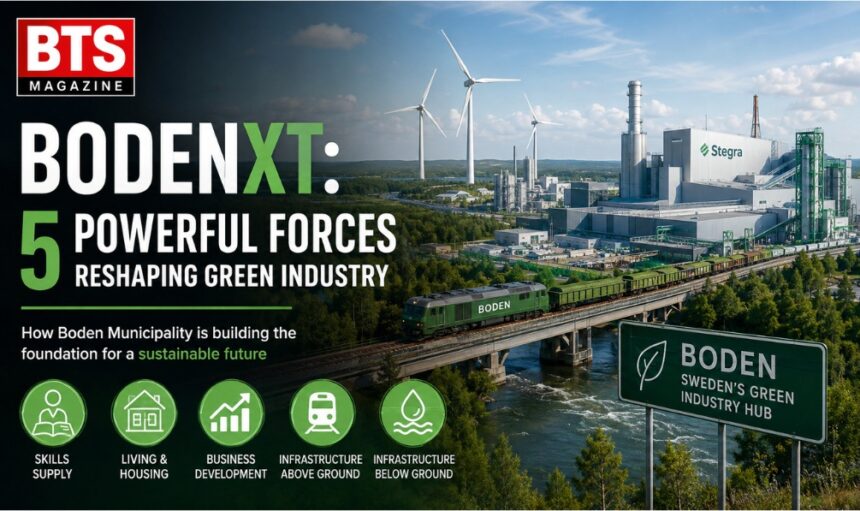
Bodenxt is a municipal initiative created by Boden Municipality to manage the rapid economic and social transformation taking place in Boden, northern Sweden. Rather than being a steel manufacturer, construction project, or standalone development, Bodenxt brings together the different systems required to support large-scale industrial expansion.
- What Is Bodenxt Designed to Achieve?
- Bodenxt and Stegra: Related but Different
- Why Boden Is Becoming a Green Industry Hub
- 1. Skills Supply
- 2. Living and Housing
- 3. Business Development
- 4. Infrastructure Above Ground
- 5. Infrastructure Below Ground
- What does Bodenxt mean?
- Is Bodenxt the same as Stegra?
- Why is Bodenxt closely associated with green steel?
- How many jobs could the wider development create?
- What is one of Bodenxt’s biggest challenges?
The initiative covers areas such as housing, workforce development, business growth, transportation, utilities, and public services. The major investment by Stegra in green steel production is one of the primary forces accelerating this transformation, but Bodenxt extends far beyond the factory itself.
The municipality’s challenge is unusually ambitious: development that might normally take around two decades needs to be delivered within just a few years.
This makes Bodenxt interesting for a reason that goes beyond green steel. The bigger question is how a relatively small municipality can prepare homes, workers, schools, roads, utilities, businesses, and public services quickly enough to support a rapidly expanding industrial economy.
What Is Bodenxt Designed to Achieve?
Bodenxt is intended to make sure industrial expansion results in a functioning community rather than simply creating a large factory surrounded by housing and infrastructure shortages.
Boden Municipality has divided its work into five major areas:
- Skills supply
- Living and housing
- Business development
- Infrastructure above ground
- Infrastructure below ground
These areas are closely connected. A company may recruit an engineer from another country, for example, but that employee still needs somewhere to live. A growing supplier needs transportation infrastructure, reliable utilities, and access to skilled workers. Schools and public services must also expand as the population increases.
This makes Bodenxt essentially a capacity-building and coordination framework for rapid municipal growth.
The initiative can also be understood alongside broader industrial development concepts such as industrial cluster development on Wikipedia, where businesses, infrastructure, skills, and supporting institutions reinforce one another.
Bodenxt and Stegra: Related but Different
Stegra, formerly known as H2 Green Steel, is developing a major green steel facility at Boden Industrial Park. Bodenxt, however, is not the company behind that factory.
Instead, Bodenxt represents Boden Municipality’s response to the wider changes generated by industrial investment.
| Category | Bodenxt | Stegra |
| Organization | Municipal initiative | Private industrial company |
| Primary role | Coordinates community growth and transformation | Develops and operates green steel production |
| Main areas | Housing, skills, infrastructure, businesses and public services | Hydrogen, iron and steel production |
| Geographic impact | Municipality and surrounding regional economy | Industrial site and related supply chain |
| Main objective | Help Boden absorb and benefit from rapid growth | Produce steel with substantially lower emissions |
The relationship can therefore be described as an anchor-and-ecosystem model. Stegra provides the major industrial anchor, while Bodenxt works on the broader ecosystem required for that investment to succeed and generate lasting local benefits.
Why Boden Is Becoming a Green Industry Hub
Several factors make Boden attractive for major industrial development.
The municipality benefits from access to relatively low-carbon electricity, industrial land, transportation infrastructure, technical expertise, and the wider mining and energy economy of northern Sweden.
Stegra’s production model is based on hydrogen rather than the traditional coal-intensive blast-furnace process. Electricity is used to split water into hydrogen and oxygen, while hydrogen is then used in the ironmaking process to remove oxygen from iron ore.
According to Stegra’s plans, the hydrogen facility is expected to use 37 large electrolyzer modules and more than 700 megawatts of electrolysis capacity. Annual hydrogen production is planned to exceed 100,000 tonnes, while the wider industrial site covers roughly 270 hectares.
Stegra has stated that its production technology could reduce carbon dioxide emissions by as much as 95% compared with conventional steelmaking based on coke-fired blast furnaces.
The scale of the industrial investment explains why Boden’s transformation cannot be handled solely as an industrial planning exercise. The surrounding community must grow alongside it.
The Five Major Areas Behind Bodenxt
1. Skills Supply
A modern industrial cluster requires far more workers than engineers and metallurgists.
Technicians, electricians, construction specialists, logistics workers, teachers, healthcare professionals, retail employees, maintenance teams, and public-sector staff are also necessary for a growing community.
Boden is therefore adapting its education system to the emerging labor market.
The Upper Secondary Engineering Programme at Björknäsgymnasiet is scheduled to start in autumn 2026. The program is designed to combine technical education with workplace learning, industrial design, and product development.
Stegra, SMS Group Nordic, other local industrial organizations, and the Swedish Armed Forces are involved in connecting education with real-world employment opportunities.
The objective is not simply to produce workers for one company. It is to build a broader skills base capable of supporting the municipality’s expanding industrial and public-service economy.
2. Living and Housing
Housing could become one of the most important tests of Bodenxt’s effectiveness.
Boden Municipality expects more than 4,000 additional residents by 2030. Its projections also point toward approximately 10,000 direct and indirect regional jobs, including around 2,000 positions associated with Stegra, while existing development plans could enable approximately 1,300 apartments.
Expansion by the Swedish Armed Forces adds another source of demand.
Population growth is already becoming visible. Boden recorded 28,624 registered residents at the end of 2025, which was 376 more people than the municipality had forecast.
At the same time, the number of people physically working in Boden can be higher than official population statistics suggest because temporary workers do not necessarily register as permanent residents.
That creates a difficult housing equation.
In May 2026, the municipality reported that rental vacancies were close to zero. A lack of available housing can make recruitment more difficult because potential employees may accept jobs but struggle to find somewhere to live.
This highlights an important principle behind Bodenxt: industrial jobs alone do not automatically produce sustainable population growth. Housing connects employment opportunities with permanent community development.
3. Business Development
Bodenxt also aims to ensure that economic growth reaches smaller companies instead of remaining concentrated around one major industrial employer.
Potential opportunities exist across construction, maintenance, engineering, transportation, logistics, retail, technology, and industrial supply services.
A stronger local supplier network can keep more economic activity within the region while reducing reliance on external providers.
Boden’s business environment has also shown positive indicators. The municipality ranked fourth nationally in Sweden’s Insikt 2025 survey and achieved a customer satisfaction score of 87 for business-related regulatory services.
Although permits, inspections, and municipal administration may seem less important than factories or railways, they can significantly influence how quickly businesses are able to establish themselves and expand.
4. Infrastructure Above Ground
Transportation infrastructure is one of the most visible components of Boden’s transformation.
A major example is the railway connection serving Boden Industrial Park.
The completed railway project includes approximately six kilometers of track and nine bridges, with the capacity to handle trains as long as 1,000 meters. It connects the industrial area with the Malmbanan railway and Sweden’s broader national rail network.
The project was completed one month ahead of schedule and below its budget through a public-private partnership involving Polar Structure and Boden Municipality.
Road and cycling infrastructure is also being upgraded.
According to current municipal information, the relevant road and pedestrian-cycle connection is expected to reopen on October 1, 2026, while work toward Road 605 is scheduled to continue into autumn 2027.
These projects are important not only for Stegra but also for attracting additional companies to the industrial area.
5. Infrastructure Below Ground
Some of the most important infrastructure is almost invisible.
Water networks, wastewater treatment, drainage, electricity distribution, fiber connections, and other underground utilities determine how much additional population and industrial activity a community can actually support.
These systems are difficult and expensive to expand after new neighborhoods and businesses have already been established.
For that reason, Bodenxt can be viewed as a long-term capacity-planning effort as much as a green-industry initiative.
The municipality is attempting to increase infrastructure capacity before shortages become a barrier to further development.
What Has Bodenxt Accomplished?
Bodenxt is still evolving, but several measurable developments have already taken place.
| Area | Progress | Main challenge |
| Population | 28,624 registered residents at the end of 2025 | Turning temporary workers into permanent residents |
| Relocation | Around 640 people connected to Stegra-related relocation | Providing sufficient housing for future recruitment |
| Housing | Plans enabling approximately 1,300 apartments | Very limited rental availability and financing challenges |
| Rail | Six-kilometer railway completed ahead of schedule and under budget | Further road and logistics improvements |
| Skills | Engineering program scheduled for autumn 2026 | Filling industrial and public-service positions |
| Collaboration | Sustainability Center funding planned through 2029 | Building long-term cooperation between sectors |
The relocation numbers demonstrate how industrial investment can directly affect the local population.
By the end of 2025, Boden’s Relocation Service reported that approximately 275 Stegra employees were already living in the municipality. When accompanying partners, children, and other family members were included, the number of people connected with the company was estimated at around 640.
Another initiative is the Boden Sustainability Center, which is intended to establish a longer-term platform for collaboration among the municipality, businesses, academia, and civil society.
The project has a budget exceeding SEK 16 million and is scheduled to operate from autumn 2026 through summer 2029.
The Biggest Innovation May Be Municipal Coordination
Much of the attention surrounding Boden focuses on hydrogen technology, green steel, and industrial investment. Those developments are important, but Bodenxt offers another lesson that may be more transferable to other communities.
Its central innovation is coordinated municipal execution.
Instead of treating housing, education, relocation, permits, infrastructure, utilities, and transportation as unrelated administrative issues, Bodenxt connects them as parts of one transformation.
That approach addresses a common problem with major industrial projects.
Private companies can recruit employees and begin construction relatively quickly, while public infrastructure often takes years to plan, finance, approve, and build.
Bodenxt is essentially attempting to close that timing gap.
However, the challenges should not be underestimated. Housing availability remains tight, infrastructure investments carry financial and operational risks, and the schedule for the major industrial project can change.
In June 2026, after completing a €1.4 billion financing round, Stegra said it was increasing construction activity again while indicating that its overall project timeline remained under review.
This means Bodenxt should be evaluated with both optimism and caution.
The initiative has already contributed to infrastructure improvements, population growth, relocation support, and new educational opportunities. Its long-term performance will depend on whether it can deliver enough housing, maintain municipal finances, retain workers, support industrial commissioning, and encourage economic diversification.
Why Bodenxt Could Matter Beyond Sweden
Bodenxt provides a useful example for municipalities facing sudden investment in clean energy, advanced manufacturing, mining, data centers, or defense.
The most important lesson is that industrial transformation is rarely limited to the industrial site itself.
It can simultaneously become:
- A housing challenge
- A workforce challenge
- A transportation challenge
- A utilities challenge
- A public-service challenge
- A business-development challenge
Other municipalities do not need to reproduce Boden’s exact projects to apply the same planning philosophy.
They can identify the major investment driving growth, determine which systems will experience pressure, create cross-sector delivery teams, establish measurable targets, and track whether short-term construction activity develops into lasting local economic value.
FAQs
What does Bodenxt mean?
Bodenxt refers to Boden Municipality’s framework for coordinating the community-wide transformation associated with rapid industrial and economic development. Its work includes housing, skills, business development, and infrastructure.
Is Bodenxt the same as Stegra?
No. Stegra is the company developing the green steel facility in Boden, while Bodenxt is the municipal initiative responsible for coordinating the broader community transformation.
Why is Bodenxt closely associated with green steel?
Stegra’s green steel project is one of the main drivers behind Boden’s rapid industrial expansion. It is contributing to increased demand for workers, housing, transportation, infrastructure, and local services.
How many jobs could the wider development create?
Boden Municipality projects approximately 10,000 direct and indirect regional jobs, with around 2,000 of those connected to Stegra.
What is one of Bodenxt’s biggest challenges?
Housing is among the most significant constraints. Very low rental availability can make it harder for employers to recruit workers and for new employees to establish permanent lives in Boden.
What to Watch Next
Bodenxt has moved beyond the purely conceptual stage.
Rail infrastructure has been delivered, new residents have arrived, technical education is expanding, and major industrial construction is progressing.
The next phase will determine whether Boden can convert this rapid momentum into a stable and diversified community.
Four indicators will be especially important:
- Housing completions — whether new homes are delivered quickly enough to accommodate population growth.
- Stegra’s commissioning schedule — whether the major industrial project progresses according to its revised timeline.
- Permanent population growth — whether temporary workers become long-term residents.
- Business diversification — whether companies outside the steel project establish and expand operations in the region.
For residents, workers, investors, and local businesses, the most useful information will increasingly come from actual project delivery rather than announcements.
Bodenxt’s significance ultimately lies in whether Boden can transform a major industrial opportunity into a community that remains economically strong, socially functional, and sustainable long after the initial construction boom has passed.
Read also: Wind Power Startup Investments: 10 Best Opportunities