

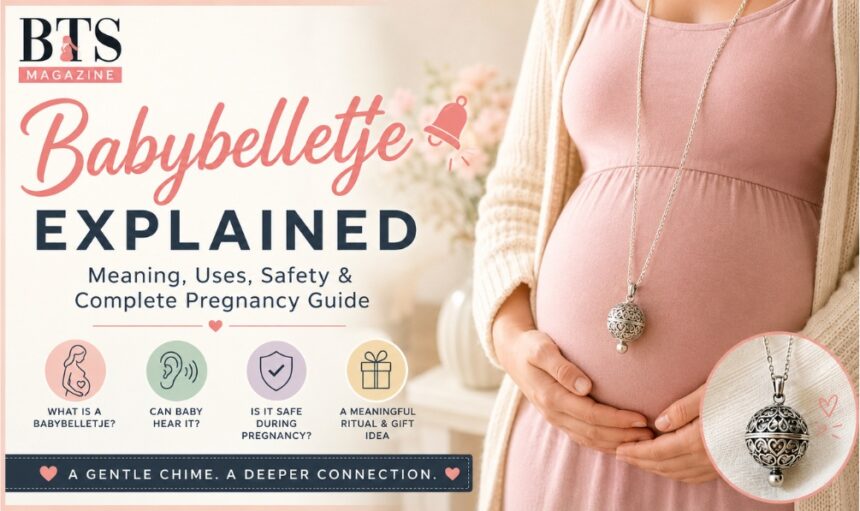
A Babybelletje is a long necklace designed for pregnancy, featuring a small pendant that produces a soft chiming sound as the wearer moves. Because the pendant generally hangs over the lower part of the belly, it is also known by names such as pregnancy bell, pregnancy bola, harmony ball, baby bell, or the Dutch term zwangerschapsketting.
- What Does Babybelletje Mean?
- Babybelletje, Pregnancy Bola, and Harmony Ball: What’s the Difference?
- How Does a Babybelletje Produce Its Sound?
- Can a Baby Hear a Babybelletje Before Birth?
- Why Do People Wear a Babybelletje?
- When Is the Best Time to Start Wearing One?
- How to Choose a Good Babybelletje
- Is a Babybelletje Safe During Pregnancy?
- Can You Continue Wearing It After Birth?
- How to Care for Your Babybelletje
- Common Babybelletje Myths
- A Meaningful Accessory, Not a Medical Treatment
- FAQs
For many expectant parents, this type of necklace is more than an accessory. It can represent the connection between parent and unborn baby and may become a simple daily reminder to pause, relax, and enjoy the pregnancy.
The basic concept is straightforward: movement causes a small internal piece inside the pendant to create a gentle sound. Since fetal responses to sound develop during the later stages of pregnancy, some Babybelletje sellers suggest that the sound may become familiar to the baby before birth. However, there is not enough strong clinical evidence to say that a Babybelletje can reliably soothe a newborn, improve development, or affect fetal positioning.
It is therefore best viewed as symbolic pregnancy jewelry and a personal bonding ritual rather than a medical product.
What Does Babybelletje Mean?
The name Babybelletje has a Dutch appearance. In Dutch, bel refers to a bell, while belletje is a diminutive meaning a small bell. In modern online shopping and pregnancy-related discussions, Babybelletje generally describes a pregnancy necklace containing a small chiming pendant.
The name should not be confused with Mini Babybel, the well-known cheese product. Although the words look similar, they have nothing to do with each other.
A traditional Babybelletje typically consists of a long chain or cord and a hollow pendant containing a small moving component. When the wearer walks or changes position, the internal piece moves and creates the characteristic soft chime.
The pendant is generally intended to hang over the lower portion of the pregnancy bump rather than press tightly against the abdomen.
Babybelletje, Pregnancy Bola, and Harmony Ball: What’s the Difference?
Different sellers use several names for pregnancy-bell jewelry. In many cases, the practical difference is relatively small, with variations mainly involving design, branding, materials, and cultural descriptions.
| Name | Common description | What to consider |
| Babybelletje | A small pregnancy bell or chiming necklace | Check whether the pendant actually contains a chime |
| Zwangerschapsketting | Dutch term for pregnancy necklace | Some versions may not contain a bell |
| Pregnancy bola | Long pregnancy necklace with a chiming pendant | Examine its material, length, and construction |
| Harmony ball | Decorative pendant that produces a gentle sound | Check tone, size, and intended purpose |
| Angel caller | Spiritual or gift-focused term for a chiming pendant | Treat supernatural or protective claims as symbolic |
The name alone does not tell you whether a necklace is well made. Pay closer attention to its materials, dimensions, construction, comfort, and safety information.
How Does a Babybelletje Produce Its Sound?
The pendant normally contains a small loose component inside a hollow shell. When the necklace moves, the internal piece rolls, strikes, or moves against another surface, producing a light ringing sound.
Some designs use a small ball inside a metal casing, while others use different internal chime mechanisms.
A well-designed pregnancy bell usually produces a relatively subtle tone. It should be noticeable to the wearer without sounding like a loud traditional bell.
For many people, the most realistic value of the sound is not medical but emotional. The repeated chime can become a mindfulness cue that encourages someone to slow down, take a breath, touch their belly, or simply become more aware of the moment.
Can a Baby Hear a Babybelletje Before Birth?
Fetal hearing develops gradually during pregnancy. According to the CDC, the ears develop by around 20 weeks, and fetuses begin responding to sounds at approximately 24 weeks.
That does not mean an unborn baby hears a Babybelletje exactly as an adult standing beside the pendant would. Sounds entering the womb are affected by the mother’s body, surrounding tissues, clothing, the pendant’s position, the sound’s frequency, and the stage of pregnancy.
Research also indicates that lower-frequency sounds can travel through the body more effectively than higher-frequency sounds. This means a delicate, high-pitched jewelry chime may be considerably softer inside the womb than it appears outside the body.
Research into prenatal exposure to speech and music has found evidence that babies can respond to and sometimes retain familiarity with repeated sounds. However, this should not be interpreted as proof that a particular pregnancy bell produces the same effect.
For additional background on fetal development, you can also explore the relevant information on Wikipedia’s Fetal Development page.
What Research Generally Supports
Several points are reasonably consistent with current knowledge:
- Fetal hearing and sound responses develop during the second half of pregnancy.
- The uterus does not completely eliminate sounds from the outside environment.
- Repeated sounds may sometimes become familiar to a baby before or after birth.
- A repeated sound can also have emotional significance for the pregnant person.
What Has Not Been Established
There is not strong evidence showing that a Babybelletje:
- Can be clearly heard by every fetus
- Consistently calms newborn babies
- Improves intelligence or developmental outcomes
- Improves a baby’s hearing
- Improves sleep after birth
- Causes a fetus to move toward the pendant
- Changes or causes a breech presentation
For this reason, be skeptical of advertisements using phrases such as “guaranteed,” “clinically proven,” or “instant calming.” A pregnancy bell can still be meaningful without making medical promises.
Why Do People Wear a Babybelletje?
Creating a Personal Pregnancy Ritual
Pregnancy can involve appointments, physical changes, preparation, uncertainty, and many practical decisions. A simple ritual can provide a sense of continuity.
Some people enjoy touching the pendant whenever they notice fetal movement. Others associate its sound with evening walks, quiet breathing exercises, or relaxing moments at home.
In this sense, the necklace can function as a reminder rather than a treatment. It may encourage mindfulness, but it does not replace prenatal healthcare.
Symbolic and Emotional Meaning
Babybelletjes are often decorated with symbols such as:
- Hearts
- Stars
- Moons
- Flowers
- Trees
- Wings
- Birthstones
- Initials
- Family symbols
The same design can have different meanings for different families. For one person, the bell might symbolize protection; for another, it may simply represent the pregnancy or serve as a keepsake.
There are also many online claims connecting pregnancy bolas with Mayan, Balinese, Indonesian, Celtic, or other cultural traditions. Some of these stories may be based on modern interpretations or commercial storytelling rather than well-documented history. It is therefore useful to distinguish documented historical information from legend and marketing language.
A Meaningful Pregnancy Gift
A Babybelletje can make a thoughtful baby-shower or maternity gift because it is intended for the pregnant person rather than exclusively for the baby.
It also does not depend on the baby’s sex, clothing size, nursery design, or birth season. A small note explaining the symbolism behind the necklace can make the gift more personal.
If mentioning its potential soothing qualities, describe them as personal experiences or traditional beliefs, rather than guaranteed benefits.
When Is the Best Time to Start Wearing One?
There is no medically required starting point because a Babybelletje is jewelry rather than a prenatal treatment.
Some people begin wearing one immediately after receiving it, while others choose to start around 20 to 24 weeks, when fetal hearing and responses to sound are becoming more developed.
Comfort is the most important consideration. As the pregnancy progresses, the cord or chain may need to be adjusted so the pendant hangs naturally over the bump without placing unnecessary pressure on the neck.
Ordinary walking and daily movement are generally enough to produce the sound. There is no established benefit to deliberately shaking the pendant against the abdomen.
How to Choose a Good Babybelletje
A reliable product listing should provide practical information rather than depending entirely on phrases such as “luxury,” “premium,” or “high quality.”
| Feature | Practical choice | Why it matters |
| Length | Adjustable chain or cord, commonly around 100–120 cm | Allows room for a growing bump |
| Material | Clearly identified metal and nickel information | Useful for people with sensitive skin |
| Construction | Securely assembled pendant | Helps reduce loose components |
| Sound | Gentle tone during ordinary movement | Comfortable for regular use |
| Weight | Lightweight design | Reduces pulling around the neck |
| Finish | Smooth surfaces and durable coating | Helps reduce snagging and premature wear |
| Seller information | Measurements, care instructions, returns, and contact details | Provides greater transparency |
Pay Attention to Materials
Pregnancy bells may be made from silver, stainless steel, brass, gold-plated materials, or combinations of metal and textile.
Plated jewelry can gradually change when exposed to sweat, water, perfume, lotion, and friction. If you have sensitive skin, do not rely solely on the phrase “hypoallergenic.”
Instead, check the actual material composition and ask the seller for clarification if important information is missing.
Listen to the Sound Before Buying
The sound is one of the defining features of this type of jewelry, so an audio or video demonstration can be useful.
A soft, pleasant chime may be preferable to a sharp or loud tone, particularly if you expect to wear the necklace throughout the day.
Remember that online recordings cannot reproduce the exact sound perfectly. Still, listening to a demonstration can help you avoid a pendant with a tone that seems too harsh, metallic, or distracting.
Inspect the Cord and Fastener
Look carefully at the chain, cord, clasp, knots, connecting rings, and pendant attachment.
The necklace should not easily catch on clothing, bags, furniture, exercise equipment, or other objects. Remove it whenever an activity creates a significant snagging risk.
Is a Babybelletje Safe During Pregnancy?
For most adults, a properly constructed pregnancy necklace is generally a low-risk accessory. The main concerns are practical rather than related to the pregnancy itself.
Potential issues include:
- Skin irritation
- Broken components
- Loose parts
- Snagging
- An unnecessarily heavy pendant
- Poor-quality materials
- Misleading health claims
A Babybelletje should never be considered a substitute for prenatal appointments, fetal-movement advice, scans, or professional medical assessment.
If you have concerns about your pregnancy, speak with your midwife, obstetrician, or another qualified healthcare professional.
There is also no reliable evidence that wearing the necklace higher or lower on the abdomen causes breech presentation. Fetal positioning is influenced by multiple factors, especially as pregnancy progresses.
Take Extra Care With Aromatherapy Versions
Some pregnancy necklaces are designed to hold essential oils, scented pads, or porous stones.
The fact that an ingredient is described as “natural” does not automatically mean it is appropriate for pregnancy. The NHS recommends discussing aromatherapy and other complementary products with a healthcare professional because some remedies may not be suitable during pregnancy.
Avoid allowing undiluted essential oils to contact your skin through the pendant. If a scented insert causes irritation, nausea, dizziness, headaches, or breathing discomfort, discontinue use and seek appropriate advice.
Can You Continue Wearing It After Birth?
Yes, a Babybelletje can remain an adult accessory after pregnancy. However, it should never be treated as an infant necklace or unsupervised baby toy.
Do not:
- Put the necklace around a baby’s neck
- Attach it to a baby’s clothing
- Place it inside a cot
- Hang it where an infant can reach it
- Leave it with a sleeping baby
- Allow a baby to chew on the pendant or cord
Long cords and jewelry can create choking or strangulation risks for infants.
Some parents may choose to wear the necklace during supervised feeding. If you do, keep the chain under control and remove it if the baby starts pulling, grabbing, chewing, or becoming tangled in it.
A safer long-term option is to keep the necklace as an adult accessory or preserve it as a pregnancy keepsake.
How to Care for Your Babybelletje
Proper care can help maintain both the appearance and sound of the pendant.
It is generally sensible to remove the necklace before:
- Showering
- Swimming
- Sleeping
- Intense exercise
- Activities involving machinery or snagging hazards
Water, sweat, cosmetics, perfume, and household chemicals can affect metal finishes, cords, stones, or internal components.
For routine cleaning, gently wipe the necklace with a soft, dry cloth and follow the manufacturer’s instructions.
Avoid soaking the pendant unless the manufacturer specifically states that it is water-safe. Moisture entering the internal mechanism can potentially affect its sound.
Store the necklace somewhere dry and preferably separate from other jewelry to prevent tangling and scratches.
If the sound suddenly changes, the pendant becomes loose, or the casing appears damaged, stop wearing it until it has been checked.
Common Babybelletje Myths
One widespread claim is that a pregnancy bell has scientifically proven calming properties. Although prenatal sound exposure is a legitimate area of research, that does not establish a guaranteed calming effect from pregnancy-bell jewelry.
Another claim is that hearing the pendant can improve a baby’s intelligence or “train” the developing brain. There is no strong evidence supporting that promise.
You may also encounter claims that a specific metal, symbol, or design provides physical protection during pregnancy. Such ideas may have cultural, spiritual, or personal significance, but they should not be presented as medical facts.
The simplest and most honest reason to wear a Babybelletje may also be the best one: you like the jewelry, enjoy its sound, appreciate its symbolism, or find the ritual personally meaningful.
A Meaningful Accessory, Not a Medical Treatment
A Babybelletje is best understood as a piece of pregnancy jewelry that combines a gentle sound with personal symbolism.
It may become part of a calming routine, a way to mark pregnancy, a sentimental keepsake, or a meaningful gift. However, there is no strong basis for presenting it as a guaranteed method for calming a baby, improving development, or changing pregnancy outcomes.
When choosing one, focus on the things that can actually be evaluated: comfort, materials, construction, weight, durability, and sound quality.
Its greatest value may ultimately come from the meaning you give it—whether that means wearing it during a walk, pausing for a quiet breath when it chimes, taking pregnancy photos, or simply enjoying it as a reminder of an important chapter in your life.
FAQs
What is a Babybelletje?
A Babybelletje is a long pregnancy necklace with a small pendant that produces a gentle chiming sound. The pendant is usually worn so that it rests over the lower part of the pregnancy bump.
When can a baby hear a Babybelletje?
Fetal hearing develops progressively. The ears are developed by around 20 weeks, while responses to sound begin around the middle of the second half of pregnancy. However, it is impossible to guarantee exactly how clearly a particular Babybelletje is heard inside the womb.
Can a Babybelletje calm a newborn?
A baby may recognize familiar sounds after birth, but there is not strong evidence that a Babybelletje consistently calms newborns.
Can wearing a Babybelletje cause breech presentation?
There is no good evidence that pregnancy-bell jewelry causes breech presentation or makes a baby move toward the sound.
Can I put a Babybelletje on my baby?
No. Necklaces, cords, and detachable jewelry components should be kept away from infants because they can create choking and strangulation hazards.
Is a Babybelletje a medical device?
No. It is best considered pregnancy jewelry or a personal keepsake. It should not be used as a substitute for professional prenatal care.
Is the sound harmful to the fetus?
A normal, gentle jewelry chime is not generally considered a medical treatment or intervention. Nevertheless, there is no reason to deliberately expose the abdomen to loud sounds. The pendant should be used normally rather than shaken forcefully or placed directly against the abdomen.
Is a Babybelletje the same as a pregnancy bola?
The terms are often used for similar products. A pregnancy bola generally refers to a long necklace with a chiming pendant, while Babybelletje is another name used for a pregnancy bell. Exact designs vary between sellers.
Read also: Family Opportunity Mortgage: Requirements & Benefits