
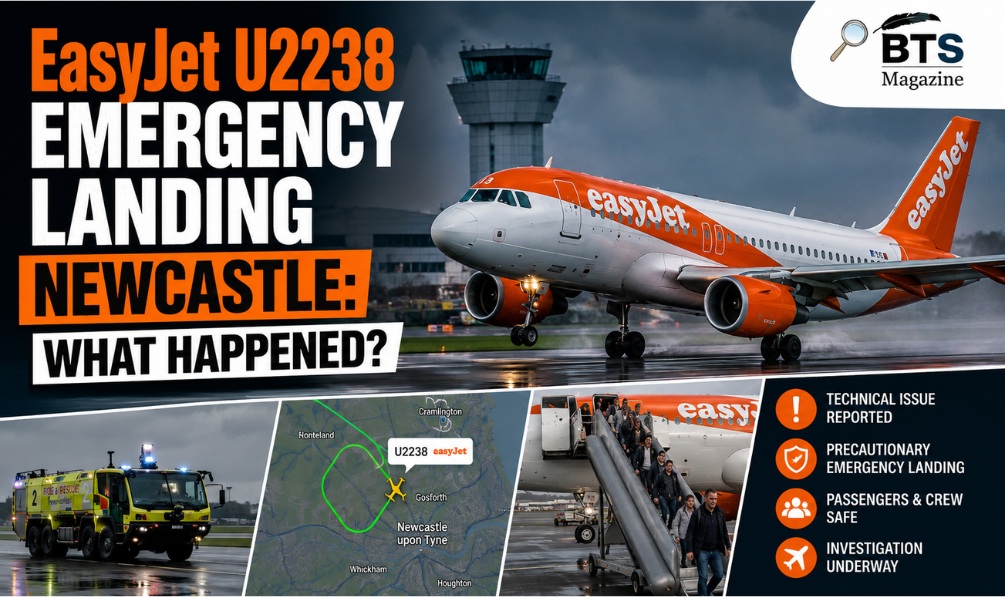
Picture this: you’re on a late-night flight, half asleep, dreaming of your own bed. Then the captain’s voice cuts in with news of an unexpected stop. That’s exactly the kind of moment passengers faced during the EasyJet U2238 Emergency Landing Newcastle.
The good news? Everyone was in safe hands. In this article, we’ll walk through what really happened, why the plane diverted, and what you can learn as a traveler. Let’s dive in!
For more travel, aviation, and current-interest stories, visit BTS Magazine.
What Is the EasyJet U2238 Emergency Landing?
The EasyJet flight U2238 emergency landing in Newcastle happened on October 27, 2025. Flight EZY2238 was traveling from Copenhagen to Manchester when a passenger needed urgent medical care. The Airbus A320 diverted and safely landed at Newcastle Airport at 10:52 pm, where paramedics were waiting.
In simple terms, this was an in-flight medical emergency that led to a quick, unscheduled landing. The crew acted fast, the passenger got help, and the flight continued its journey soon after.
Key facts at a glance:
- Flight: EZY2238 (U2238)
- Route: Copenhagen to Manchester
- Aircraft: Airbus A320
- Diversion airport: Newcastle Airport
- Reason: Passenger needing urgent medical attention
- Landing time: 10:52 pm, October 27, 2025
Why Did the Plane Divert to Newcastle?
The plane diverted because a passenger onboard suddenly needed urgent medical attention. When someone falls seriously ill mid-flight, the crew can’t always wait until the final destination. Getting the person to a hospital quickly becomes the top priority.
Newcastle Airport was the closest and safest choice at that moment. It had the runway, the medical support, and the ground crews ready to help.
An EasyJet spokesperson explained it clearly: “Flight EZY2238 from Copenhagen to Manchester on October 27 diverted to Newcastle, due to a customer onboard requiring urgent medical attention.”
They added that safety and wellbeing are always easyJet’s highest priority. That’s the heart of every diversion decision.
What Happened Step by Step
Here’s how the night unfolded, step by step:
- Departure: EZY2238 left Copenhagen bound for Manchester, a routine evening flight.
- Medical emergency: A passenger onboard became unwell and needed urgent care.
- Quick decision: The crew alerted air traffic control and chose Newcastle as the nearest safe option.
- Landing: The Airbus A320 touched down at Newcastle Airport at 10:52 pm on October 27, 2025.
- Medical response: North East Ambulance Service met the plane. Crews received a call at 10:33 pm.
- Hospital transfer: The patient was taken to the Royal Victoria Infirmary (RVI) in Newcastle for further treatment.
- Journey resumes: The plane took off again at 12:02 am on October 28.
- Final arrival: It landed in Manchester just 27 minutes later.
From start to finish, this was a smooth and well-managed response. No injuries were reported among other passengers.
How Airlines Handle In-Flight Medical Emergencies
Ever wondered what happens behind the scenes during an in-flight medical emergency? It’s more organized than you might think! Airlines train their crews for exactly these moments.
Here’s the usual process:
- Cabin crew assess the situation and check the passenger’s condition.
- They call for medical help onboard, asking if a doctor or nurse is present.
- The captain contacts ground control to weigh the options.
- A diversion is arranged if the situation is serious.
- Ambulance crews are alerted so they’re ready on landing.
Most planes also carry first-aid kits and emergency medical supplies. Some airlines even connect with ground-based doctors by radio for real-time advice. This is the EasyJet safety protocol in action, and it’s designed to protect you every step of the way.
What This Means for Passengers
A flight diversion can feel scary, but it’s actually a sign the system is working. When a plane makes an unscheduled landing to help someone, it shows the crew’s commitment to passenger safety.
So what does this mean for you as a traveler?
- Delays may happen, but they’re for good reasons.
- Your safety comes first, always.
- The crew is trained to handle these situations calmly.
- Diversions are usually short, as we saw with the quick turnaround in Newcastle.
In this case, the delay was minimal. The plane was back in the air within about an hour and reached Manchester safely. That’s a great outcome!
Common Misconceptions About Emergency Landings
Let’s clear up a few myths about emergency landings. Many travelers worry more than they need to!
Myth 1: Emergency landings are always dangerous.
Not true! Most diversions are precautionary. They often happen because of a medical issue, not a plane fault.
Myth 2: They’re extremely rare.
Actually, emergency landings happen more often than you’d think. Airlines make them routinely to keep everyone safe.
Myth 3: The plane is damaged.
In cases like the Newcastle Airport diversion, the aircraft was perfectly fine. The issue was a passenger’s health, not the plane.
Myth 4: You’ll be stranded for hours.
Often the flight continues once the situation is handled, just like EZY2238 did within an hour.
Expert Tips for Passengers During Emergencies
Want to feel more prepared next time you fly? Here are some handy tips to keep you calm and comfortable during any flight diversion:
- Stay calm and listen. The crew will guide you clearly. Panic never helps.
- Follow instructions quickly. Buckle up and keep your seat area clear.
- Speak up if you feel unwell. Tell the crew right away. Early action matters.
- Keep essentials handy. Store medication, water, and snacks in your carry-on.
- Charge your phone before flying. You’ll want it for updates and rebooking.
- Know your rights. Check your airline’s policy on delays and diversions.
- Be kind to the crew. They’re working hard to keep everyone safe!
A little preparation goes a long way toward a smoother trip. Trust me, these small habits make a big difference!
FAQs
What was the EasyJet U2238 emergency landing?
The EasyJet U2238 emergency landing was a diversion of flight EZY2238 from Copenhagen to Manchester. It landed at Newcastle Airport at 10:52 pm on October 27, 2025, because a passenger needed urgent medical attention. The passenger was taken to hospital, and the flight later continued to Manchester.
Why did EasyJet flight U2238 divert to Newcastle?
The flight diverted because a passenger onboard needed urgent medical care. Newcastle Airport was the nearest safe airport with medical support ready. This allowed the crew to get the passenger help quickly and safely.
What type of aircraft was flight EZY2238?
Flight EZY2238 was an Airbus A320. This is one of the most common short-haul planes in EasyJet’s fleet, known for its reliability on European routes.
What happened to the passenger?
The passenger was met by the North East Ambulance Service at Newcastle Airport. They were then transported to the Royal Victoria Infirmary (RVI) in Newcastle for further treatment.
How long was the delay?
The delay was fairly short. The plane landed at 10:52 pm, then took off again at 12:02 am and reached Manchester just 27 minutes later.
Are emergency landings common with EasyJet?
Yes, diversions for medical reasons happen across all airlines, including EasyJet. They are part of standard safety procedures and show the crew’s commitment to passenger wellbeing.
Was anyone else hurt during the diversion?
No. No other injuries were reported. The diversion was purely to help one unwell passenger, and everyone else was safe throughout.
Conclusion
The EasyJet flight U2238 emergency landing in Newcastle is a reassuring story of quick thinking and teamwork. When a passenger needed urgent help, the crew acted fast, landed safely, and made sure they reached the hospital. Then the flight carried on to Manchester with minimal delay.
The big takeaway? Emergency landings are about keeping you safe, not putting you at risk. Airlines like EasyJet follow strict safety protocols for exactly these moments.
For official information about airline operations, passenger safety, and aviation regulations in the UK, you can also refer to the UK Civil Aviation Authority.
Planning a trip soon? Bookmark this guide, share it with fellow travelers, and fly with confidence knowing your safety always comes first. Safe travels.