

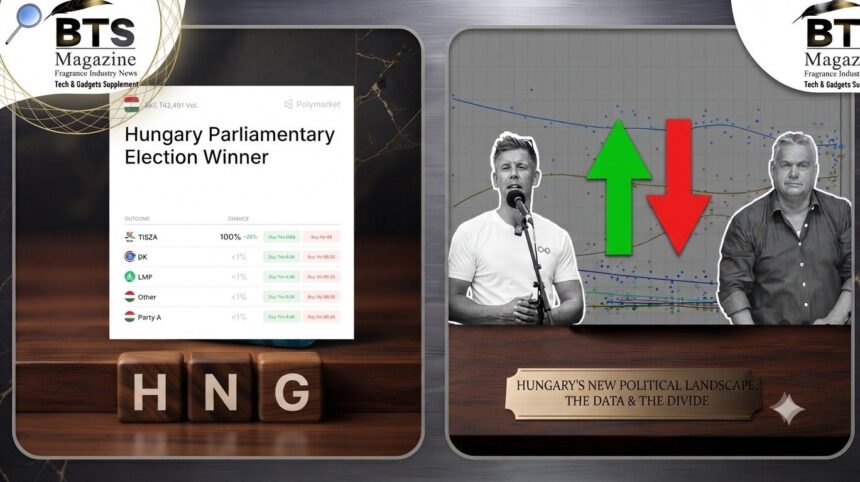
Polymarket Hungary elections markets got a lot of attention in 2026, and honestly, it’s easy to see why. When a country’s political future is up for grabs, people don’t just watch the polls anymore. They watch the money. And on Polymarket, real money was being placed on who would lead Hungary next.
- What Are the Polymarket Hungary Elections Markets?
- How Prediction Markets Actually Work
- Hungary’s Election System Explained
- Key Facts About the 2026 Hungarian Parliamentary Election
- Orbán vs. Magyar: The Big Political Story
- Why the Polymarket Odds Leaned Toward Magyar
- Prediction Markets vs. Traditional Polls
- How to Read Election Odds Without Getting Fooled
- What the 2026 Election Meant for Hungary
- Things We Can’t Confirm Here
- Quick Recap: The Main Takeaways
- Final Thoughts
Here’s the thing. Prediction markets can tell a different story than traditional polling. So in this post, I’ll walk you through what these markets showed, how Hungary’s election actually works, and what the numbers really mean.
What Are the Polymarket Hungary Elections Markets?
Polymarket is a prediction market platform. In plain terms, it lets people bet on the outcome of real-world events using cryptocurrency. Elections, sports, economics, you name it.
The Polymarket Hungary elections section listed hundreds of live markets in 2026. Traders could put money behind questions like “Who will be the next Prime Minister of Hungary?” The prices on those markets act like odds.
To be honest, that’s what makes it interesting. Instead of a survey, you’re seeing what people are willing to risk their own cash on.
How Prediction Markets Actually Work
Each outcome on Polymarket trades as a share priced between 0 and 100 cents. If a candidate is trading at 80 cents, the market thinks there’s roughly an 80% chance they win.
When traders buy and sell, the price shifts. So the odds move in real time based on news, sentiment, and new information.
Why People Trust Election Odds
The idea is simple. People betting real money tend to think harder than people answering a free poll. That’s the theory, anyway.
Prediction markets aren’t perfect. They can be wrong, thin on volume, or swayed by a few big traders. But they often catch shifts faster than traditional polling.
Hungary’s Election System Explained
Before jumping into the numbers, let’s cover how Hungary votes. It helps everything make more sense.
Hungary elects all 199 members of its National Assembly. This is a single-chamber parliament. The party or coalition that wins a majority of those seats gets to form the government.
The system mixes individual district seats with party-list seats. So a strong party can turn a modest vote lead into a large seat advantage.
Why 199 Seats Matter
Winning power in Hungary isn’t just about the popular vote. It’s about seats. A party needs a working majority in that 199-seat chamber to govern comfortably.
That’s why the Polymarket Hungary elections markets focused so heavily on party performance and the top job, not just vote percentages.
Key Facts About the 2026 Hungarian Parliamentary Election
Let’s get to the specifics. Here are the verified basics:
- The 2026 Hungarian parliamentary election was held on April 12, 2026.
- Voters elected all 199 members of the National Assembly.
- It was the country’s 10th parliamentary election since the modern system began.
These are the core facts that framed every Polymarket Hungary elections market leading up to the vote.
What the Markets Predicted
On Polymarket’s “Next Prime Minister of Hungary” market, one name stood out: Péter Magyar. At one point his outcome was trading at 100%, according to the market data.
Now, a reading of 100% is unusual. It usually means the market had essentially settled on an expected result, or that the outcome was near-certain based on how the market was structured.
Orbán vs. Magyar: The Big Political Story
You can’t talk about Hungarian politics in 2026 without these two figures. This rivalry shaped the whole race.
Viktor Orbán and Fidesz
Viktor Orbán has been the dominant face of Hungarian politics for years. His party, Fidesz, held power for a long stretch and became the establishment force in the country.
Orbán built a strong, centralized political machine. For a while, few thought anyone could seriously challenge it.
Péter Magyar and the TISZA Party
Then came Péter Magyar. He rose as a challenger and became the leading opposition figure through the TISZA party.
What’s interesting is how quickly the mood shifted. Magyar went from newcomer to the person the prediction markets favored as the next Prime Minister. That’s a big turn in a country long shaped by Fidesz.
Why the Polymarket Odds Leaned Toward Magyar
So why did the Polymarket Hungary elections markets tilt so strongly toward Péter Magyar?
Part of it is momentum. Prediction markets react to news, and a rising challenger draws attention. When traders sense a shift, prices move fast.
Part of it is confidence. A price near 100% suggests traders saw little doubt about the leading outcome. Still, I’d treat any single number carefully.
A Quick Word of Caution
A market showing 100% doesn’t guarantee a real-world result. Markets can be thin, and prices can reflect timing more than certainty.
To be honest, that’s why you should always pair Polymarket data with official results and credible reporting.
Prediction Markets vs. Traditional Polls
Both tools try to answer the same question: who’s going to win? They just go about it differently.
- Polls ask a sample of people directly.
- Prediction markets show what traders will risk money on.
Polls give you a snapshot. Markets give you a live, moving estimate. Neither is flawless, but together they paint a fuller picture of Hungarian politics.
How to Read Election Odds Without Getting Fooled
If you’re going to follow prediction markets, a few habits help a lot.
- Check the trading volume. Higher volume usually means more reliable odds.
- Watch how prices move over time, not just one snapshot.
- Remember that odds are probabilities, not promises.
- Cross-check with official election results once they’re in.
That approach keeps you grounded. Markets are a signal, not the final word.
What the 2026 Election Meant for Hungary
A close, high-stakes race like this matters beyond the numbers. It signaled a real contest for direction in the country.
For years, Fidesz set the terms. The rise of Magyar and TISZA showed that competition had returned in a serious way.
The Role of Public Attention
The heavy interest in Polymarket Hungary elections markets also says something. People wanted a fast, transparent read on a tense race, and prediction markets offered exactly that.
Things We Can’t Confirm Here
I want to be straight with you. I’m sharing the verified facts and the market signals as reported.
I won’t claim final certified vote totals, exact seat splits, or confirmed government formation details, because those specifics aren’t something I can verify from the data available here. If you need the official outcome, always check trusted sources.
That honesty matters more than a confident guess.
Quick Recap: The Main Takeaways
Let’s pull the key points together.
- Polymarket is a prediction market where people trade on real events, including elections.
- The 2026 Hungarian parliamentary election was held on April 12, 2026, for all 199 National Assembly seats. It was the 10th such election.
- On Polymarket, Péter Magyar led the “Next Prime Minister” market, reportedly at 100%.
- The race centered on Viktor Orbán’s Fidesz versus Péter Magyar’s TISZA party.
- Treat election odds as probabilities, and always confirm with official results.
Final Thoughts
Here’s the thing about following the Polymarket Hungary elections markets. They give you a fast, money-backed read on a race, but they’re one tool among many. Smart readers combine market odds, polling, and official reporting before drawing conclusions.
If you want the verified background and the full record of that vote, the 2026 Hungarian parliamentary election Wikipedia page is a solid place to start. Read the data, stay curious, and remember that even confident odds deserve a second look.
Continue reading: Robokeh: The Freelance Illustrator Redefining Male Aesthetic Digital Art