

BINI stock is the ticker for Bollinger Innovations, Inc., an electric vehicle company based in Brea, California. If you’ve been searching for what this stock actually is, you’re in the right place. Here’s the thing: BINI has a pretty wild backstory, a rollercoaster share price, and a name change that trips up a lot of people. Let me break it all down in plain language.
- What Is BINI Stock?
- The Company Behind the Ticker
- Formerly Known as Mullen Automotive
- Two Business Segments
- The Products BINI Makes
- BINI Stock’s Move to OTC Markets
- BINI Stock Price History
- Key Financial Data for BINI Stock
- Reverse Stock Splits and BINI
- Activist Investor News
- How BINI Stock Compares to Its Peers
- Related Context You Should Know
- Is BINI Stock Right for You?
- Frequently Asked Questions About BINI Stock
- 1. What company is BINI stock?
- 2. Why did the company change its name?
- 3. Where does BINI stock trade now?
- 4. Why is BINI stock so cheap?
- 5. Is BINI stock a good investment?
- Final Thoughts on BINI Stock
What Is BINI Stock?
BINI stock represents ownership in Bollinger Innovations, Inc., a small EV maker in the United States. The company builds, sells, and distributes electric vehicles, and it also works on battery system technology.
To be honest, most people who look up BINI stock are trying to figure out one thing: is this the same company they read about a while back under a different name? The answer is yes. More on that in a second.
The Company Behind the Ticker
Bollinger Innovations sits in the consumer cyclical sector, under the auto manufacturers industry. It’s a full EV player, not just a parts supplier.
The company has about 388 full-time employees and runs its fiscal year ending September 30. It’s headquartered in Brea, California, and you can find its main site at bollingerev.com.
Formerly Known as Mullen Automotive
What’s interesting is that BINI didn’t always go by this name. The company used to be called Mullen Automotive, Inc. In July 2025, it rebranded to Bollinger Innovations, Inc.
So if you remember Mullen Automotive from a few years back, that’s the same business now trading as BINI stock. The rename is a big reason people get confused when researching it.
Two Business Segments
Bollinger Innovations operates in two main segments. Knowing these helps you understand what BINI stock actually covers.
Bollinger Segment
This side focuses on Bollinger’s own electric vehicle lineup, including commercial and passenger vehicles.
Mullen Commercial Segment
This part carries over the commercial EV work from the Mullen days. It leans into last-mile delivery vehicles and fleet solutions.
The Products BINI Makes
The company’s product range includes both passenger and commercial electric vehicles. On top of that, it develops battery system technology to power those vehicles.
One recent deal shows this in action. Bollinger signed an agreement with Ariel Fleet Holdings to supply 34 commercial EVs for FedEx-linked last-mile delivery operations. That’s the kind of business the Mullen Commercial side chases.
BINI Stock’s Move to OTC Markets
Here’s a big one. BINI stock used to trade on NASDAQ. In October 2025, the company announced it was moving its common stock to OTC (over-the-counter) markets, effective Monday, October 13, 2025.
For everyday investors, an OTC move often signals trouble keeping up with a major exchange’s listing rules. It also usually means lower liquidity and higher risk.
BINI Stock Price History
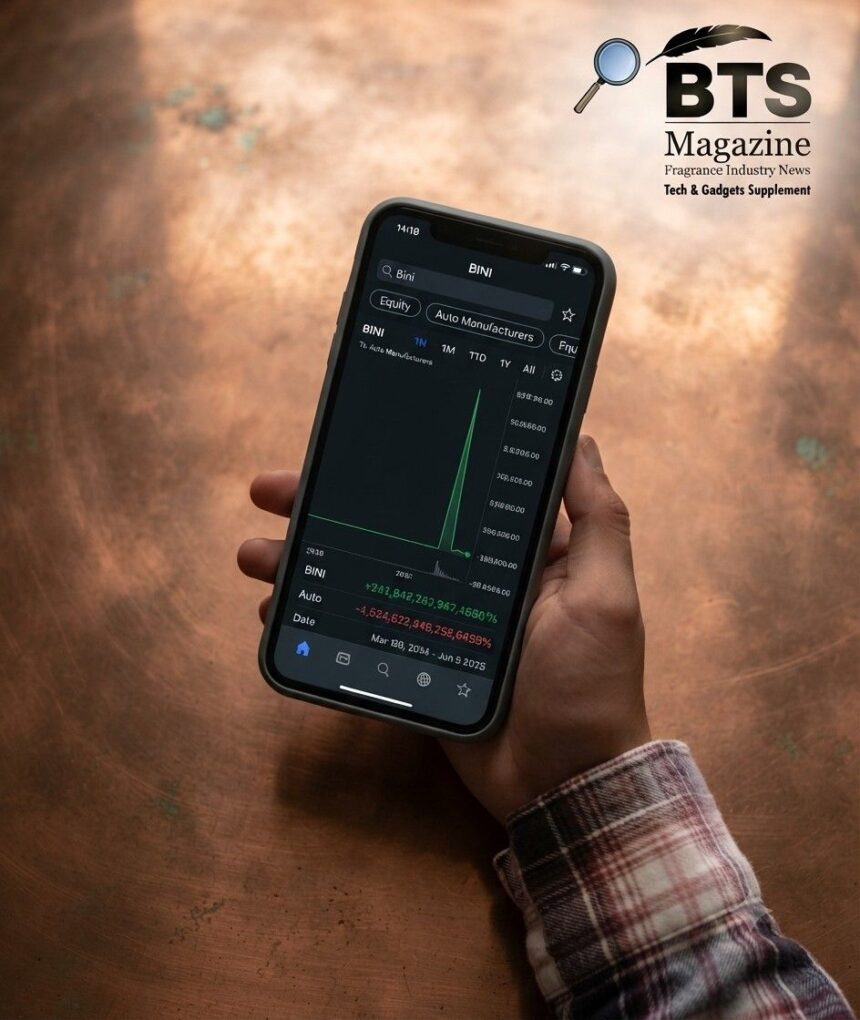
Let me be straight with you: the price chart for BINI stock is rough. The 52-week range runs from $0.01 all the way up to $22.50. That’s a massive swing.
Recent trading shows the stock sitting around a few cents. Over one year, it dropped close to 99.7%. Over five years, the decline is basically 100%. Numbers like that tell a clear story.
Why the Price Moves So Much
Penny stocks like this one are extremely volatile. Small news, share dilution, and thin trading volume can push the price around fast. That’s why BINI stock behaves the way it does.
Key Financial Data for BINI Stock
Now let’s look at the money side, since that’s what really matters when you weigh any stock.
- Revenue (trailing twelve months): about $9.34 million
- Net loss (available to common): roughly -$472.94 million
- Market cap: extremely small, in the low tens of thousands of dollars range
- Profit margin: 0%
- Return on assets: around -107.73%
Here’s the thing about those numbers. Revenue is tiny compared to the huge net loss. That gap is a warning sign for anyone thinking about BINI stock as a long-term hold.
Reverse Stock Splits and BINI
Companies with very low share prices sometimes do reverse stock splits to lift the price. Bollinger has dealt with this too.
The company made a public commitment to long-term stability by announcing no further reverse stock splits for the next three years. That was meant to reassure shareholders who’d grown tired of the repeated splits.
Activist Investor News
BINI stock also caught attention from an activist investor. This investor took a 9.99% stake in Bollinger Innovations.
The activist pushed the CEO to keep the NASDAQ listing and sought control of the board through a tender offer at a 55% premium. The demands also included proposing a dividend, bringing in new funding, and even advocating a spin-off. Activist moves like this often shake up how a company runs.
How BINI Stock Compares to Its Peers
It helps to see BINI next to other EV names, since the whole sector has struggled.
Lucid Group (LCID)
Lucid trades far higher, around $6 a share, with a market cap in the billions. It’s a much bigger and more established EV player than BINI.
Workhorse Group (WKHS)
Workhorse focuses on commercial EVs, similar to Bollinger’s commercial side. Its share price and market cap are both well above BINI’s.
Faraday Future (FFAI)
Faraday Future is another struggling EV startup. Even so, its market cap sits in the tens of millions, which dwarfs BINI’s tiny valuation.
To be honest, when you line them up, BINI stock is the smallest and most fragile of the bunch. That doesn’t mean it can’t move, but the risk is clearly higher.
Related Context You Should Know
The EV industry has faced a tough stretch. Rising costs, funding gaps, and stiff competition have hit smaller makers hard. Some Bollinger-linked operations even faced shutdown reports during financial pressure.
For anyone tracking BINI stock, this backdrop matters. A small EV company fighting for cash in a crowded market is walking a tightrope.
Is BINI Stock Right for You?
I won’t give financial advice here. But I’ll say this plainly: BINI stock is a high-risk, speculative penny stock. The huge losses, the OTC move, and the price collapse all point to serious caution.
If you’re curious about it, do your own research first. Look at the latest filings, check the volume, and only risk what you can afford to lose.
Frequently Asked Questions About BINI Stock
1. What company is BINI stock?
BINI stock is Bollinger Innovations, Inc., an electric vehicle maker based in Brea, California. It was formerly known as Mullen Automotive, Inc.
2. Why did the company change its name?
Mullen Automotive rebranded to Bollinger Innovations, Inc. in July 2025. The BINI ticker reflects that new name.
3. Where does BINI stock trade now?
BINI stock moved from NASDAQ to OTC markets, effective October 13, 2025. That means it now trades over-the-counter instead of on a major exchange.
4. Why is BINI stock so cheap?
The price fell sharply due to heavy losses, share dilution, and industry pressure. Its 52-week range runs from $0.01 to $22.50, which shows just how volatile it’s been.
5. Is BINI stock a good investment?
That depends on your risk tolerance. BINI is a speculative penny stock with large net losses and low liquidity, so it carries significant risk. Always research before you buy.
Final Thoughts on BINI Stock
Here’s the bottom line. BINI stock tells the story of a small EV company that renamed itself, moved off NASDAQ, and battled steep losses along the way. What’s interesting is that it still keeps trying, signing new commercial deals and promising more stability to shareholders.
If you want to understand the bigger picture behind companies like this, it helps to know how the whole electric vehicle market works and why it’s such a competitive space. That context makes it a lot easier to judge where a stock like BINI might be headed.
Continue reading: Andrew Tate: Who He Is, What He Did, and Why Everyone’s Talking About Him