

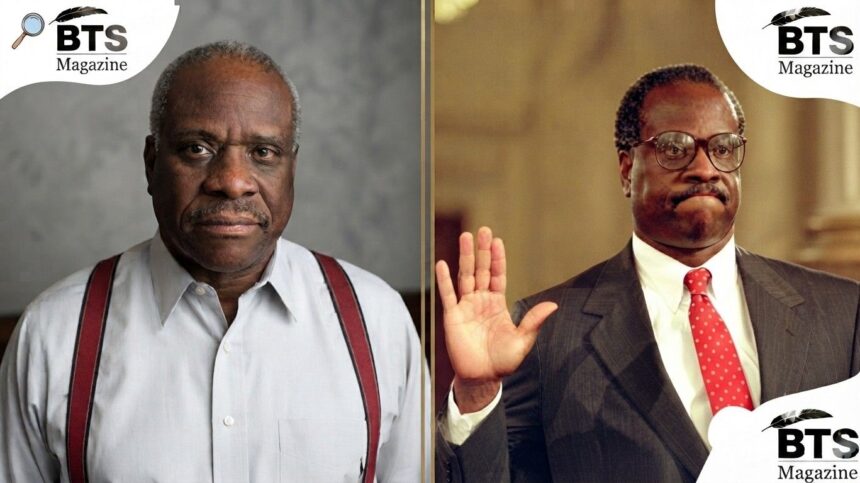
Clarence Thomas is one of the most talked-about figures on the U.S. Supreme Court today. He’s served as an associate justice since 1991, which makes him the second longest-serving justice in the Court’s history. Love him or not, his story is pretty remarkable.
- Quick Bio Table
- A Humble Start in Pin Point, Georgia
- The Grandfather Who Shaped Everything
- Education at Holy Cross and Yale Law School
- Building an Early Legal Career
- Leading the EEOC
- The Road to the Supreme Court
- The Anita Hill Controversy
- A Razor-Thin Confirmation Vote
- Clarence Thomas and His Judicial Philosophy
- Key Supreme Court Decisions
- Personal Life and Faith
- Ethics Questions and Undisclosed Gifts
- Final Thoughts
Here’s the thing: he grew up poor in a small Georgia community and rose all the way to the highest court in the country. That journey alone is worth knowing about. Let’s walk through his life, his ideas, and the controversies that have followed him.
Quick Bio Table
| Detail | Information |
|---|---|
| Full Name | Clarence Thomas |
| Date of Birth | June 23, 1948 |
| Birthplace | Pin Point, Georgia, U.S. |
| Age | 76 |
| Parents | M.C. Thomas and Leola Williams |
| First Marriage | Kathy Ambush (married 1971, divorced 1984) |
| Child | Jamal Adeen Thomas (born 1973) |
| Second Marriage | Virginia “Ginni” Lamp (married 1987) |
| Education | College of the Holy Cross (BA); Yale Law School (JD, 1974) |
| Political Party | Republican |
| Current Role | Associate Justice, U.S. Supreme Court (since 1991) |
A Humble Start in Pin Point, Georgia
Thomas was born on June 23, 1948, in a small wooden shack in Pin Point, Georgia. It was a tiny community near Savannah, founded by freedmen back in the 1880s.
His parents were M.C. Thomas, a farm worker, and Leola Williams. He was the middle of three kids. To be honest, his early years were tough by almost any measure.
His father left the family when Thomas was young. After that, money was tight and life was hard. The family even spoke Gullah, a creole language rooted in the descendants of enslaved people along the coast.
The Grandfather Who Shaped Everything
When Thomas was about seven, he and his brother went to live with their maternal grandfather, Myers Anderson. That move changed his life.
For the first time, Thomas had things like indoor plumbing and regular meals. His grandfather had built a successful business delivering coal, oil, and ice, even though he had little formal schooling.
What’s interesting is how much his grandfather believed in hard work and self-reliance. He was strict, even harsh, but he drilled into Thomas the value of education. Thomas later said his grandfather influenced his life more than anyone else.
Education at Holy Cross and Yale Law School
Thomas first headed toward the priesthood, attending a seminary in Missouri. But after hearing a racist comment following Martin Luther King Jr.’s assassination, he walked away from that path.
He then enrolled at the College of the Holy Cross in Massachusetts on a scholarship. He was one of the school’s first Black students and helped start its Black Student Union.
After graduating with honors in 1971, he went on to Yale Law School. He earned his Juris Doctor there in 1974. Funny enough, he later felt mixed about Yale, believing some assumed he only got in because of affirmative action.
Building an Early Legal Career
With no big law firm offers, Thomas took a job with Missouri Attorney General John Danforth. He worked as an assistant attorney general from 1974 to 1977.
He later called it “the best job I’ve ever had.” After that, he spent a short time as a lawyer at Monsanto before rejoining Danforth in Washington, D.C.
During these years, Thomas switched his party from Democrat to Republican. That shift would shape the rest of his career.
Leading the EEOC
In 1981, President Ronald Reagan named Thomas Assistant Secretary for Civil Rights at the Department of Education. Soon after, he became chairman of the EEOC, the Equal Employment Opportunity Commission.
He led the EEOC from 1982 to 1990. His job was to enforce the Civil Rights Act of 1964, and he ran the agency with a no-nonsense style.
Settlement amounts for discrimination victims tripled during his time there. He testified before Congress more than 50 times, though the agency also faced some criticism near the end of his tenure.
The Road to the Supreme Court
President George H.W. Bush first put Thomas on the U.S. Court of Appeals for the D.C. Circuit in 1990. He spent only 19 months there.
Then, in 1991, Justice Thurgood Marshall announced his retirement. Bush nominated Thomas to fill the seat, calling him the “best qualified at this time.”
That nomination kicked off one of the most heated confirmation battles in modern history.
The Anita Hill Controversy
Just as the Senate was about to vote, things took a dramatic turn. Anita Hill, a former colleague of Thomas at the EEOC and the Department of Education, accused him of sexual harassment.
The hearings reopened, and the country watched closely. Hill testified for hours, describing inappropriate comments. Thomas firmly denied everything.
He famously called the proceedings a “high-tech lynching for uppity blacks.” That moment shifted public opinion in his favor. The episode still sparks debate decades later.
A Razor-Thin Confirmation Vote
On October 15, 1991, the Senate confirmed Thomas by a vote of 52–48. That’s the narrowest margin for a Supreme Court justice in over a century.
He took his oaths and became the Court’s 106th justice on October 23, 1991. Interestingly, he remains the most recent justice confirmed by a Senate controlled by the opposite party of the appointing president.
Clarence Thomas and His Judicial Philosophy
So what does Clarence Thomas actually believe as a justice? In short, he’s an originalist. That means he tries to interpret the Constitution based on what it originally meant when written.
He once put it simply: there are really only two ways to read the Constitution, either figure out what the framers intended or just make it up. He firmly picks the first option.
Thomas is also known for being willing to overturn precedent more than other justices. As his old colleague Antonin Scalia once said, Thomas “does not believe in stare decisis, period.”
Key Supreme Court Decisions
Over the years, Thomas has shaped major rulings. He’s widely seen as the Court’s most conservative justice, and his influence has grown a lot recently.
In 2022, he wrote the majority opinion in a major Second Amendment case, expanding the right to carry firearms in public. That same year, he helped overturn Roe v. Wade.
He’s also been a strong voice on free speech, often siding with First Amendment claims. On race, he firmly opposes affirmative action, arguing the Constitution forbids treating people differently based on race.
For years, Thomas was famous for staying silent during oral arguments. That changed around 2020, and he now regularly asks questions.
Personal Life and Faith
Thomas married Kathy Ambush in 1971. They had one son, Jamal Adeen Thomas, born in 1973. The couple divorced in 1984.
In 1987, he married Virginia “Ginni” Lamp, a conservative activist. The two have traveled across the country in a motorcoach between Court terms since 1999.
Faith matters to him, too. Thomas is a practicing Catholic and was reconciled with the Church in the mid-1990s. Books by Thomas Sowell, Ayn Rand, and Richard Wright also shaped his thinking over the years.
Ethics Questions and Undisclosed Gifts
In recent years, Thomas has faced scrutiny over gifts he received but didn’t report. ProPublica reported in 2023 that he’d accepted luxury trips for two decades from wealthy donor Harlan Crow.
These included private jet flights, yacht cruises, and stays at exclusive resorts. Reports also revealed Crow paid private school tuition for Thomas’s grandnephew.
Thomas later filed amendments to some disclosure forms, saying certain details had been “inadvertently omitted.” In early 2025, the U.S. Judicial Conference declined to refer him to the Justice Department over the matter.
Final Thoughts
The story of Clarence Thomas is, in many ways, a classic American climb. He went from a wooden shack in Georgia to the Supreme Court, shaping the law for over three decades.
He remains a divisive figure. Some admire his steady originalism, while others question his ethics and decisions. Either way, his impact on constitutional interpretation is hard to overstate.
If you want to dig deeper into the full timeline of his life, cases, and writings, the detailed Wikipedia page on Clarence Thomas is a solid place to keep reading.
Continue reading: Chocolate Recalled Nationwide: What You Need to Know About the 2026 FDA Alerts